


Your financial success hinges on how seamlessly your expense tracking app can provide a budgeting experience to users. An expense tracking app can be your most valuable ally in the journey of achieving success in the fintech industry.
Gone are the days of manual spreadsheets and receipts. Modern expense tracking apps are equipped with a range of tools to streamline your financial management. With the right features, these apps monitor spending and allow one to make informed decisions.
Having personal financial assistance can help you take control of your financial life. The right app can change the complex task of budgeting into an engaging experience. A survey indicates that businesses that keep track of their expenses are 40% more likely to save money than those that do not. This number is even more significant today as rising costs and economic uncertainty have made disciplined expense management a top priority for individuals and businesses alike.
It shows the importance of an expense tracking app. If you want to produce high business profits and stand out in the market, it’s important to choose a skilled mobile application development company in USA which incoporates essential features that users need.
With fintech competition at an all-time high, the features you choose to build will directly determine whether your app becomes a market leader or gets lost in the crowd. In this blog, we will be discussing the 15 must-have features that can pave the way for your success in the industry.
Key Takeaways
- AI-powered insights and predictive analytics are transforming expense tracking apps into proactive financial management platforms.
- Features like voice logging, subscription tracking, and automation significantly improve user engagement and daily app usage consistency.
- Seamless integrations with UPI, digital wallets, and banking systems provide users a unified financial overview.
- Data security, compliance, and privacy-first architecture are critical for building trust in modern fintech applications.
- Future-ready apps combine AI, automation, and personalization to deliver smarter, scalable, and highly user-centric financial experiences.
Table of Contents
Why Do You Need to Develop an Expense Tracking App?
Many businesses find it tougher to manage their income because it varies every month. It is very crucial to handle a budget, and an expense tracking app helps track receipts, keep income records, make a budget, handle taxes, sync cards, and do more things. Let’s understand the need for an expense tracking app.
- A lot of businesses are tired of using paper and Excel spreadsheets to keep records of their cash payments and online transactions. It’s better to develop a daily expense tracker app that collects insights from the data. In this modern, competitive app development industry, these apps leverage AI to deliver real-time financial insights automatically, without any manual effort from the user.
- If you want to keep your users happy, your app should help users store all receipts by only clicking on their images. Modern apps now utilise AI-enhanced OCR to instantly extract, categories, and store receipt data with almost 100% accuracy.
- Using an expense management app automates the workflow of handling money and finance. This prevents fraud and ensures accuracy and transparency. With AI-powered fraud detection now embedded in most fintech apps, suspicious transactions are flagged in real time before any damage is done.
- Humans may make some errors because of carelessness or misunderstanding. With an expense manager application, human errors can be reduced. By the end of 2026, smart auto-correction features and AI-driven data validation will have made these apps even more reliable and error-free.
- Excel spreadsheets are capable of tracking and storing data to create helpful charts, but an expense tracking app carries out predictive analysis and helps you make informed decisions. Today’s modern app development strategy involves the use of machine learning models. This means that now apps can forecast future spending, identify saving opportunities, and deliver personalized financial recommendations.
- With the rapid rise of UPI, digital wallets, and multi-currency transactions globally, expense tracking apps in 2026 are also built to seamlessly sync across all payment models. This then results in giving users a truly unified view of their finances.
This is why collaborating and working with a skilled custom app development company is crucial for fintech businesses to satisfy users’ needs.
As user expectations continue to evolve, businesses often collaborate with a mobile application development company to build expense tracking solutions that offer advanced functionality, strong security, and a seamless user experience.
Key Features Every Expense Tracking App Should Include
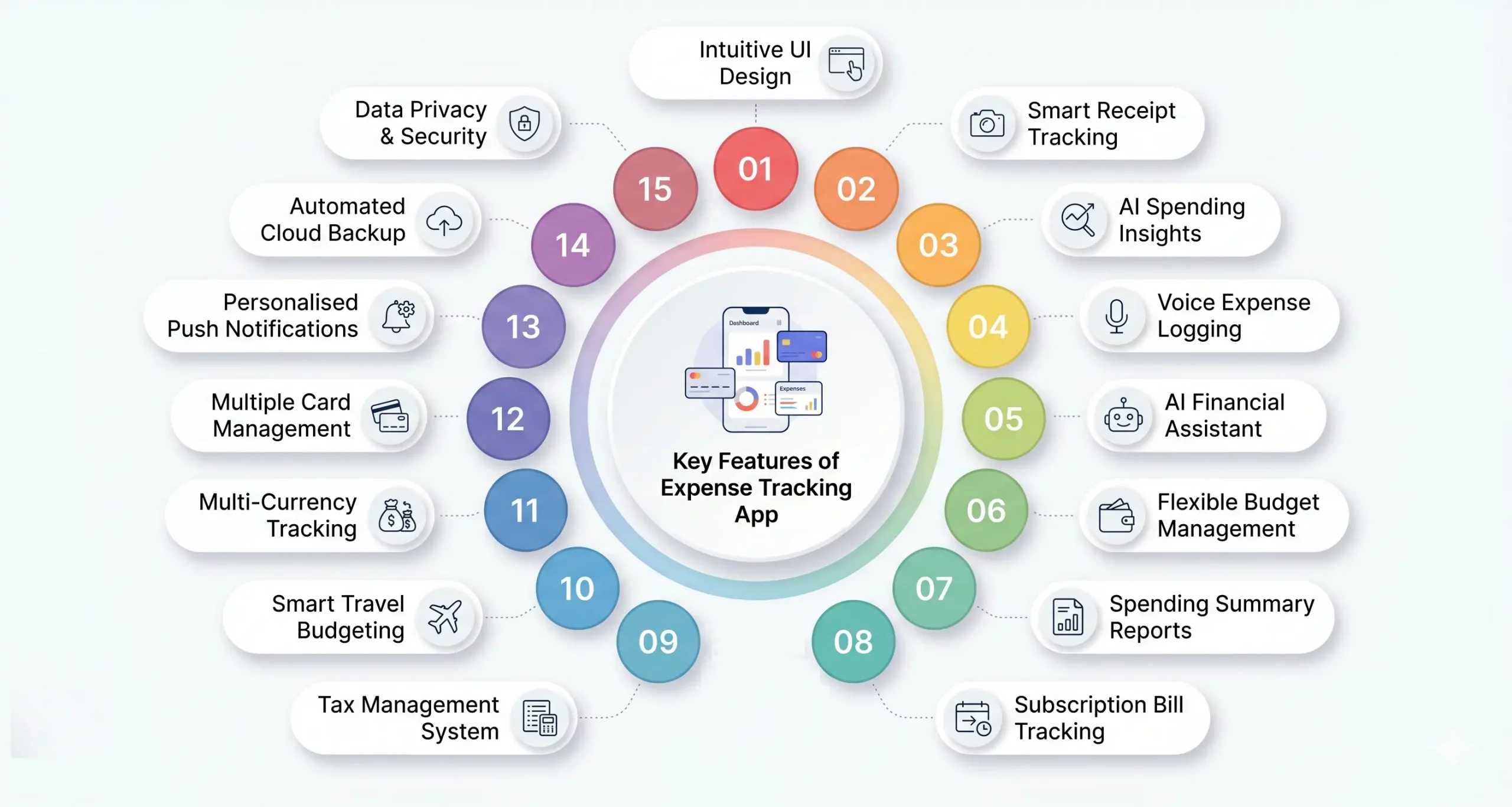
Now you understand the need for an expense tracking app, so it’s crucial to look for one of the top fintech app development companies. But before finding a company, you should know the requirements and functionality you want in the app. We have compiled a list of the must-have features that should be included in the app.
1. Intuitive Mobile UI Design
When you decide to build an expense tracking app, you should provide an intuitive UI to the users. This means the feature of accessing the app on mobile and a sleek user interface. An experienced ui ux design agency can add appealing mobile app designs so that the users can seamlessly access the mobile app. An easy-to-navigate UI helps them approve and upload documents, and easily submit and manage expenses.
In 2026, a mobile-friendly UI goes beyond just a clean design. Users expect a personalized dashboard that surfaces the most relevant financial information the moment they open the app, without needing to navigate through multiple screens.
Features like dark mode, accessibility support, customizable layouts, and gesture-based navigation are no longer extras; they are standard expectations. Investing in a thoughtfully designed UI from day one directly impacts user retention, daily engagement, and the overall success of your expense tracking app in a competitive fintech market.
2. Smart Receipt Tracking System
This feature of the expense monitoring app eliminates the problem of forgetting about some costs or missing out on some transactions. The ability to scan receipts with OCR technology makes expensing much more efficient. The users only need to click an image of the receipt every time they get cash or an online payment.
The technology extracts all the necessary information to process the expense and automatically categorizes it as a receipt or invoice. The images are saved on the cloud, so they can’t lose them. Currently, in 2026, AI-enhanced OCR implements basic text extraction with the help of machine learning. ML models detect duplicate entries, auto-correct misread values, and map expenses to the right category with accuracy.
It also eliminates unnecessary data entry, reduces human errors, and saves your expenses tracker app from fraudulent activities as well. It’s common to use AI for fraud detection and prevention.
3. AI-Driven Spending Insights
One of the most in-demand features in expense tracking apps in 2026 is AI-powered spending analysis. Unlike static charts and summaries, this feature uses machine learning to actively analyze a user’s financial behavior and deliver forward-looking, actionable insights. The app can automatically detect unusual spending spikes, surface forgotten subscriptions silently draining money, and recommend specific saving opportunities based on past patterns.
Predictive analytics can forecast how much a user is likely to spend in the coming weeks, empowering them to plan rather than react after overspending. For example, the app can alert a user that their grocery spending is trending 20% higher than last month and suggest adjustments before the month ends.
For fintech businesses, this feature is one of the strongest ways to boost user retention and stand out in a competitive market where users expect their apps to work proactively for them.
4. Voice-Based Expense Logging
In 2026, typing out every expense is considered friction. Voice-based expense logging allows users to simply say “I spent ₹500 on groceries today”, and the app automatically logs, categorizes, and saves the entry hands-free. This feature is powered by natural language processing (NLP) and is especially useful while driving, travelling, or multitasking, when pulling out a phone to type is inconvenient.
Integrating voice commands into your expense tracker significantly improves daily usage frequency. Users are far more likely to log expenses consistently when the process takes only a few seconds of speech rather than multiple taps and typing. An experienced AI development company can help you build accurate, multilingual voice logging tailored to your target audience, thus making your app accessible and convenient for a much wider user base.
5. AI-Powered Financial Assistant
Customer support is a very crucial feature of an expense tracking app. In 2026, a basic rule-based chatbot is no longer sufficient to meet user expectations. Today’s top expense tracking apps integrate LLM-based AI financial assistants that go far beyond answering FAQs. These assistants understand natural language queries, proactively suggest budget adjustments, and predict upcoming expenses based on a user’s spending history.
For example, instead of simply responding to “What did I spend on food?”, a modern AI assistant can say: “You’ve overspent on dining by 28% this month want me to adjust your budget for next week?” These assistants are voice-enabled, available 24/7, and deeply personalized to each user’s financial behavior.
An experienced AI development company can help you build such intelligent assistants that dramatically improve user engagement and retention, making this feature a key differentiator for top-performing expense tracking apps in 2026.
6. Flexible Budget Period Management
Finding a company that can include unique features in an expense management app can save you valuable time. The stand-out feature of managing budget periods allows users to set budget periods that match how they receive money, like weekly or monthly. This flexibility is especially important for freelancers and gig economy workers whose income does not follow a fixed monthly cycle.
When built through availing top-notch cross-platform app development frameworks, this feature ensures consistent performance and accessibility across devices. Thus, helping users manage their finances seamlessly, whether on Android, iOS, or a desktop. It aligns with real-life financial patterns and offers more accurate, personalized insights. This gives users a sense of control over their money that rigid, calendar-based budgeting tools simply cannot provide.
7. Weekly and Monthly Summaries
The weekly and monthly summaries feature an expense tracking app them with an overview of spending patterns. The weekly summary breaks down the expenses in various categories such as food, transportation, and entertainment. They can compare their spending with the previous week to identify the increase and decrease.
The monthly summary report offers a more in-depth analysis of total expenses for the month. Comparing actual spending against a set budget can provide insights to improve spending. This feature reminds users to control their spending and stay within budget to avoid a shortage of money. You need to find a skilled company that can develop a fintech app with advanced features to deliver these summaries in a clear, visual, and easily digestible format.
8. Subscription and Bill Tracker
With the average user in 2026 subscribed to multiple streaming, SaaS, and lifestyle services, a dedicated subscription and bill tracker has become an essential feature of any modern expense tracking app. This mobile app feature automatically detects recurring charges from linked accounts and cards, organizes them by renewal date, and alerts users before each billing cycle so they are never caught off guard.
Users can see all their active subscriptions in one place, identify ones they no longer use, and take action to cancel them directly through the app. This single feature alone can help users save a significant amount each month without any extra effort on their part.
Including it in your fintech app signals that you genuinely understand how modern users spend their money and positions your product as a truly comprehensive financial management tool.
9. Tax Management and Assistance
Managing taxes alongside daily expenses is one of the biggest pain points for freelancers, small business owners, and salaried professionals alike. In 2026, top expense tracking apps have bridged this gap by offering built-in tax management features that automatically tag tax-deductible expenses, calculate estimated tax liability, and generate ready-to-export financial reports with a single tap.
The app can also send reminders for upcoming tax deadlines and integrate with popular tax filing platforms, saving users hours of manual work every year. This feature is particularly valuable for self-employed users and small business owners who previously needed separate accounting tools to manage this aspect of their finances.
Investing in this feature while building your fintech app positions your product as a complete financial management solution, not just an expense logger, which significantly increases its long-term value to users.
10. Smart Travel Budget Planning
This feature of an expense manager application helps users make a budget before they go on a tour or shopping. The app should provide the feature of entering tour details and a graph at their convenience. After planning their budget properly, the users can make a list of goods they need. It ensures that they stay financially prepared throughout the trip without any last-minute surprises.
Including this feature, while investing in fintech app development services, helps businesses stand out because users like to plan their trips according to their budget. In 2026, travel budgeting features are further enhanced with AI-powered suggestions that estimate typical travel costs based on the destination, duration, and the user’s past travel spending patterns. This makes the planning process smarter, faster, and more accurate than ever before.
Read Also: Travel App Development Guide: Journey from Ideation to Launch
11. Multi-Currency Expense Tracking
As remote work and international travel have grown significantly, multi-currency support has become a must-have feature for expense tracking apps in 2026. This feature allows users to log expenses in any currency, with the app automatically converting amounts to their home currency using live exchange rates. Users no longer need to manually calculate conversions or maintain separate records for international spending.
Whether a user is travelling abroad, freelancing for international clients, or managing expenses across multiple countries, this feature provides a unified and accurate financial picture at all times. It also supports split billing in different currencies for groups travelling together, making it especially valuable for frequent travellers and globally mobile professionals. Building this feature into your app significantly expands your potential user base beyond domestic markets.
Since exchange rates, banking APIs, and financial regulations continue to evolve, ongoing application maintenance and support services are essential to keep multi-currency tracking accurate, secure, and reliable for users across different regions.
12. Multiple Card Management System
The multiple card management feature allows users to securely add, store, and manage their cards within the app. They can track all the transactions in real-time, categorise the expenses, and set individual spending limits for each card to stay within budget. This gives users complete visibility over their financial activity across all their accounts in one single place.
This feature should support automatic transaction syncing with bank accounts and provide clear summaries of card-wise spending. It helps users understand which card they are using the most and whether their spending habits align with their financial goals. In addition, safety protocols like two-factor authentication and biometric verification help users secure their card information, making the feature both powerful and trustworthy for everyday financial management.
13. Personalized Push Notifications
A spending monitoring app should push out alerts via email and mobile because it keeps users engaged with the expense process. Businesses can remind users to log their expenses by sending timely notifications throughout the day. These notifications will keep the users consistently connected to your application and build the habit of regular expense tracking, which is the foundation of healthy financial management.
Sending bill-paying reminders to users can help them pay their bills on time and increase loyalty towards your app. The ability to personalize these alerts based on each user’s spending behavior, budget limits, and preferred timing helps attract and retain more users. In 2026, smart notification systems can also be triggered by AI, for example, alerting a user the moment their spending in a particular category crosses a predefined threshold, enabling real-time financial control.
14. Automated Cloud Data Backup
This feature of the expense management app ensures that users’ financial data is saved without any manual intervention. The app regularly syncs expense records to secure cloud storage, using encryption protocols to protect data during both transfer and storage. Users never have to worry about losing months of financial history due to a lost or damaged device.
When built through a professional MVP development strategy, this feature can be tested early to validate reliability and user trust before full-scale deployment. It ensures users can restore their data anytime, providing peace of mind and confidentiality. In 2026, best-in-class expense tracking apps will also offer granular backup controls, allowing users to choose backup frequency, select preferred cloud providers, and access version history to recover older records if needed.
15. Data Privacy and Security
You need robust data privacy and security protection because you’re dealing with sensitive expense data of your users, including their card and bank account details. High-security measures are crucial to protect users’ data, and investing in fintech app development with a security-first approach can help businesses build long-term trust with their audience.
In 2026, security expectations have gone well beyond passwords. Your app must incorporate biometric authentication such as face ID and fingerprint login, end-to-end encryption, and real-time suspicious activity alerts.
Additionally, with evolving global data privacy laws, your app should be fully compliant with frameworks relevant to your target markets, including GDPR (Europe), DPDP Act (India), and HIPAA-compliant (USA). Building with a compliance-first approach from day one is no longer optional; it is a baseline user expectation that directly impacts your app’s credibility and market success.

Future of Expense Tracking Apps
As technology continues to evolve, expense tracking apps are moving beyond basic expense logging to become intelligent, proactive financial management platforms. In 2026 and beyond, these apps will not just track spending but actively help users optimize, automate, and take control of their financial decisions with minimal effort.
1. AI-Powered Financial Assistants
Modern expense tracking apps will integrate advanced AI assistants that act like personal CFOs. They will analyze spending behavior, predict upcoming expenses, and provide real-time suggestions to improve budgeting and savings.
2. Automation in Financial Management
Automation will become a core feature, enabling users to automate savings, set dynamic budgets, and manage finances without constant manual input. This will make financial planning more efficient and stress-free. It is also becoming a key focus area in modern fintech apps development, where efficiency, intelligence, and user convenience are prioritized in product design.
To implement such advanced automation workflows and ensure seamless performance across platforms, businesses often collaborate with a USA app development company to build scalable, secure, and intelligent financial applications.
3. Deep Banking & Fintech Integrations
With the rise of open banking, UPI, and digital wallets, future apps will seamlessly integrate with multiple financial systems. This will allow users to manage all transactions, accounts, and payments within a single unified payment gateway integration platform.
4. Hyper-Personalized User Experience
Expense tracking apps will leverage user data to deliver highly personalized insights, recommendations, and financial strategies tailored to individual lifestyles, income patterns, and goals.
5. Predictive & Proactive Insights
Instead of showing past spending, apps will focus on predictive analytics, alerting users about potential overspending, upcoming bills, and opportunities to save before financial issues arise.
6. Reduced Manual Effort & Frictionless Usage
Future apps will aim to minimize user effort through features like voice input, auto-tracking, and intelligent automation, making expense management seamless and intuitive.
7. Competitive Edge Through Innovation
Fintech businesses that adopt AI, automation, and seamless integrations will stand out in the market, improve user engagement, and build long-term customer trust and retention.
To successfully implement these advanced capabilities and stay ahead of evolving market demands, many businesses choose to work with a mobile application development company that can transform innovative ideas into scalable digital solutions.
Final Words
A future-ready expense tracking app is defined by its ability to combine intelligence, automation, and user-centric design. Your expense management app should offer a seamless, engaging, and innovative experience. Your app must have the essential and advanced features that meet the changing user needs. The above-mentioned features ensure the flexibility and efficiency of your application. In case you want some additional features, you can add them according to your requirements.
RipenApps is an award-winning mobile app development company in USA. We have experience in building high-performance expense tracking apps. Our team of experts focuses on carefully analyzing the requirements. We are a top choice for fintech startups and enterprises because we have built top-quality apps.
FAQs
Q1: What is the best expense tracking app in 2026?
The best expense tracking app in 2026 depends on your needs, but apps like Jupiter, Walnut, and YNAB stand out for their AI-powered insights, automatic expense categorisation, and real-time financial tracking. Modern apps also offer features like subscription tracking, predictive analytics, and UPI integration for a seamless experience.
Q2: Is my financial data secure in an expense tracking app?
Yes, most modern expense tracking apps use advanced security measures such as end-to-end encryption, biometric authentication, and two-factor authentication. To enhance security, users should also follow best practices like using strong passwords, enabling device security, and reviewing app permissions regularly.
Q3: Can I use an expense tracking app across multiple devices?
Yes, most expense tracking apps support cross-platform usage across smartphones, tablets, and desktops. With cloud syncing, users can access real-time financial data from any device without losing information or continuity.
Q4: Do expense tracking apps support multiple bank accounts and payment methods?
Yes, modern expense tracking apps allow users to connect multiple bank accounts, credit/debit cards, UPI apps, and digital wallets. This provides a unified view of all transactions, helping users manage their finances more efficiently in one place.
Q5: How do expense tracking apps help users save money?
Expense tracking apps help users save money by providing real-time insights into spending habits, identifying unnecessary expenses like unused subscriptions, and offering personalised budgeting recommendations. Many apps also use predictive analytics to alert users before they overspend.
Q6: Are expense tracking apps suitable for freelancers and businesses?
Yes, many expense tracking apps are designed for freelancers and businesses, offering features like tax categorisation, invoice tracking, and financial reporting. These tools simplify expense management and help users stay compliant with financial regulations.

SHARE
WRITTEN BY

Manish Kumar
Technical Content Writer
Manish is a Senior Technical Content Writer at RipenApps. He has over 7+ years of experience and holds immense tech knowledge. His educational background in science and expertise in the IT domain has made him an expert writer. He has authored various tech blogs and guest posts for leading sites. When he is not writing, he researches on the latest market trends and reads sci-fic novels.
View All Articles







 India
India USA
USA Australia
 Canada
 UK
UK UAE
UAE