


Key Takeaways
- Successful AI integration starts with clear business goals, not trend-driven feature implementation or experimental automation strategies.
- Poor data quality and weak infrastructure planning remain the biggest reasons behind failed AI-powered digital products.
- AI systems require continuous optimization, monitoring, retraining, and scalability planning to maintain long-term performance and accuracy.
- User-focused AI experiences with transparency, personalization, and explainable interactions significantly improve engagement, trust, and adoption rates.
- Businesses that prioritize scalable architecture, AI security, and operational governance achieve stronger ROI from intelligent platforms.
Artificial intelligence is rapidly reshaping how businesses build digital products in 2026. From predictive analytics and smart recommendation systems to AI-powered chatbots and generative AI experiences, companies across industries are integrating AI into apps and platforms to improve operational efficiency, customer engagement, automation, and personalization.
Businesses are no longer treating AI as an experimental technology. It has become a core part of modern digital transformation strategies. Whether it is healthcare, fintech, ecommerce, logistics, education, SaaS, or enterprise mobility, organizations are actively investing in intelligent systems that enhance decision-making and create competitive advantages.
However, despite growing adoption, many AI implementation projects still fail to deliver meaningful results. Businesses often integrate AI features without proper planning, infrastructure readiness, user experience alignment, or long-term scalability considerations. This results in rising costs, weak adoption rates, performance bottlenecks, inaccurate outputs, and operational inefficiencies.
Unlike traditional software features, AI integration requires businesses to think beyond coding and deployment. AI systems depend heavily on data quality, infrastructure scalability, model optimization, compliance, and continuous monitoring. A poorly planned AI strategy can quickly become a costly operational burden rather than a growth enabler.
This is why businesses increasingly seek expert AI consulting services before implementing AI-driven capabilities into their digital products. Strategic AI implementation helps companies avoid common integration failures while building scalable and high-performing AI ecosystems aligned with long-term business goals. In this comprehensive guide, we will explore the most common AI integration mistakes businesses make while developing apps and platforms, the operational impact of these mistakes, and proven strategies to avoid them successfully.
Table of Contents
Why AI Integration Fails in Modern Apps & Platforms
AI integration failures usually happen because businesses approach AI as a feature rather than a long-term operational capability. Many companies focus heavily on AI tools and technologies while ignoring:
- Business alignment
- Infrastructure readiness
- User behavior
- Data governance
- Scalability planning
- Performance optimization
- Operational management
As a result, AI systems fail to create measurable value. Some of the most common consequences include:
- Low user adoption
- Poor AI accuracy
- Rising cloud infrastructure costs
- Slow application performance
- Weak recommendation quality
- Customer dissatisfaction
- Compliance and security risks
- High operational maintenance
Organizations investing in the integration of AI in product development often discover that successful AI implementation depends more on strategic execution than simply adding AI APIs or machine learning models. Modern AI integration requires:
- Strong backend architecture
- Continuous model optimization
- Real-time monitoring systems
- Scalable deployment infrastructure
- Intelligent UX design
- High-quality datasets
- Cross-platform compatibility
Key AI Integration Challenges Businesses Must Understand Before Implementation
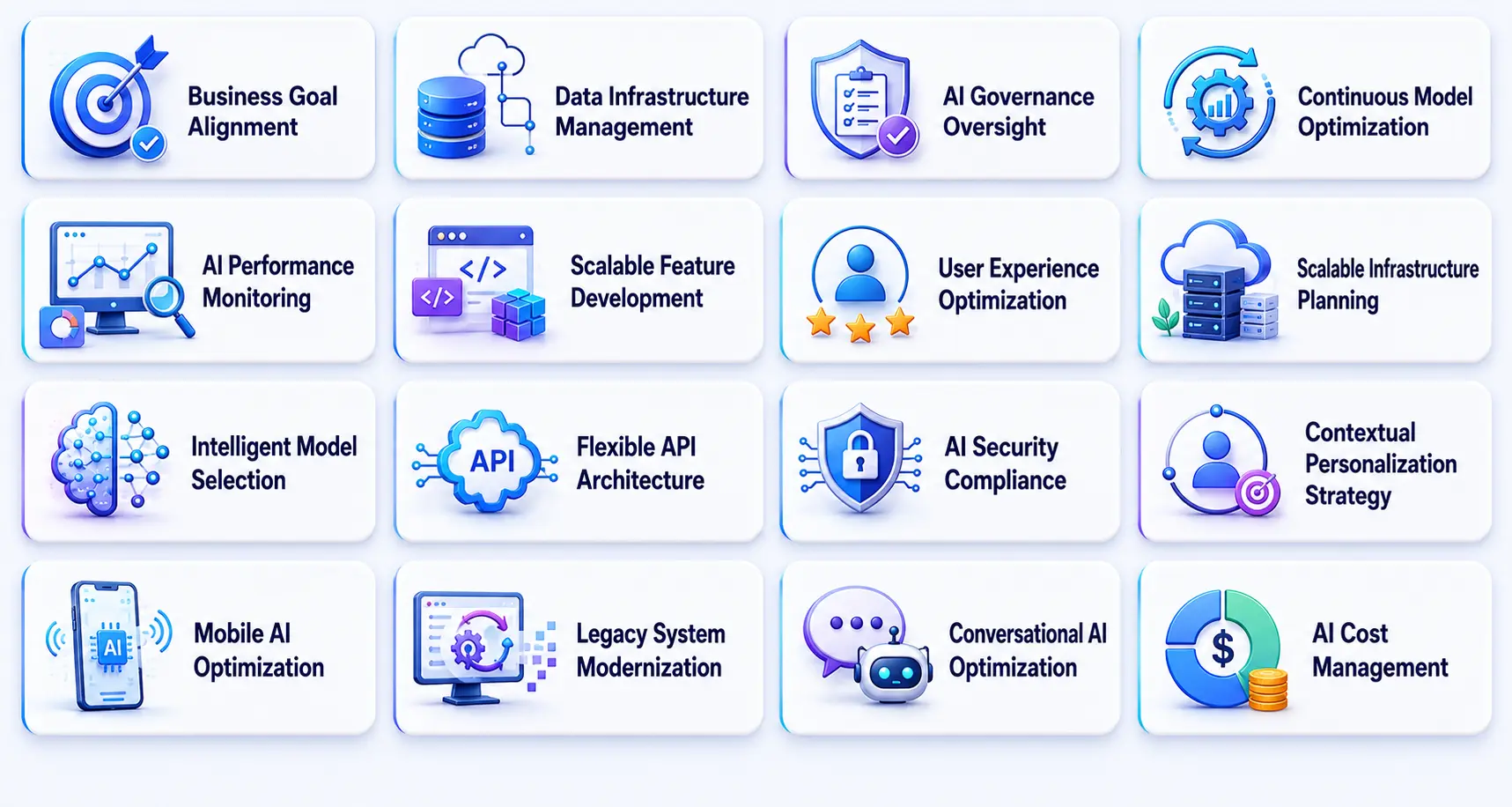
Businesses that understand these foundational requirements early are far more likely to achieve long-term AI success. So, let’s look into these:
1. Integrating AI Without Clear Business Objectives
One of the biggest AI implementation mistakes businesses make is adopting AI simply because competitors are doing it. Without a clear AI strategy for digital products, companies often invest in technologies that fail to solve real business challenges or deliver measurable outcomes.
- The exact business problem
- Expected ROI
- User pain points
- Success metrics
- Operational improvements
This often leads to AI features that look innovative but provide little practical value. For example:
- AI chatbots that cannot solve customer queries
- Recommendation engines with irrelevant suggestions
- Predictive dashboards with no actionable insights
- AI-generated content that lacks workflow integration
AI should always support a measurable business outcome. Before implementing AI, organizations should identify:
- Which operational problem AI will solve
- How AI will improve user experiences
- What KPIs will measure AI success
- Which processes require automation
- How AI will impact scalability and revenue
How to Avoid This Mistake
- Define AI goals aligned with business outcomes
- Build AI around user pain points
- Prioritize high-impact AI use cases
- Create measurable performance metrics
- Validate AI value before scaling implementation
2. Ignoring Data Quality and Data Infrastructure
AI systems depend entirely on data quality. Poor datasets produce:
- Inaccurate outputs
- Biased predictions
- Weak personalization
- Irrelevant recommendations
- Low automation accuracy
Many businesses underestimate how much data preparation is required before AI deployment. Common data problems include:
- Duplicate records
- Missing values
- Unstructured datasets
- Poor labeling
- Inconsistent tracking
- Outdated customer information
Without strong data governance, even advanced AI models fail to deliver meaningful business results. Businesses implementing recommendation engine development services especially rely on clean behavioral datasets for delivering accurate personalization and intelligent user recommendations.
How to Avoid This Mistake
- Centralize data pipelines
- Clean and validate datasets regularly
- Standardize data collection systems
- Build AI-ready data infrastructure
- Monitor data quality continuously
3. Ignoring AI Governance and Decision Oversight
Many businesses focus on AI performance but overlook governance systems that ensure AI decisions remain transparent, accountable, and compliant. Without proper governance, AI systems may struggle with:
- AI hallucinations
- biased recommendations
- inaccurate automated decisions
- lack of explainability
- compliance risks
- weak approval workflows
This becomes especially risky in customer-facing platforms, enterprise workflows, and AI-powered decision systems. Without governance frameworks:
- customer trust declines
- operational risks increase
- AI outputs become less reliable
- compliance challenges grow
- decision accountability weakens
How to Avoid This Mistake
- Implement human review systems
- Maintain AI audit trails
- Monitor explainability and bias
- Create approval workflows
- Establish compliance validation processes
- Continuously review AI-generated outcomes
Strong AI governance improves reliability, operational trust, scalability, and long-term business stability.
4. Treating AI as a One-Time Development Project
Many businesses assume AI integration ends after deployment. This is a major misconception. AI systems require:
- Continuous retraining
- Model optimization
- Monitoring pipelines
- Infrastructure scaling
- Feedback analysis
- Data refresh cycles
Unlike static software features, AI models evolve continuously as user behavior changes. Without ongoing optimization:
- AI accuracy decreases
- Recommendations become outdated
- Search relevance drops
- Prediction quality weakens
- Automation reliability declines
In production environments, AI systems may also experience declining recommendation accuracy, increased hallucination frequency, and slower inference performance over time if models are not continuously optimized and retrained using fresh behavioral data. Companies investing in generative AI development services often build long-term AI operations frameworks to ensure consistent performance and scalability.
How to Avoid This Mistake
- Implement MLOps workflows
- Continuously monitor model performance
- Build automated retraining pipelines
- Create AI governance processes
- Analyze real-world AI outcomes regularly
5. Lack of AI Monitoring and Observability
Many businesses deploy AI systems without establishing proper monitoring and observability frameworks. Unlike traditional software systems, AI models continuously evolve through changing data patterns, user behavior, and operational environments. Without proper monitoring, businesses may struggle with:
- model drift
- inference latency
- hallucination frequency
- declining recommendation accuracy
- prompt performance issues
- API failures
- rising infrastructure costs caused by inefficient inference requests, excessive token consumption, and poorly optimized AI workloads
Without observability systems:
- AI performance may silently degrade
- customer experiences may suffer
- operational risks increase
- optimization becomes difficult
- infrastructure inefficiencies grow
- scalability challenges become harder to identify
AI systems processing high-volume inference requests may experience increasing GPU utilization, latency spikes, rising token-processing costs, and slower response times if monitoring systems are not implemented early. In large-scale environments, poor AI observability can significantly increase operational expenses while reducing platform performance and user experience quality.
How to Avoid This Mistake
- Implement real-time AI monitoring systems
- Track inference and infrastructure performance
- Monitor hallucinations and model drift
- Build operational alerting systems
- Analyze prompt and recommendation performance
- Continuously review AI-generated outcomes
Strong AI observability improves reliability, scalability, operational efficiency, and long-term AI performance management.
6. Overcomplicating AI Features Too Early
Many businesses try to launch highly advanced AI ecosystems during the MVP stage. This creates:
- Development delays
- Increased infrastructure complexity
- Rising operational costs
- Slow debugging cycles
- Performance instability
Examples include:
- Multi-model AI ecosystems too early
- Real-time AI without scalable infrastructure
- Excessive automation layers
- Overengineered recommendation systems
Instead of solving one problem effectively, businesses create unnecessarily complex AI architectures. Organizations evaluating AI app development cost often realize that phased AI implementation significantly reduces risk and operational inefficiencies.
How to Avoid This Mistake
- Start with AI MVPs
- Focus on one core AI use case
- Scale gradually based on user feedback
- Prioritize stability over complexity
- Optimize infrastructure step by step
7. Ignoring User Experience During AI Integration
AI functionality alone does not create successful products. Poor AI user experiences often result in:
- Low engagement
- User confusion
- Reduced trust
- Feature abandonment
- Higher churn rates
Common UX mistakes include:
- Overwhelming AI dashboards
- Unclear AI recommendations
- Robotic chatbot interactions
- Lack of explainability
- No user control over automation
AI should simplify user journeys, not complicate them. This is why businesses increasingly invest in UX audit and redesign services before scaling intelligent features across apps and platforms.
How to Avoid This Mistake
- Design AI around real user behavior
- Keep AI explainable and transparent
- Add human override options
- Use conversational interaction flows
- Conduct continuous UX testing
8. Failing to Build Scalable AI Infrastructure
AI significantly increases infrastructure demands. Poor scalability planning often leads to:
- High latency
- Application crashes
- Slow inference speeds
- Expensive cloud infrastructure costs
- GPU resource bottlenecks
- Weak platform performance
AI systems require:
- Scalable compute resources
- Optimized inference pipelines
- GPU infrastructure
- Efficient storage systems
- Load balancing mechanisms
AI-powered platforms handling real-time recommendations, chatbot interactions, or predictive analytics may experience sharp increases in GPU utilization, cloud processing costs, and inference latency as user traffic scales. Without optimized infrastructure planning, operational costs can rise significantly while overall platform responsiveness declines. Businesses exploring edge computing and on-device AI increasingly adopt decentralized AI architectures to improve speed and reduce cloud dependency.
How to Avoid This Mistake
- Build cloud-native AI infrastructure
- Optimize inference workflows
- Use edge AI where possible
- Implement scalable microservices
- Continuously monitor infrastructure loads
9. Choosing the Wrong AI Models and Frameworks
Not every AI problem requires large language models or deep neural networks. Many businesses select AI technologies based on hype rather than product requirements.
This leads to:
- Unnecessary operational costs
- Slow system performance
- Difficult maintenance
- Excessive infrastructure consumption
Examples include:
- Using LLMs for basic FAQs
- Deploying deep learning where rules-based systems are sufficient
- Choosing real-time AI without latency optimization
How to Avoid This Mistake
- Match models with business use cases
- Balance performance and cost
- Evaluate model efficiency carefully
- Optimize inference speed
- Use scalable frameworks
10. Depending Too Heavily on Closed AI APIs Without Long-Term Flexibility
Many businesses rapidly adopt closed AI APIs without evaluating long-term architectural flexibility. While third-party AI providers accelerate development timelines, excessive dependency on a single AI vendor may create:
- pricing instability
- limited customization
- infrastructure dependency
- migration complexity
- compliance limitations
- restricted model control
As AI ecosystems evolve rapidly, overdependence on one provider can increase operational risks and reduce scalability flexibility. Without long-term planning:
- operational costs may rise unexpectedly
- switching AI providers becomes difficult
- scalability challenges increase
- infrastructure flexibility decreases
- AI innovation slows over time
How to Avoid This Mistake
- Use abstraction layers for AI services
- Support multi-model AI architectures
- Separate orchestration logic from vendor APIs
- Evaluate open-source AI alternatives
- Maintain scalable infrastructure compatibility
- Regularly assess AI performance and operational costs
Flexible AI architectures help businesses adapt more efficiently as AI technologies, regulations, and operational requirements continue evolving.
11. Neglecting AI Security and Compliance
AI systems process massive amounts of user data. Without proper security controls, businesses risk:
- Data breaches
- Compliance violations
- Model exploitation
- Privacy failures
- Prompt injection attacks
Industries like healthcare and fintech face especially strict compliance obligations. AI security should include:
- Encryption
- Access controls
- Audit logs
- Governance frameworks
- Secure APIs
How to Avoid This Mistake
- Build secure AI infrastructure
- Follow GDPR and industry regulations
- Conduct regular security audits
- Restrict sensitive model access
- Monitor vulnerabilities continuously
12. Poor Personalization Strategies in AI Systems
Users expect intelligent personalization from modern AI-powered platforms. Generic AI experiences often fail because they lack:
- Context awareness
- Behavioral learning
- User segmentation
- Adaptive recommendations
Without personalization, AI becomes another static feature rather than a growth driver. Businesses implementing AI in mobile app development increasingly focus on contextual user experiences to improve retention and engagement.
How to Avoid This Mistake
- Use behavioral analytics
- Build contextual recommendation systems
- Track user interactions continuously
- Personalize content dynamically
- Optimize AI recommendations regularly
13. Ignoring Mobile AI Optimization
Many AI systems are optimized for cloud environments but not mobile performance.
This creates:
- High battery consumption
- Slow app responsiveness
- Poor offline performance
- Network dependency
Mobile AI requires lightweight architectures and optimized inference systems.
How to Avoid This Mistake
- Use compressed AI models
- Reduce inference latency
- Implement offline AI capabilities
- Optimize battery efficiency
- Use mobile-friendly frameworks
14. Integrating AI Into Legacy Web Architectures
Many businesses attempt to integrate artificial intelligence in web development without upgrading backend systems first. Legacy systems often struggle with:
- Real-time AI processing
- API orchestration
- High concurrency
- AI scalability
- Data synchronization
This creates technical debt and weak system performance.
How to Avoid This Mistake
- Modernize backend infrastructure
- Build API-first architectures
- Use scalable microservices
- Optimize frontend delivery
- Implement AI-ready architectures
15. Poor AI Chatbot Implementation Strategies
Many chatbot implementations fail because businesses prioritize automation over actual customer support quality. Poor chatbots often:
- Misunderstand intent
- Deliver repetitive responses
- Frustrate users
- Increase support escalations
Modern AI chatbot development services require contextual understanding, conversational memory, and human escalation workflows.
How to Avoid This Mistake
- Train chatbots on real support conversations
- Add fallback escalation systems
- Improve contextual understanding
- Optimize conversational UX
- Continuously retrain intent models
16. Underestimating AI Development and Operational Costs
AI costs extend far beyond initial development. Businesses often ignore:
- GPU infrastructure costs
- Cloud inference expenses
- API token consumption pricing
- Model retraining costs
- AI monitoring infrastructure
- Long-term scalability expenses
Organizations implementing seamless AI feature integration often reduce long-term operational inefficiencies through early infrastructure and architecture planning.
How to Avoid This Mistake
- Plan long-term AI operational budgets
- Optimize infrastructure usage
- Use phased deployment strategies
- Monitor AI infrastructure costs
- Balance scalability with efficiency
Real-World Examples of Failed AI Implementations
Artificial intelligence has become one of the most transformative technologies in modern digital ecosystems. Businesses across industries are integrating AI into apps, platforms, enterprise systems, ecommerce solutions, and customer engagement workflows to improve efficiency, automation, and personalization. However, despite heavy investments in AI technologies, many implementations still fail to deliver meaningful business outcomes.
One of the biggest reasons behind failed AI adoption is that businesses often prioritize technology implementation over strategic execution. AI systems require much more than advanced algorithms or machine learning models. They depend heavily on clean data, scalable infrastructure, operational alignment, user experience design, and continuous optimization.
Several real-world examples demonstrate how poor planning and weak implementation strategies can cause AI projects to fail, even for large organizations with significant budgets and technical resources.
1. AI Chatbots With Poor Intent Recognition
AI chatbots are among the most widely adopted AI solutions across industries. Businesses integrate chatbots into websites, mobile apps, and customer support systems to automate interactions, reduce operational costs, and improve customer engagement.
However, many chatbot implementations fail because businesses underestimate the complexity of human communication.
A common issue occurs when chatbots cannot accurately understand user intent. Instead of resolving problems efficiently, they generate repetitive, irrelevant, or confusing responses. Customers often become frustrated when chatbots fail to interpret conversational context, emotional tone, or complex requests.
For example, many ecommerce platforms launched AI-powered customer support bots to handle order tracking, refunds, delivery queries, and product assistance. But poorly trained chatbots frequently misunderstood customer requests, redirected users repeatedly, or provided generic responses that did not solve actual issues.
This resulted in:
- Higher customer frustration
- Increased support escalation
- Lower customer satisfaction
- Reduced trust in automated systems
- Negative brand perception
In some cases, businesses experienced higher support costs after chatbot implementation because human agents had to intervene more frequently to correct AI-generated mistakes.
These failures highlight an important lesson: chatbot implementation is not just about automation. Effective conversational AI requires:
- Strong intent recognition models
- Contextual conversation memory
- Human escalation workflows
- Continuous conversational training
- Real-world customer interaction datasets
Without these foundations, AI chatbots often create operational inefficiencies instead of improving support experiences.
2. Recommendation Engines With Weak Data
Recommendation systems have become essential for ecommerce platforms, streaming services, social media applications, and digital marketplaces. Businesses rely on AI-driven recommendation engines to improve engagement, increase conversions, and personalize user experiences.
However, recommendation systems often fail when businesses lack high-quality behavioral data.
For example, streaming platforms sometimes continue recommending content users have already watched or content completely unrelated to their interests. Similarly, ecommerce platforms may repeatedly suggest products users have no intention of purchasing.
Poor recommendation systems negatively impact:
- Customer engagement
- Session duration
- Conversion rates
- User retention
- Brand trust
The problem usually originates from weak data collection and personalization strategies. Recommendation engines depend heavily on:
- User browsing behavior
- Search history
- Purchase activity
- Engagement patterns
- Contextual preferences
Without strong behavioral datasets and continuous optimization, recommendation systems become ineffective.
This demonstrates why AI personalization requires long-term data governance strategies rather than simple algorithm deployment.
3. Predictive Analytics Without Business Alignment
Many enterprises implement predictive analytics systems to improve
forecasting, operational planning, customer insights, and strategic decision-making. AI-powered dashboards can analyze large datasets and generate predictions related to sales, customer churn, inventory demand, fraud detection, and market trends.
However, predictive analytics often fail when businesses do not align AI insights with real operational workflows.
In many organizations, AI systems generate predictions that teams cannot practically use for decision-making. The dashboards may produce technically accurate forecasts, but if the business lacks actionable processes connected to those predictions, the insights become meaningless.
For example, a predictive sales dashboard may forecast customer churn accurately, but if the company has no retention strategy, automation workflow, or customer engagement process linked to those predictions, the AI output provides little real value.
Similarly, supply chain forecasting systems may predict inventory shortages without giving operational teams the tools or flexibility required to respond effectively.
These failures occur because businesses focus heavily on analytical capabilities while ignoring operational execution.
Successful predictive analytics systems require:
- Clear business alignment
- Actionable workflows
- Cross-department collaboration
- Operational integration
- Measurable KPI tracking
Without these elements, AI dashboards often become expensive reporting tools with limited practical impact.
4. AI Moderation Systems Producing Bias
Content moderation has become one of the most challenging applications of artificial intelligence. Social media platforms, online communities, gaming systems, and digital marketplaces increasingly rely on AI moderation systems to detect harmful content, spam, abuse, misinformation, and policy violations.
However, AI moderation systems frequently produce biased or inaccurate outcomes because of poor training data.
If moderation models are trained on incomplete or biased datasets, they may incorrectly flag legitimate content while failing to detect harmful material. In some cases, moderation systems disproportionately target certain languages, cultural expressions, or communication styles because the training data lacks diversity.
For example:
- Harmless posts may be removed incorrectly
- Hate speech may go undetected
- Cultural slang may be misclassified
- Legitimate discussions may be flagged unfairly
These moderation failures can damage platform trust, create public backlash, and raise serious ethical concerns.
Bias in AI systems usually originates from:
- Limited training datasets
- Inconsistent labeling
- Lack of demographic diversity
- Poor contextual understanding
This is why businesses must continuously audit and improve AI training pipelines to reduce algorithmic bias and ensure fair decision-making systems.
These real-world failures clearly demonstrate that successful AI implementation requires much more than simply adopting AI technologies. Businesses must focus on strategy, infrastructure, data quality, scalability, operational alignment, and user experience to build AI systems that create meaningful and sustainable business value.
Best Practices for Successful AI Integration
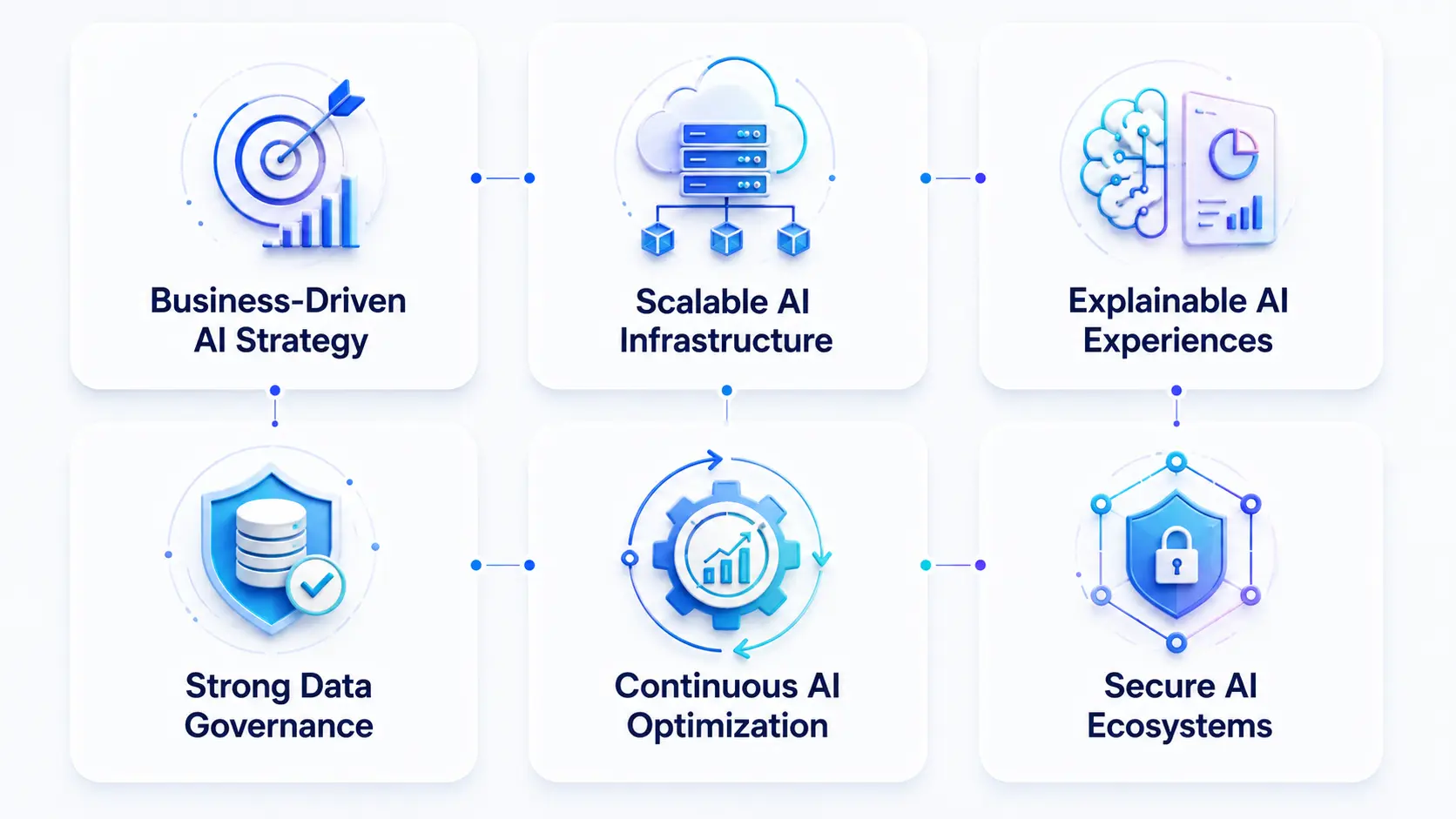
1. Start With Business Objectives
Successful AI integration begins with solving a real business challenge instead of adopting AI for trend value alone. Businesses should clearly define operational goals, customer pain points, and measurable KPIs before implementation. AI systems aligned with business objectives generate better ROI, stronger adoption rates, and more meaningful long-term performance improvements.
2. Build Scalable Infrastructure
AI-powered apps require scalable infrastructure capable of handling high data volumes, real-time processing, and growing user traffic efficiently. Without scalable architecture, businesses often experience performance bottlenecks, rising cloud costs, and slower application responsiveness. Flexible AI-ready systems ensure long-term scalability, operational stability, and smoother future feature expansion opportunities.
3. Prioritize UX and Explainability
AI should improve user experiences through transparency, usability, and intuitive interactions instead of creating confusion or frustration. Users are more likely to trust AI systems that clearly explain recommendations, predictions, or automated actions. Prioritizing explainable AI design improves engagement, builds customer confidence, and increases long-term feature adoption rates significantly.
4. Focus on Data Governance
Reliable AI systems depend heavily on clean, structured, and well-governed datasets for accurate predictions and personalization. Poor data quality often results in biased outputs, weak automation, and unreliable recommendations. Strong data governance frameworks help businesses maintain consistency, security, compliance, and long-term AI performance across digital platforms and applications.
5. Implement Continuous Optimization
AI integration is not a one-time deployment process because user behavior, datasets, and operational conditions constantly evolve over time. Businesses must continuously monitor AI systems, retrain models, optimize infrastructure, and analyze real-world performance metrics regularly. Continuous optimization ensures better accuracy, scalability, efficiency, and long-term operational reliability for AI ecosystems.
6. Secure AI Ecosystems
AI systems process sensitive customer, operational, and enterprise data, making security and compliance critical from the beginning. Weak AI security frameworks increase risks related to data breaches, unauthorized access, and compliance violations. Businesses should implement encryption, access controls, governance policies, and continuous monitoring to protect AI infrastructure and model integrity.
Enterprise AI Integration Checklist
Before integrating AI into apps and platforms, businesses should ensure they have:
- clearly defined AI business objectives
- scalable infrastructure planning
- clean and reliable training data
- AI governance frameworks
- observability and monitoring systems
- long-term model optimization plans
- security and compliance safeguards
- vendor flexibility strategies
- human oversight mechanisms
- measurable operational KPIs
Businesses that approach AI implementation strategically are far more likely to achieve scalable, reliable, and commercially successful AI adoption.
Future AI Integration Trends Businesses Must Prepare For
AI integration strategies will continue evolving rapidly as businesses move beyond basic automation toward intelligent, scalable, and operationally mature AI ecosystems. Key trends shaping the future include:
- Edge AI adoption for faster real-time processing
- Multimodal AI systems combining text, voice, image, and video intelligence
- Autonomous and multi-agent AI workflows
- AI-powered enterprise automation systems
- Real-time hyper-personalization
- Privacy-first and compliant AI architectures
- Hybrid cloud AI infrastructure
- AI observability and monitoring platforms
- Flexible multi-model AI ecosystems
As AI technologies become more deeply integrated into business operations, companies must also prepare for growing challenges related to governance, scalability, infrastructure optimization, compliance, and long-term operational management.

Final Thoughts
AI integration is transforming modern apps and platforms, but successful implementation requires far more than simply adding machine learning models or generative AI tools into digital products. Businesses that fail to plan strategically often face rising operational costs, infrastructure instability, poor AI accuracy, weak user adoption, and lower return on investment. In contrast, the most successful AI-powered products are built on strong business alignment, scalable architecture, clean and structured data systems, user-focused experiences, and continuous optimization frameworks that ensure long-term performance, reliability, and business growth.
At RipenApps, businesses receive end-to-end AI implementation support, from AI strategy and intelligent architecture planning to scalable deployment and optimization. Whether you are building AI-powered mobile apps, SaaS platforms, enterprise systems, or web applications, the right AI integration strategy can help transform your digital product into a scalable and future-ready business ecosystem.
FAQs
1. What are the most common AI integration mistakes?
The most common AI integration mistakes include unclear business goals, poor data quality, weak scalability planning, ignoring UX design, and underestimating AI operational costs. Many businesses also fail to implement continuous monitoring and optimization strategies, which negatively impacts long-term AI performance and user adoption.
2. Why do many AI projects fail?
Many AI projects fail because businesses focus on technology instead of business alignment, infrastructure readiness, and long-term operational management. Organizations often underestimate the importance of clean data, scalable architecture, user experience, and governance frameworks required to maintain reliable AI systems successfully.
3. How much does AI integration cost?
AI integration costs vary depending on infrastructure complexity, AI features, deployment scale, model type, and ongoing optimization requirements. Costs can also increase due to cloud infrastructure, API usage, data management, security systems, and continuous model retraining needed for long-term scalability and performance.
4. Why is data quality important in AI systems?
AI models depend entirely on data quality. Poor datasets lead to inaccurate predictions, weak personalization, and unreliable automation. High-quality data helps AI systems improve recommendation accuracy, user experiences, operational efficiency, and decision-making capabilities while reducing bias and inconsistencies in automated outputs significantly.
5. Why is AI governance important in enterprise applications?
AI governance helps businesses maintain transparency, accountability, compliance, and operational reliability across AI-powered systems. Strong governance frameworks reduce risks related to hallucinations, biased outputs, inaccurate automated decisions, weak explainability, and compliance failures while improving long-term AI trust and scalability.
6. What is AI observability?
AI observability refers to monitoring AI system performance, inference behavior, model drift, hallucinations, operational failures, infrastructure efficiency, and recommendation accuracy to ensure long-term reliability, scalability, and operational stability across AI-powered platforms.
7. How can businesses reduce AI implementation risks?
Businesses can reduce AI risks through phased deployment strategies, scalable architecture planning, AI governance frameworks, and continuous monitoring systems. Regular performance evaluation, strong security practices, and user feedback analysis also help organizations improve AI reliability while minimizing operational failures and unexpected implementation challenges.
8. Why is AI scalability important?
As user traffic and data volumes grow, scalable AI systems ensure consistent performance, low latency, and operational efficiency. Businesses with scalable AI infrastructure can handle increasing workloads more effectively while supporting future feature expansion, real-time processing requirements, and long-term business growth without major architectural rebuilds.

SHARE
WRITTEN BY

Ishan Gupta
CEO & Founder
Ishan Gupta is a seasoned entrepreneur and CEO with extensive 8+ years of experience in business and mobile app development landscape. He believes that the right digital product allows companies to focus on what they do best, while technology handles the rest. With deep exposure to global markets, he understands what makes an app succeed. His approach translates business needs into clear product strategies, ensuring that every feature contributes to measurable ROI.
View All Articles




 India
India USA
USA Australia
 Canada
 UK
UK UAE
UAE