



Key Takeaways
- The cost of web application development in 2026 depends heavily on the complexity of the architecture, integration requirements, scalability needs, and infrastructure planning.
- Simple web applications may cost between $20,000 and $70,000, while enterprise-grade platforms can exceed $200,000, depending on features and operational scale.
- Hidden expenses such as cloud infrastructure, third-party APIs, security compliance, maintenance, and scalability optimization significantly impact long-term costs.
- Choosing the wrong development approach early often leads to expensive rebuilds, performance issues, and operational inefficiencies later.
- Businesses that plan around long-term scalability, workflows, and ROI make more cost-efficient web development decisions.
The average website development cost in 2026 ranges from $8,000 to $100,000+, depending on the complexity of the project. Factors such as feature requirements, business goals, design quality, integrations, scalability, and technology stack directly influence the final development budget. A basic business website costs significantly less than a large-scale platform with advanced workflows, automation, and custom functionalities.
According to reports by Market Mind Partners, the web development market is expected to grow at a CAGR of 8.03% between 2025 and 2033. Businesses across industries are increasing investments in modern digital platforms that support automation, customer engagement, operational efficiency, and data-driven decision-making. As a result, website development has become a major strategic investment for startups, enterprises, and growing businesses alike.
Accurately estimating website development costs is now an essential part of business planning. Modern web applications require far more than visual design and coding. Businesses must also consider scalable architecture, backend infrastructure, security systems, API integrations, performance optimization, and long-term maintenance requirements.
This is why companies increasingly partner with experts offering web application development services to build scalable, high-performing digital platforms aligned with long-term business growth. In this blog, we break down website development costs in 2026, explain the major pricing factors, and share practical insights to help businesses plan their development budgets more effectively.
Table of Contents
What does Website Development Cost Represent in 2026
Website development costs in 2026 represent the total investment required to design, build, deploy, and operate a digital platform that aligns with business goals. In today’s digital era, cost is no longer driven by the number of pages or visual complexity alone. It reflects architectural decisions, integration depth, performance expectations, and governance requirements.
A modern business website typically includes multiple interconnected layers:
- A front-end experience optimized for speed, accessibility, and conversion across devices
- A back-end system responsible for content management, data handling, and integrations
- Analytics and tracking infrastructure that supports data-driven decisions
- Security and compliance mechanisms that protect customer and business data
Each of these layers influences the cost of website development. When you understand this structure, budgeting discussions become more strategic, which can help you to make more informed decisions.
How Much Does It Cost to Build a Website in 2026?
In 2026, website development cost varies widely because websites now serve different business goals. A basic business website requires a smaller investment, while ecommerce and enterprise platforms demand higher budgets due to advanced features and scalability needs. Factors such as development effort, technology stack, team structure, and location directly influence the final cost. Reviewing pricing through these lenses helps businesses estimate how much a website will cost with greater accuracy and control.
Pricing by Website Type and Hours Required
Industry benchmarks show how time investment correlates with cost. Below is an extrapolation based on standard development hours and average professional rates (adjusted for 2026 norms).
| Website Category | Estimated Cost Range | Common Use Cases |
| Landing Page / Campaign Website | $3,000 – $7,200 | Marketing campaigns, lead generation |
| Portfolio / Blog Website | $4,000 – $8,400 | Personal brands, content creators |
| Small Business Website | $5,000 – $15,000 | Local businesses, service providers |
| Corporate Website | $9,600 – $18,000 | Brand presence, business information |
| eCommerce Website | $15,000 – $72,000 | Online stores, payment integrations |
| Progressive Web App (PWA) | $20,000 – $60,000 | App-like web experiences |
| Headless CMS Website | $25,000 – $75,000 | Omnichannel content management |
| SaaS Platform | $50,000 – $150,000 | Subscription products, dashboards |
| Healthcare Website | $40,000 – $150,000 | Telemedicine, patient portals |
| Enterprise Platform | $100,000 – $500,000+ | Large-scale business operations |
Team & Location Impact on Website Development Cost
Where your developers are located and how you engage them affects website development cost dramatically. Below are common team models and their typical investment for a 1,000-hour project.
| Team Type | Cost Estimate | Primary Trade-off |
| Freelancers | $30,000 – $50,000 | Affordable but limited governance |
| Outsource Agency | $40,000 – $80,000 | Cost-effective with some quality variation |
| Local Agency | $80,000 – $150,000 | Quality and communication |
| In-House Team | $90,000 – $180,000 | Control and internal alignment, but costly |
Team costs vary based on skill, region, and specialization. Many enterprise websites use a blend of in-house strategy and external execution.
Developer Hourly Rates by Geography
| Region | Hourly Rate |
| USA / UK / Western Europe | $80 – $150/hr |
| Eastern Europe | $40 – $90/hr |
| India & South Asia | $25 – $60/hr |
| Southeast Asia / Philippines | $25 – $100/hr |
These ranges reflect global market trends demonstrating high variance by region and expertise level.
Read Also: A Business Guide To Web Application Development For 2026
Website Development Cost by Industry
Website and web application development costs vary across industries because every business has different technical requirements, integrations, compliance standards, and user expectations. A healthcare platform, for example, requires stronger security and compliance systems than a standard business website, while eCommerce platforms demand advanced payment, inventory, and order management capabilities.
Here’s a general breakdown of website development costs by industry in 2026:
| Industry | Typical Cost Range | Major Cost Factors |
| eCommerce / Retail | $15,000 – $250,000 | Product catalogs, payment gateways, ERP integrations |
| Healthcare / Telemedicine | $25,000 – $150,000 | HIPAA compliance, appointment systems, EHR integrations |
| FinTech / Banking | $40,000 – $300,000 | KYC verification, security layers, and real-time data processing |
| SaaS Platforms | $50,000 – $500,000 | Multi-user architecture, billing systems, API integrations |
| Real Estate | $10,000 – $60,000 | Property listings, maps, and advanced search filters |
| Education / EdTech | $15,000 – $100,000 | LMS systems, video streaming, assessments |
| Logistics & Supply Chain | $20,000 – $120,000 | Fleet tracking, live status updates, partner dashboards |
AI’s Impact on Website Development Cost in 2026
Artificial intelligence is changing how websites are built in 2026. AI-powered coding tools like GitHub Copilot, Cursor, and Gemini Code Assist help developers complete repetitive tasks faster and improve overall development efficiency.
But lower coding effort does not always mean lower project costs. Businesses now expect advanced features like smart search, AI chat support, personalized experiences, automation, and faster performance within the same budget range. This has increased the complexity of modern web projects. Many enterprises are also investing in legacy application modernization services to upgrade outdated systems and support modern AI-driven capabilities more efficiently.
AI-powered features such as recommendation systems, chatbots, predictive search, and personalization engines often increase development costs because they require custom integrations, backend processing, and continuous optimization.
Here’s how different development approaches compare in 2026:
| Development Approach | Cost Range | Best For |
| AI Website Builders | $0 – $500/month | Landing pages, MVPs, personal websites |
| Template + AI-Assisted Development | $3,000 – $12,000 | Small business websites |
| Custom Development with AI Tools | $15,000 – $80,000 | Growing businesses and SaaS platforms |
| Full Custom + AI Features | $80,000 – $300,000+ | Enterprise platforms and large marketplaces |
Businesses working with offshore development teams also gain cost advantages with AI-assisted workflows. Many companies now combine AI tools with experienced development teams to reduce timelines, improve productivity, and optimize overall website development costs.
Key Factors That Drive Website Development Costs
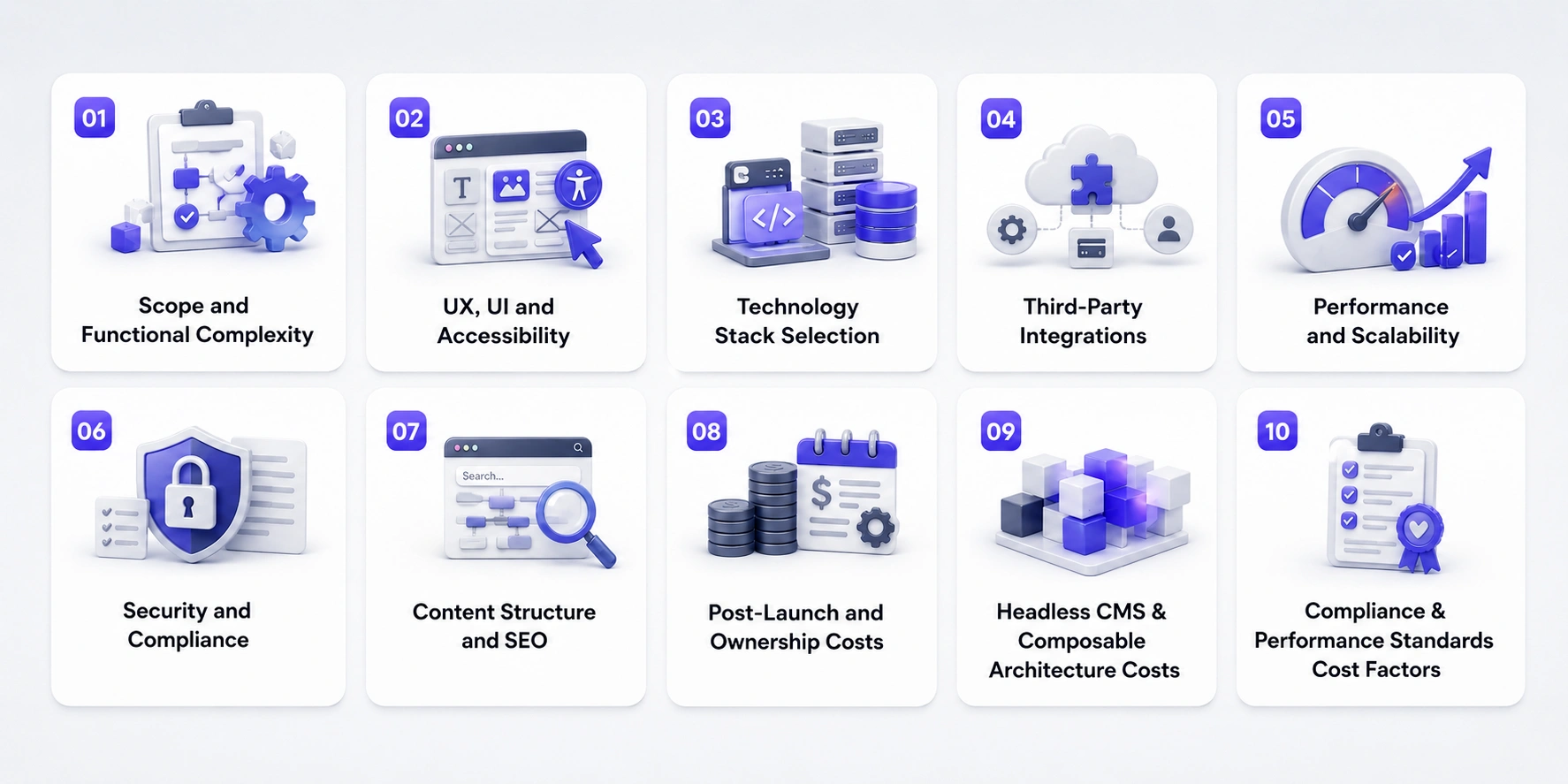
Planning a website budget in 2026 goes far beyond asking how much it costs to build a website. The website development cost depends on multiple strategic and technical decisions taken before development even begins. From design depth to platform selection, each choice shapes the overall website creation cost and long-term ownership value. Understanding these drivers helps businesses control website development costs without compromising performance or scalability.
Scope and Functional Complexity
The more pages, features, and user actions your website includes, the higher the development effort. A basic business site costs far less than a platform with dashboards, custom workflows, or role-based access. Businesses aiming to control MVP development cost often start with essential features only, since every added function increases design, development, and testing time. Thus, directly impacts the overall budget.
UX, UI and Accessibility
Good design is not only about looks. It focuses on ease of use, clear navigation, and accessibility for all users. When a professional web design and development company builds websites with user-first layouts, mobile responsiveness, and accessibility standards, the process involves deeper planning and testing. Therefore, it may increase cost but leads to stronger engagement and higher conversion rates.
Technology Stack Selection
Your choice of technologies shapes both upfront and long-term costs. Simple stacks work for static or small business sites, while scalable frameworks, headless CMS, or custom backend setups cost more. The right full-stack web development technologies stack helps future growth, but it needs skilled developers and a higher initial investment. You can work closely with a top-rated website development company to seamlessly integrate advanced technologies into your website.
Third-Party Integrations
Websites often rely on external tools like payment gateways, CRMs, analytics, chat systems, or APIs. Each integration takes time to configure, test, and secure. Some tools also carry recurring subscription fees, which add to the total ownership cost over time.
Performance and Scalability
Fast load times and the ability to handle traffic growth do not happen by chance. They require optimized code, caching, hosting setup, and scalable architecture. Businesses often rely on backend development services to build systems capable of handling high traffic, real-time processing, and long-term scalability. Websites designed for strong performance usually require additional infrastructure planning, which increases development costs.
Security and Compliance
Security is essential, especially for websites handling user data, payments, or logins. Features like SSL, data encryption, secure authentication, and compliance with privacy laws add development effort. These measures protect your business but require ongoing monitoring and updates.
Content Structure and SEO
A website built for search visibility needs a clean structure, optimized content flow, and SEO-friendly development. This includes page hierarchy, loading speed, schema setup, and CMS flexibility. SEO-ready builds cost more initially but reduce marketing spend later.
Post-Launch and Ownership Costs
Website costs do not stop after launch. Maintenance, updates, hosting, security patches, and feature improvements are ongoing expenses that businesses must plan for. Businesses investing in professional full-stack development services often benefit from smoother long-term maintenance because both frontend and backend systems are managed together more efficiently. Planning for post-launch support helps ensure long-term stability, performance, and scalability.
Headless CMS & Composable Architecture Costs
Many businesses now use headless CMS architecture to improve website speed, flexibility, and multi-platform content delivery. Platforms like Contentful and Sanity are commonly paired with frontend frameworks like Next.js for better scalability and performance.
However, headless CMS development usually adds extra costs due to advanced API integrations, frontend customization, and performance optimization requirements.
| Cost Factor | Estimated Cost |
| Frontend Development | $5,000 – $20,000 |
| CMS Setup & Integrations | $3,000 – $12,000 |
| CMS Subscription | $600 – $2,500/month |
| Performance Optimization | $2,000 – $6,000 |
Compliance & Performance Standards Cost Factors
Modern websites must meet performance, accessibility, privacy, and security standards from the start. Ignoring these requirements often increases post-launch fixing and maintenance costs.
| Compliance Standard | Estimated Cost Addition |
| Core Web Vitals Optimization | $2,000 – $8,000 |
| WCAG Accessibility Compliance | $3,000 – $10,000 |
| GDPR / CCPA Compliance | $2,500 – $15,000 |
| PCI-DSS Compliance | $5,000 – $20,000 |
| HIPAA Compliance | $10,000 – $40,000+ |
Read Also: Web Application Architecture Guide: Things That Make Your Website Successful
Hidden Costs Often Overlooked by Leaders
Many executive teams focus only on upfront development costs and ignore critical ongoing expenses:
| Cost Category | Annual/Recurring Impact |
| Maintenance & Updates | 10–20% of the initial cost |
| Hosting & Infrastructure | $500 – $10,000+ depending on traffic |
| Security Monitoring | $1,000 – $8,000 |
| Analytics & Optimization | $2,000 – $15,000 |
| Content Production | $1,000 – $20,000+ |
Omitting these from initial budgets often leads to overruns or performance problems after launch.
3-Year Total Cost of Ownership (TCO) Model
Many businesses only calculate the initial website development cost and overlook the long-term expenses required to run, maintain, and scale the platform. In reality, website ownership includes hosting, security, maintenance, content updates, and performance optimization costs over time.
Here’s an example of a 3-year cost breakdown for a custom website built at $40,000:
| Cost Category | Year 1 | Year 2 | Year 3 |
| Initial Development | $40,000 | — | — |
| Hosting & Infrastructure | $2,400 | $2,400 | $3,000 |
| Security & SSL | $3,000 | $3,000 | $3,500 |
| Maintenance & Updates | $6,000 | $6,000 | $7,000 |
| Content & Optimization | $11,000 | $12,000 | $15,000 |
Estimated 3-Year TCO: ~$114,300
This shows that long-term operational costs often exceed the initial development budget. Businesses that invest in scalable architecture and quality development early usually reduce future rebuilding and maintenance expenses.
Real-World Website Cost Examples From Popular Brands
Looking at well-known brands helps decision-makers understand how website development cost scales with business ambition, traffic volume, and technical depth. While exact figures are rarely disclosed, industry estimates provide a realistic view of what it takes to build and maintain websites at scale. Thus, offering valuable insight into future-proof web development for startups planning long-term growth and scalability.
Shopify Website Platform

Shopify’s website ecosystem represents a high-scale ecommerce and SaaS platform rather than a simple website. Industry analysts estimate Shopify’s core web platform and supporting systems require $150,000 to $250,000+ annually in development and optimization. The Shopify website development cost reflects advanced ecommerce workflows, global scalability, security compliance, and continuous feature releases. This shows how costs rise when performance and reliability are non-negotiable.
Airbnb Web Platform
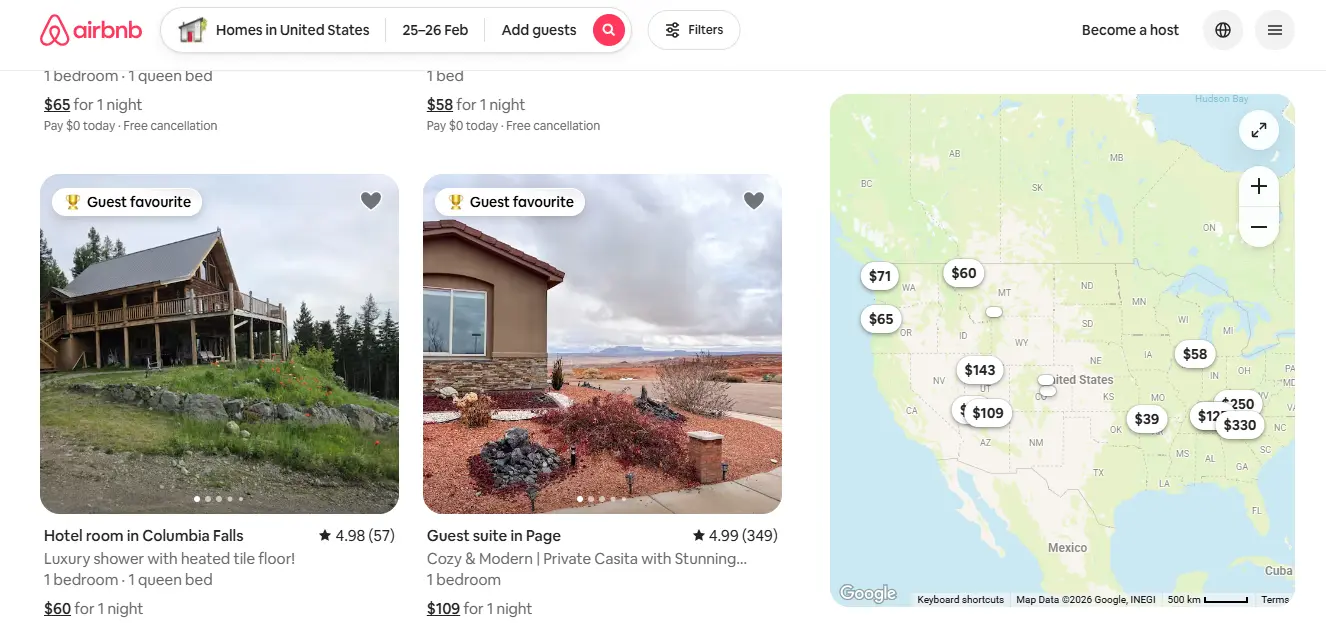
Airbnb’s website functions as a global marketplace with real-time availability, booking systems, payment processing, and personalized user experiences. Based on complexity and ongoing development, experts estimate the cost of website development and optimization at $150,000 to $200,000+ for similar marketplace platforms. This example highlights how website programming cost increases when custom UX, data handling, and integrations drive the business model.
HubSpot Corporate Website

HubSpot’s website is a content-driven, lead-generation powerhouse integrated with CRM, analytics, and marketing automation tools. Industry estimates place the average cost to develop and maintain such a platform between $60,000 and $100,000+. This investment reflects advanced website design cost, SEO-focused content architecture, accessibility standards, and the growing role of AI in web development for content personalization, lead scoring, and automated user journeys that improve conversion efficiency.
Amazon Web Experience

Amazon’s public website experience sits on one of the most complex digital infrastructures globally. While Amazon operates at a different scale, building even a simplified enterprise-grade commerce website inspired by its architecture can cost $150,000+. This illustrates how website development costs escalate when performance, security, uptime, and massive traffic handling become critical business requirements.
Wrapping Up
Website development cost in 2026 depends on far more than design or page count. It is shaped by business goals, platform complexity, integrations, performance expectations, and long-term scalability needs. From small business websites to enterprise-grade platforms, understanding cost drivers, hidden expenses, and real-world benchmarks helps leaders plan budgets with confidence and avoid costly rebuilds later.
Choosing the right development partner plays a major role in controlling cost and outcomes. At RipenApps, websites are built as scalable business platforms, not short-term digital assets. With a focus on performance, security, and future growth, we help businesses invest wisely, launch faster, and build websites that support measurable business results.

FAQs
1. What is the average cost to develop a website for a small business?
The average cost of website development for a small business ranges from $8,000 to $25,000. This typically includes responsive design, basic SEO structure, content pages, and standard integrations.
2. How to calculate website development cost?
To calculate website development cost, start by defining your website’s scope, features, and business goals. Estimate development hours based on design, functionality, integrations, and testing. Then multiply by the team’s hourly rate. Always include ongoing costs such as hosting, maintenance, and future enhancements to get an accurate total budget.
3. What factors influence website development costs the most?
Key cost drivers include website complexity, custom design needs, technology stack, third-party integrations, security requirements, and future scalability. Business goals play a major role in defining how much investment is needed upfront.
4. Are there hidden costs in website development projects?
Yes, common hidden costs include ongoing maintenance, hosting, security updates, third-party tool subscriptions, and future feature enhancements. Planning for total ownership cost helps avoid budget surprises after launch.
5. Should I hire a freelancer or a website development company?
Freelancers may offer lower upfront costs, but a professional website development company provides structured delivery, quality assurance, scalability planning, and post-launch support. For long-term business goals, agencies often deliver better ROI.
6. How much time does it take to develop a website?
Website development timelines usually range from 8 to 16 weeks, depending on project scope and complexity. A basic business website may take upto 6 weeks, while feature-rich or enterprise websites with custom design, integrations, and testing often require 12–16 weeks or more.

SHARE
WRITTEN BY

Vaibhav Sharma
Business Head
Vaibhav Sharma bridges product vision with real-world execution. He shares consultation with startups and enterprises to shape digital strategies, refine user journeys, and create app experiences that feel intuitive from day one. His strength lies in transforming early concepts into clear development roadmaps that set products up for long-term success.
View All Articles





 India
India USA
USA Australia
 Canada
 UK
UK UAE
UAE