

Quick Summary
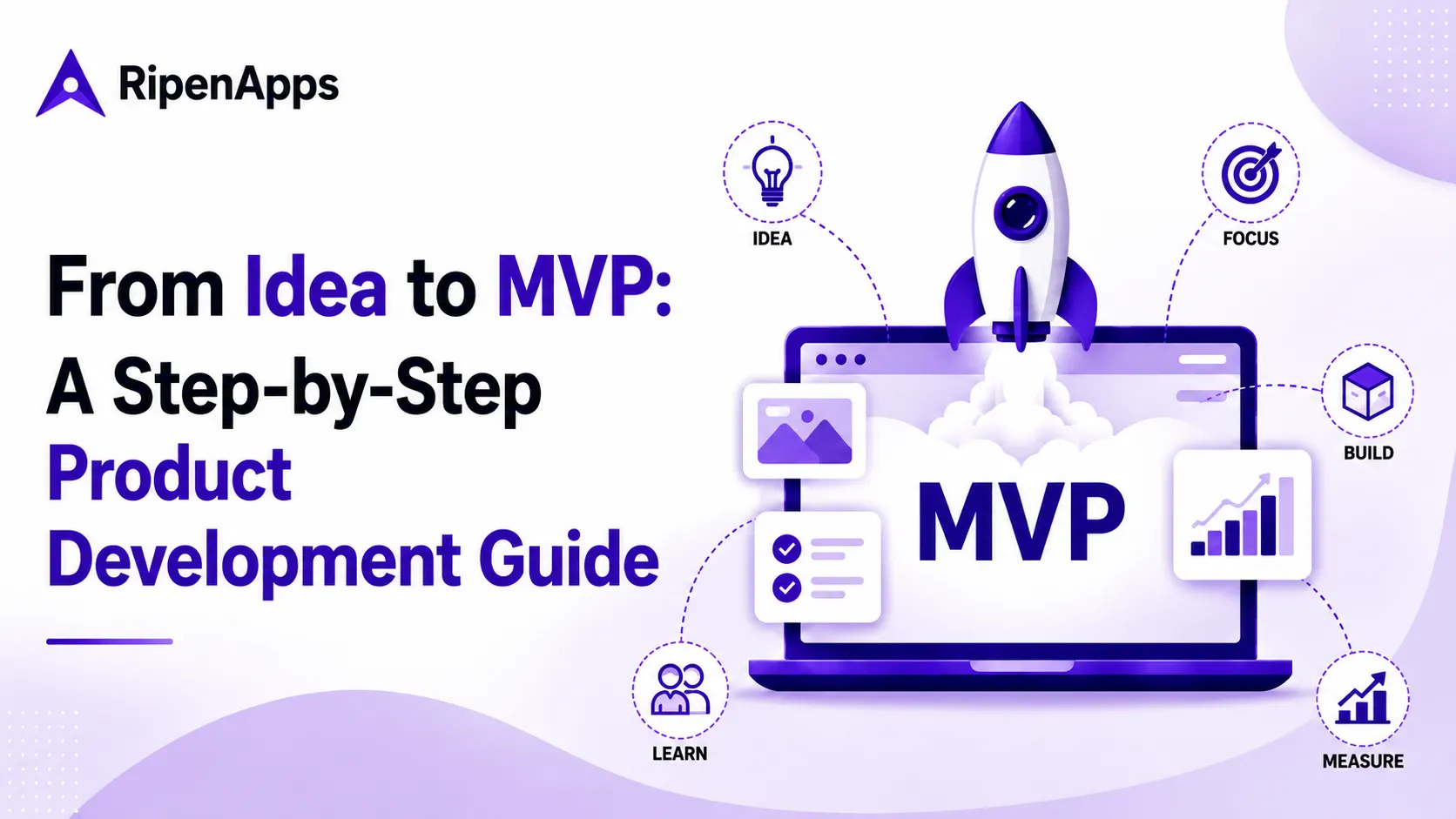
Building a successful Minimum Viable Product (MVP) in 2026 is about validating ideas quickly, minimizing risk, and making data-driven product decisions. This comprehensive guide explains MVP types, development steps, costs, validation frameworks, common mistakes, and best practices to help startups and businesses launch faster, achieve product-market fit, and scale with confidence.
Key Takeaways
- MVPs help businesses validate product ideas early, reducing risk, costs, and wasted development effort significantly.
- Successful MVPs focus on solving one core problem, enabling faster learning through real user feedback.
- The MVP journey progresses from validation to growth, evolving through MMPs toward full-scale products.
- AI-assisted development accelerates MVP creation, but customer validation remains essential for long-term product success.
- Effective MVPs prioritize essential features, measure meaningful metrics, and iterate continuously toward product-market fit.
Building a product has never been easier or riskier. With AI-powered development tools, no-code platforms, and global talent marketplaces, startups can launch products faster than ever before. Yet despite these advantages, most new products still fail because they solve the wrong problem, target the wrong audience, or include features users never wanted in the first place.
This is where a Minimum Viable Product (MVP) becomes essential. Rather than investing months or years into building a fully featured product, an MVP helps businesses validate ideas with minimal resources, gather real user feedback, and reduce the risk of costly mistakes. Whether you’re a startup founder testing a disruptive concept, an enterprise launching a new digital product, or an entrepreneur entering a competitive market, the MVP approach allows you to learn before you scale.
In 2026, MVP development has evolved significantly. Modern teams now leverage AI-assisted coding, rapid prototyping tools, cloud-native architectures, and data-driven validation frameworks to bring products to market faster than ever. Many businesses also choose to partner with an experienced MVP Development Company to accelerate product delivery, validate ideas efficiently, and reduce development risks. However, speed alone doesn’t guarantee success. The key lies in building the right product, for the right users, at the right time.
This comprehensive guide covers everything you need to know about MVP development, from understanding core concepts and choosing the right MVP type to estimating costs, validating market demand, and transforming an MVP into a successful product.
Table of Contents
What is a Minimum Viable Product?
A Minimum Viable Product (MVP) is the simplest version of a product that delivers enough value to early users while enabling businesses to validate assumptions, collect feedback, and make informed development decisions. Instead of building a feature-rich product from day one, companies launch with only the essential functionality needed to solve a specific problem for a defined audience.
The MVP approach is rooted in experimentation. Rather than relying on assumptions about what customers want, businesses use an MVP to test real-world demand before committing significant time, money, and resources. By launching early and learning quickly, teams can identify what works, eliminate unnecessary features, and continuously improve the product based on actual user behavior. This iterative approach is one of the key reasons startups build MVPs faster, allowing them to validate ideas efficiently before scaling.
For startups, an MVP helps reduce product risk and conserve limited budgets. For established businesses, it provides a structured way to test new ideas, markets, or business models without undertaking large-scale development efforts. Whether you’re building a mobile app, SaaS platform, AI-powered tool, marketplace, or enterprise solution, an MVP serves as a practical first step toward creating a successful product.
MVP vs. Prototype vs. POC vs. MMP
Many founders use terms like MVP, prototype, Proof of Concept (POC), and Minimum Marketable Product (MMP) interchangeably. While these approaches are related, each serves a different purpose in the product development lifecycle. Choosing the wrong one can lead to wasted resources, delayed launches, and misleading validation results.
A Proof of Concept (POC) is the earliest stage of idea validation. Its purpose is to determine whether a specific technology, integration, or technical approach is feasible. POCs are generally built for internal stakeholders and are not intended for real users.
A prototype is an interactive representation of a product that focuses on user experience, workflows, and interface design rather than functionality. It helps stakeholders visualize the final product, gather early feedback, and refine the user journey before development begins. Businesses often leverage rapid prototyping services to accelerate design iterations, validate concepts, and reduce development risks before building an MVP.
An MVP is the first usable version of the product released to actual users. Unlike a prototype or POC, an MVP includes working functionality that solves a real user problem. Its primary objective is validating market demand, understanding user behavior, and testing product assumptions through real-world usage.
An MMP (Minimum Marketable Product) represents the next stage of maturity. Once the MVP proves market demand, additional features, refinements, and user experience improvements are added to create a product that is ready for broader market adoption and growth.
A simple way to view the progression is:
- POC (Proof of Concept)
- Prototype
- MVP (Minimum Viable Product)
- MMP (Minimum Marketable Product)
- Full Product
Each stage reduces uncertainty while increasing investment. The earlier you validate assumptions, the lower your risk of building something customers don’t want.
Which One Do You Need First?
The answer depends on what you’re trying to validate.
If your biggest uncertainty is technical feasibility, such as whether an AI model, blockchain integration, or complex algorithm can work, a POC is usually the right starting point.
When the concept is clear but you need stakeholder approval, user feedback on workflows, or design validation, begin with a prototype.
If you already understand the problem and want to test real market demand, user adoption, and business viability, move directly to an MVP. An MMP should only be considered after your MVP demonstrates evidence of product-market fit, user engagement, or revenue potential.
For most startups in 2026, the ideal path is to begin with a product discovery workshop to validate the problem, define user needs, and prioritize core features before quickly validating technical feasibility, creating lightweight prototypes, and launching an MVP as early as possible. The sooner real users interact with your product, the sooner you’ll gain the insights needed to make confident product decisions.
Why Build an MVP in 2026?
Launching a full-scale product without validation is one of the fastest ways to waste time, money, and development resources. Markets evolve rapidly, customer expectations change frequently, and competition can emerge overnight. In this environment, businesses need a smarter approach to product development, one that prioritizes learning before scaling. Let’s look at the main factors why the MVP model remains more relevant than ever in 2026.
1. Validate Your Product Idea Before Investing Heavily
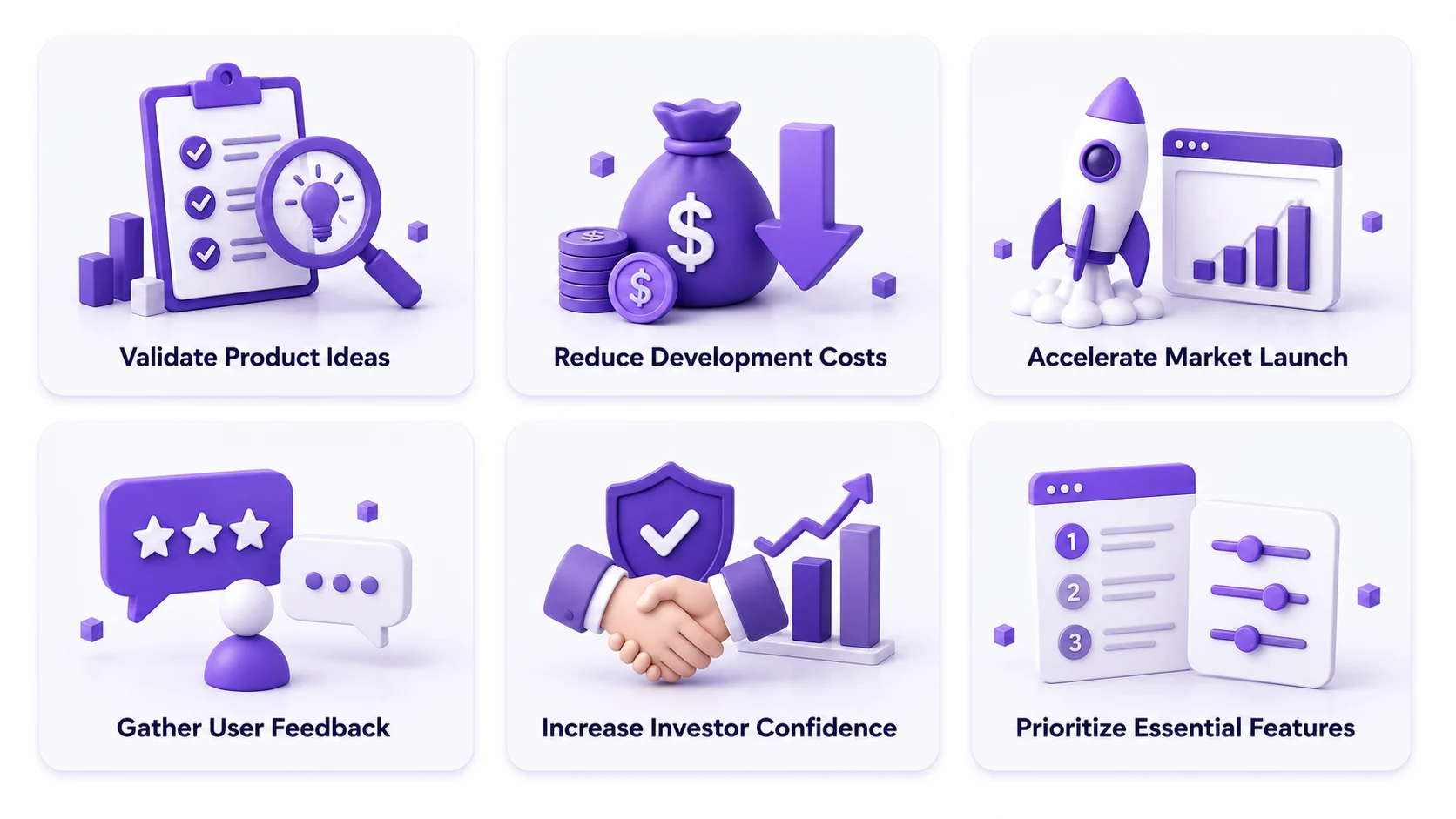
Building a full-featured product without validating demand can result in significant financial and operational losses. An MVP enables businesses to launch a simplified version of their product, test it with real users, and determine whether the problem they’re solving truly exists. Instead of relying on assumptions, companies gather actionable feedback that helps validate the product concept before committing to large-scale development.
2. Reduce Development Costs and Minimize Risk
One of the biggest advantages of an MVP is its ability to control costs while reducing business risk. By focusing only on the core features that deliver the primary value proposition, businesses avoid spending time and resources on functionality users may never need. This lean development approach helps teams identify what works, eliminate unnecessary features, and make informed investment decisions as the product evolves.
3. Accelerate Time-to-Market with AI-Assisted Development
In 2026, AI-powered development tools, low-code platforms, and automation have significantly shortened development cycles. An MVP allows businesses to leverage these technologies to launch products much faster, collect real-world user feedback, and iterate continuously. Rather than waiting months to release a polished product, organizations can enter the market quickly, stay ahead of competitors, and refine their offering based on actual customer behavior.
4. Build a Product Based on Real User Feedback
An MVP transforms product development into a continuous learning process. Instead of prioritizing features based on internal opinions, businesses can analyze user interactions, usage patterns, and customer feedback to understand what delivers the greatest value. These insights help teams prioritize future updates, improve the user experience, and create a product roadmap driven by data rather than assumptions.
5. Increase Investor Confidence and Create a Scalable Growth Strategy
For startups, an MVP demonstrates market validation before seeking additional funding, while for enterprises, it provides evidence that a new product or innovation has commercial potential. Metrics such as user adoption, engagement, retention, and customer feedback help prove product-market fit and strengthen investor confidence. At the same time, the insights gained from an MVP enable businesses to build a scalable, data-driven roadmap for long-term product growth and expansion.
6. Prioritize Features That Matter Most
One of the biggest challenges in product development is deciding which features deserve investment. An MVP helps businesses identify the functionality users truly value by observing real-world usage and collecting actionable feedback. Instead of building an extensive feature set based on assumptions, teams can prioritize high-impact enhancements, eliminate low-value features, and allocate development resources more effectively. This results in a more focused product roadmap, faster iterations, and a solution that evolves according to actual customer needs rather than internal opinions.
What Investors Look for in an MVP?
Many founders believe investors primarily evaluate the quality of the product itself. In reality, investors are often more interested in the signals the MVP generates.
A strong MVP demonstrates that a team can identify a real problem, build a practical solution, and validate demand within a target market. Investors typically look for evidence such as:
- User adoption and engagement metrics
- Customer feedback and retention patterns
- Problem-solution fit
- Early revenue or monetization potential
- Clear market opportunity
- Efficient use of resources
- A repeatable growth strategy
The most attractive MVPs are not necessarily the most advanced technically. They are the ones that provide measurable proof that customers want the solution and are willing to use, pay for, or advocate for it.
Strong validation also improves a startup’s chances of securing pre-seed funding, as investors are more likely to back businesses that demonstrate early traction, market demand, and a clear path to growth. Validation reduces uncertainty, and reducing uncertainty is exactly what investors value most when evaluating early-stage opportunities.
Common Types of MVPs
Not all MVPs are built the same way. The right MVP approach depends on factors such as your business goals, available budget, development timeline, technical complexity, and the type of validation you’re seeking. Some MVPs are designed to test demand before any product is built, while others provide a fully functional experience to gather behavioral data from real users.
Understanding the different types of MVPs can help founders choose the most efficient path to validation while avoiding unnecessary development costs. Broadly, MVPs can be categorized into low-fidelity, high-fidelity, and AI-native MVPs.
Low-Fidelity MVPs
Low-fidelity MVPs are designed to validate market demand and customer interest with minimal development effort. These MVPs focus on testing assumptions before investing in product engineering.
Common examples include:
- Landing pages that gauge interest in a product idea
- Waitlists and pre-registration campaigns
- Explainer videos demonstrating product concepts
- Concierge MVPs where services are delivered manually
- Wizard of Oz MVPs that appear automated but operate behind the scenes
The primary advantage of low-fidelity MVPs is speed and affordability. Businesses can quickly determine whether users are interested in a solution before building complex functionality. These MVPs are particularly valuable when founders are still validating problem-solution fit.
High-Fidelity MVPs
High-fidelity MVPs provide real product functionality and allow users to interact with the solution in a production-like environment. Unlike low-fidelity approaches, these MVPs involve actual development and generate deeper insights into user behavior.
Examples include:
- Mobile applications with core features
- SaaS platforms with limited functionality
- Marketplaces serving a specific niche
- Subscription-based digital products
- Internal business tools released to pilot customers
High-fidelity MVPs are useful when businesses need to validate user engagement, feature adoption, monetization potential, and long-term product viability. Although they require more resources, they often generate richer feedback and stronger validation signals.
AI-Native MVPs
AI-native MVPs have become increasingly popular in 2026 as businesses integrate artificial intelligence directly into their products from day one. These MVPs leverage technologies such as generative AI, machine learning, natural language processing, recommendation engines, and intelligent automation.
Examples include:
- AI chatbots and virtual assistants
- AI-powered content generation tools
- Intelligent workflow automation platforms
- Personalized recommendation systems
- AI-enhanced productivity applications
The advantage of AI-native MVPs is the ability to deliver differentiated value quickly. Instead of building extensive rule-based systems, startups can use existing AI models and APIs to validate user demand and product-market fit faster. However, founders must carefully evaluate factors such as model accuracy, scalability, operational costs, and data privacy requirements.
MVP Type Selector Matrix
Choosing the right MVP type depends on your primary objective:
| Goal | Recommended MVP Type |
| Validate market demand quickly | Low-Fidelity MVP |
| Test user engagement and behavior | High-Fidelity MVP |
| Validate technical feasibility | POC before MVP |
| Launch a working product to customers | High-Fidelity MVP |
| Build around AI capabilities | AI-Native MVP |
| Minimize upfront investment | Low-Fidelity MVP |
| Gather monetization insights | High-Fidelity MVP |
| Test an emerging AI business idea | AI-Native MVP |
As a general rule, start with the least expensive validation method capable of answering your biggest business question. The faster you can reduce uncertainty, the more effectively you can allocate resources toward building a successful product.
Read Also: Best Prototyping Methods for Mobile App Development
Successful MVP Examples
Some of the world’s most successful companies began with surprisingly simple MVPs. Rather than launching feature-rich products, they focused on validating a single core assumption: would people actually use the solution? These early experiments helped founders gather feedback, refine their offerings, and eventually scale into globally recognized businesses.
Studying successful MVPs reveals a common pattern. The goal was never to launch a perfect product. Instead, founders concentrated on learning as quickly as possible while minimizing risk and investment. The same principle applies to startups and businesses building products today.
Classic MVP Stories in 60 Seconds
Several iconic companies demonstrate the power of starting small.
Dropbox validated its idea before building a complete product. Instead of spending months developing complex file synchronization technology, the founders created a simple explainer video demonstrating how the product would work. The video generated significant interest and thousands of sign-ups, proving demand before major development began.
Airbnb started when its founders rented air mattresses in their apartment to conference attendees who couldn’t find hotel accommodations. The concept was simple, manual, and far from the platform we know today, but it validated that people were willing to pay for alternative lodging options.
Uber launched as UberCab in a limited geographic area with a narrow use case, connecting riders with premium black-car services. By focusing on a single city and customer segment, the company tested demand before expanding globally.
Facebook initially served only students at Harvard University. Restricting access to a small audience enabled the team to gather feedback, improve engagement, and refine the platform before broader expansion.
The lesson from these examples is clear: successful products often begin by solving one problem for one audience exceptionally well.
AI-Era MVP Examples (2024–2026)
The AI boom has created a new generation of MVP success stories. Unlike traditional software startups, many AI-native businesses use existing foundation models and APIs to launch quickly and validate market demand.
AI-powered writing assistants often began with a single use case, such as generating blog outlines, social media content, or marketing copy. Once user demand was validated, additional features were introduced gradually.
Many AI customer support platforms launched with basic chatbot functionality focused on answering frequently asked questions. As adoption increased, businesses expanded capabilities to include automation, analytics, multilingual support, and CRM integrations.
AI productivity tools frequently start by solving a narrow workflow challenge, such as meeting summaries, task generation, or document analysis. Early feedback then guides future product development and feature prioritization.
The common trend among successful AI in MVP development solutions is specialization. Rather than attempting to solve every problem, they focus on one high-value outcome and validate demand before expanding.
Lessons from Failed MVPs
While successful MVPs offer valuable inspiration, failed MVPs often provide even more important lessons.
Many MVPs fail because they attempt to include too many features. Instead of validating a single hypothesis, teams build complex products that require significant resources without generating clear insights.
Another common mistake is launching without a defined target audience. If a product tries to serve everyone, feedback becomes fragmented and difficult to interpret.
Some founders also confuse activity with validation. Generating website traffic, social media engagement, or downloads does not necessarily indicate product-market fit. Meaningful validation comes from user behavior, retention, engagement, and willingness to pay.
Perhaps the biggest lesson from failed MVPs is that success depends less on technical sophistication and more on learning efficiency. The best MVPs are designed to answer critical business questions quickly, enabling teams to adapt before investing heavily in development and growth.

Should You Even Build an MVP?
While MVPs are widely recommended for startups and new product initiatives, they are not always the right solution. In some situations, businesses benefit greatly from launching an MVP. In others, a different validation approach may be faster, cheaper, and more effective.
Before committing resources to development, founders should first determine whether an MVP is actually necessary. The goal is not to build an MVP because it is a popular methodology; the goal is to reduce uncertainty in the most efficient way possible.
An MVP makes sense when you have a clear problem to solve but lack confidence in key assumptions related to customer demand, user behavior, pricing, feature priorities, or product-market fit. By launching a simplified version of the product, you can gather evidence before making larger investments.
However, if the biggest uncertainty is technical feasibility, a Proof of Concept (POC) may be more appropriate. Likewise, if you’re primarily testing user experience or design concepts, a prototype could provide faster validation at a lower cost.
The key question is simple: What is the most important assumption you need to validate right now? The answer often determines whether an MVP is the right next step.
The 3-Question Decision Tree
Before starting MVP development, ask yourself the following questions:
- Is there a clearly defined problem worth solving?
Customers rarely buy products because of innovative technology alone. They buy solutions to meaningful problems. If the problem is unclear or poorly understood, additional customer research may be required before development begins.
- Do you have significant uncertainty about market demand?
If you already possess strong evidence of demand through customer interviews, pre-sales, or existing market traction, an MVP may not be necessary. However, if demand remains uncertain, an MVP can help validate assumptions with real users.
- Can you learn something valuable from a simplified version of the product?
Not every product can be reduced easily. Some solutions require substantial functionality before users can experience meaningful value. If a simplified version can still solve the core problem, an MVP is often the best path forward.
If the answer to all three questions is “yes,” building an MVP is likely a smart investment.
When Not to Build an MVP
Despite its popularity, there are situations where an MVP may not be the optimal choice.
You may want to avoid building an MVP when:
- Regulatory or compliance requirements demand a complete solution before launch.
- The product’s value depends on a fully integrated ecosystem that cannot be simplified.
- Technical feasibility remains unproven and requires a POC first.
- Existing customer demand has already been validated through strong market evidence.
- A prototype can answer key questions more quickly and at a lower cost.
- The target market expects enterprise-grade functionality from day one.
In these cases, alternative validation methods may provide better results while reducing unnecessary development effort.
Ultimately, an MVP is a tool, not a mandatory stage in every product journey. The smartest product teams choose the validation approach that delivers the greatest learning with the least investment, whether that involves an MVP, prototype, POC, or another method entirely.
How to Build an MVP in 7 Steps?
Building a successful MVP is not about launching the fastest product possible; it’s about creating the smallest product capable of delivering meaningful learning. The most effective MVPs follow a structured process that minimizes risk, validates assumptions, and generates actionable insights for future development.
Whether you’re building a startup app, SaaS platform, marketplace, AI product, or enterprise solution, the following seven-step framework can help you move from idea to validation efficiently.
Step 1: Validate the Problem
Before writing a single line of code, you need to confirm that you’re solving a real problem for a clearly defined audience. This involves conducting customer interviews, market research, competitor analysis, and leveraging UX research services to understand user needs, pain points, and behaviors. The insights gathered during this stage help ensure your MVP addresses a genuine market need rather than assumptions.
Many startups fail because they build products based on assumptions rather than evidence. Conduct customer interviews, market research, surveys, competitor analysis, and observational studies to understand user pain points. Focus on identifying recurring problems, existing workarounds, and unmet needs.
During this stage, avoid pitching your solution. Instead, learn how potential customers currently solve the problem and what frustrations they experience. Strong problem validation creates a foundation for everything that follows.
The goal is to gather enough evidence to confidently answer one question: Is this a problem people genuinely care about solving?
Step 2: Define Value Proposition and Success Metrics
Once the problem is validated, define the unique value your MVP will deliver.
Your value proposition should clearly explain:
- Who the product serves
- What problem it solves
- Why it is better than available alternatives
- What outcome users can expect
At the same time, establish measurable success criteria. Without predefined metrics, it becomes difficult to determine whether your MVP is succeeding or failing.
Common MVP success metrics include:
- User sign-ups
- Activation rates
- Customer retention
- Conversion rates
- Revenue generation
- Feature adoption
- Customer satisfaction scores
Defining success before development ensures that future decisions are driven by data rather than opinions.
Step 3: Map the Core User Journey
Most products contain dozens of possible user paths, but an MVP should focus on the single journey that delivers core value.
Start by identifying the primary action users must complete to achieve their desired outcome. Then map every step required to reach that goal.
For example:
- A ride-hailing app connects riders with drivers.
- A food delivery platform enables meal ordering.
- A project management tool helps teams organize work.
- An AI assistant answers user queries efficiently.
Anything that does not directly support the core user journey should be questioned. The objective is not to create a comprehensive product but to ensure users can successfully complete the most important task.
A clear user journey simplifies development, reduces scope, and improves validation quality.
Step 4: Prioritize MVP Features
Feature prioritization is where many MVPs succeed or fail. Founders often feel tempted to include every good idea, but excessive functionality increases development costs, delays launch, and weakens validation efforts.
Focus on identifying features that directly support the core user journey while eliminating anything that can wait until later releases.
MoSCoW Method
The MoSCoW framework categorizes features into four groups:
- Must Have
- Should Have
- Could Have
- Won’t Have (for now)
For MVP development, only “Must Have” features should be considered essential. Everything else belongs in the future roadmap.
RICE Scoring
RICE stands for:
- Reach
- Impact
- Confidence
- Effort
This framework helps teams evaluate features objectively based on potential business value relative to implementation effort. Higher-scoring features typically receive development priority.
The One-Loop Rule
A practical MVP principle is the One-Loop Rule: users should be able to complete the product’s primary value cycle from beginning to end.
For example:
- Riders can request and complete a ride.
- Customers can place and receive an order.
- Users can create and manage a project.
- Customers can generate AI-powered outputs.
If the core loop works, the MVP can generate meaningful learning. If it doesn’t, additional features won’t compensate for the missing value.
Step 5: Choose Your Build Approach and Tech Stack
The technology decisions you make during MVP development can significantly affect cost, speed, scalability, and future flexibility.
Most businesses choose among three primary approaches:
- No-code or low-code development
- Custom software development
- Hybrid development using existing platforms and APIs
The best option depends on factors such as complexity, budget, timeline, and growth expectations.
When selecting a tech stack, prioritize:
- Development speed
- Scalability requirements
- Security needs
- Third-party integrations
- Maintenance costs
- Availability of technical talent
In 2026, many startups accelerate development by leveraging cloud services, AI-assisted coding tools, open-source frameworks, and pre-built APIs instead of building everything from scratch.
Step 6: Build, Test, and Launch
With priorities established and technology selected, development can begin.
During this phase, teams should focus on delivering the minimum functionality required to validate assumptions. Avoid adding features that do not directly contribute to learning objectives.
Before launch:
- Conduct usability testing
- Fix critical bugs
- Validate key workflows
- Test performance and security
- Gather feedback from beta users
The objective is not perfection. Instead, launch a product that is stable enough to deliver value while generating reliable user feedback.
Early launches often provide more valuable insights than months of additional development.
Step 7: Measure, Learn, and Iterate
Launching an MVP is not the finish line; it is the beginning of the learning process.
Once users begin interacting with the product, collect both quantitative and qualitative feedback. Analyze usage patterns, retention metrics, feature adoption, support requests, and customer interviews.
Look for answers to questions such as:
- Are users experiencing the intended value?
- Which features drive engagement?
- Where are users dropping off?
- Are customers willing to pay?
- What obstacles prevent adoption?
Based on the findings, teams can improve the product, refine positioning, adjust pricing, add features, or even pivot entirely.
The most successful MVPs are not those that launch perfectly. They are the ones that enable rapid learning and continuous improvement. By treating the MVP as an experiment rather than a finished product, businesses can make smarter decisions and significantly increase their chances of achieving product-market fit.

How Much Does MVP Development Cost in 2026?
One of the most common questions founders ask is, “How much does it cost to build an MVP?” Unfortunately, there is no universal answer. The ultimate MVP development cost varies significantly based on product complexity, feature requirements, technology choices, development approach, and team location.
In 2026, the emergence of AI-assisted development tools has reduced development time for many projects, but building a successful MVP still requires investment in strategy, design, engineering, testing, and validation. Rather than focusing solely on the lowest possible cost, businesses should aim to maximize learning while staying within budget.
A well-planned MVP can help avoid unnecessary spending by validating assumptions early. In contrast, poorly scoped products often exceed budgets because they include features that users never needed in the first place.
Cost by Complexity Tier
The complexity of your product is usually the biggest cost driver.
| MVP Complexity | Estimated Cost Range |
| Simple MVP | $10,000–$30,000 |
| Moderate MVP | $30,000–$80,000 |
| Advanced MVP | $80,000–$200,000+ |
A simple MVP may include basic user authentication, a limited feature set, and straightforward workflows. Examples include appointment booking apps, productivity tools, or simple marketplaces.
Moderate-complexity MVPs often involve custom dashboards, payment integrations, real-time functionality, third-party APIs, and more sophisticated user experiences.
Advanced MVPs typically require AI capabilities, complex workflows, large-scale integrations, advanced security measures, machine learning models, or enterprise-grade architecture.
The key is not building the cheapest MVP possible but building the smallest version capable of generating meaningful validation.
Cost by Engagement Model and Region
Development costs also vary depending on who builds the product.
Freelancers
Freelancers are often the most affordable option for smaller projects. However, managing multiple specialists independently can increase coordination challenges and project risks.
In-House Team
Building internally offers greater control and long-term knowledge retention but usually involves the highest costs due to salaries, benefits, recruitment, and operational expenses.
Many startups choose to hire full-stack developers for MVP development because they can manage both frontend and backend development, reducing coordination overhead, simplifying team management, and accelerating product delivery while keeping costs under control.
MVP Development Company
A specialized MVP development company provides cross-functional expertise across strategy, design, development, testing, and product consulting. While costs may be higher than hiring individual freelancers, businesses often benefit from faster execution and reduced management overhead.
Geographic location also impacts pricing. Development rates in North America and Western Europe are generally higher than those in regions such as Eastern Europe, Asia, and Latin America. However, selecting a partner based solely on hourly rates can be risky. Experience, communication quality, and product expertise often have a greater impact on project outcomes than cost alone.
Hidden Costs Founders Miss
Many founders budget only for development while overlooking expenses that arise before and after launch.
Common hidden costs include:
- Product discovery and research
- UI/UX design
- Cloud infrastructure and hosting
- Third-party software subscriptions
- Security and compliance requirements
- Quality assurance and testing
- Analytics and monitoring tools
- Ongoing maintenance and support
- Marketing and user acquisition
Ignoring these factors can lead to significant budget overruns and delayed product milestones.
A realistic MVP budget should account for the entire product lifecycle rather than development alone.
How AI-Assisted Development Changed the Math
AI-assisted development has transformed how MVPs are built in 2026. Tools that generate code, automate testing, accelerate design workflows, and improve documentation have reduced the time required for many development tasks.
As a result, teams can often:
- Build prototypes faster
- Reduce repetitive coding effort
- Accelerate quality assurance processes
- Launch products more quickly
- Test ideas with lower initial investment
However, AI does not eliminate the need for product strategy, architecture planning, user research, security reviews, and human decision-making. While development efficiency has improved dramatically, successful MVPs still depend on solving real customer problems.
The biggest advantage of AI is not necessarily lower development costs; it is the ability to validate ideas faster. Businesses can run more experiments, gather feedback sooner, and make informed product decisions before committing significant resources to growth and scaling.
How Long Does It Take to Build an MVP?
The timeline for MVP development depends on several factors, including product complexity, feature scope, technical requirements, team structure, and the chosen development approach. While every project is unique, most MVPs can be built significantly faster than full-scale products because they focus only on core functionality.
In 2026, advancements in AI-assisted development, cloud infrastructure, reusable frameworks, and low-code platforms have shortened development cycles for many businesses. However, speed should never come at the expense of validation. A fast launch is valuable only if the MVP generates meaningful insights that guide future product decisions.
For most projects, MVP timelines typically fall into the following ranges:
| MVP Complexity | Estimated Timeline |
| Simple MVP | 4–8 Weeks |
| Moderate MVP | 8–16 Weeks |
| Advanced MVP | 4–6 Months+ |
A simple MVP may include a focused feature set, basic user authentication, and straightforward workflows. Examples include booking platforms, internal productivity tools, or niche marketplaces.
Moderate MVPs often require custom dashboards, payment processing, third-party integrations, and more advanced user experiences, resulting in longer development cycles.
Advanced MVPs involving artificial intelligence, real-time systems, enterprise integrations, machine learning models, or complex architectures generally require additional planning, testing, and optimization.
Several factors can accelerate or delay development timelines:
- Clarity of product requirements
- Number of features included in the MVP
- Availability of design assets
- Third-party integrations
- Regulatory and compliance requirements
- Team experience and communication efficiency
- Quality assurance and testing scope
One of the biggest mistakes founders make is trying to add “just a few more features” during development. Scope creep can quickly turn a three-month MVP into a six-month project.
The most successful teams prioritize speed of learning over feature quantity. By focusing on a single core user journey and launching as early as possible, businesses can begin collecting real-world feedback sooner and reduce the risk of building features customers never wanted. Many startups also partner with a product development company to accelerate MVP delivery, streamline iterations, and transform validated ideas into scalable digital products.
How to Validate Your MVP?
Building an MVP is only half the challenge. The real objective is validation, proving whether your assumptions about customers, problems, and solutions are correct. Without a structured validation process, an MVP becomes little more than a smaller version of a product rather than a tool for learning.
Following the best ways for MVP testing helps teams evaluate real user behavior, validate assumptions, and make data-driven decisions before investing in further development.
Many founders make the mistake of measuring vanity metrics such as website visits, app downloads, or social media engagement. While these numbers can indicate interest, they do not necessarily prove that users find enough value in the product to continue using it or pay for it.
Effective MVP validation focuses on user behavior rather than opinions alone. What users actually do is often more valuable than what they say they will do.
The goal is to gather evidence that helps answer critical questions:
- Are users experiencing the problem you identified?
- Does the MVP solve that problem effectively?
- Are users engaging with the product consistently?
- Would they pay for the solution?
- Is there enough demand to justify further investment?
By establishing clear validation criteria before launch, teams can make objective decisions about whether to scale, improve, pivot, or discontinue the product. Teams can also learn how startups validate product ideas using prototypes to reduce uncertainty, test assumptions earlier, and gather meaningful feedback before investing in full-scale development.
The Validation Gate Framework
A practical way to evaluate MVP performance is through a Validation Gate Framework. Instead of treating launch as a success by itself, businesses establish predefined checkpoints that determine whether the product is progressing toward product-market fit.
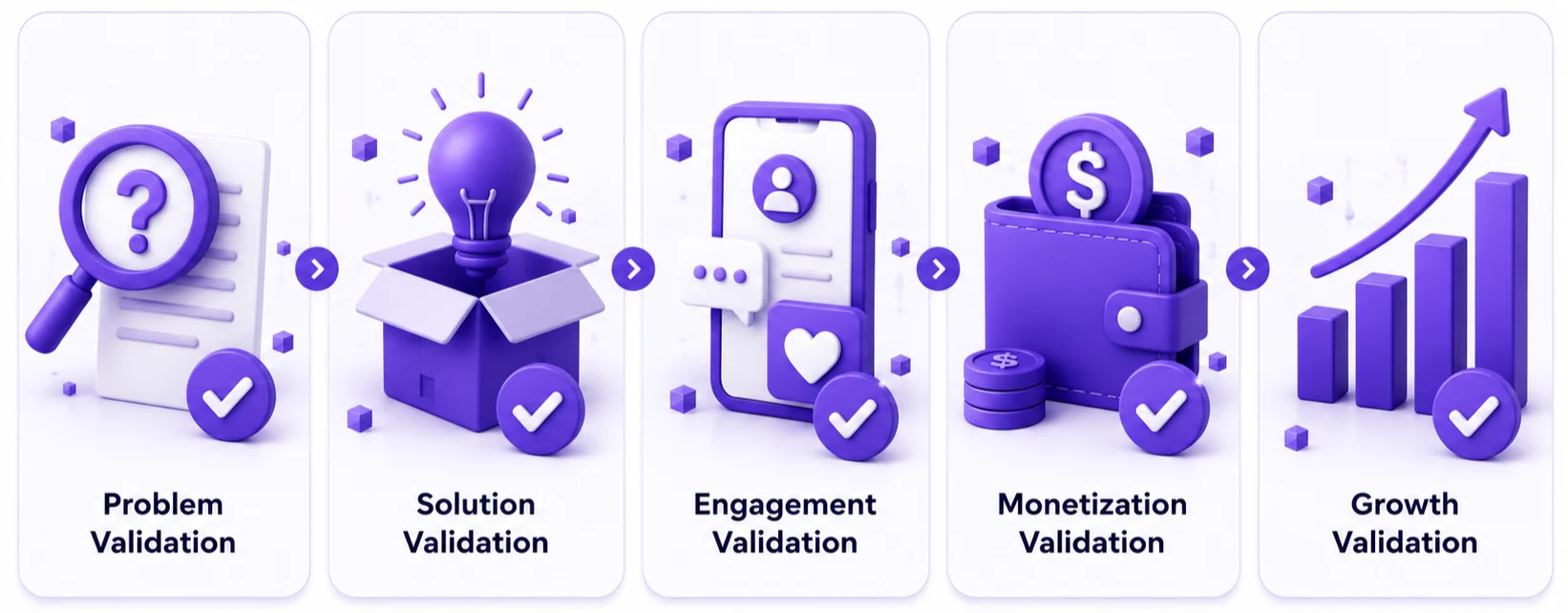
Typical validation gates include:
Problem Validation
Problem validation confirms whether the issue your product aims to solve is genuine, frequent, and significant enough for users to seek a solution. By collecting feedback through interviews, surveys, and early testing, businesses can determine whether they’re addressing a real market need instead of relying on assumptions. This reduces the risk of building a product that solves a problem customers don’t actually have
Solution Validation
Solution validation measures whether users can successfully accomplish their goals using the MVP. It evaluates usability, functionality, and overall customer satisfaction to determine if the product effectively solves the identified problem. User testing, feature adoption, and direct feedback help businesses identify improvements before investing in full-scale development, ensuring the final product delivers meaningful value.
Engagement Validation
Engagement validation focuses on how users interact with the product over time. Metrics such as daily or weekly active users, session duration, feature usage, and retention rates reveal whether customers find the product valuable enough to return. Strong engagement indicates that the MVP meets user expectations and provides lasting value beyond the initial experience.
Monetization Validation
Monetization validation determines whether users are willing to pay for the product through subscriptions, one-time purchases, premium features, or other revenue models. Testing pricing strategies and analyzing customer purchasing behavior helps businesses validate their business model early. This ensures the product has commercial potential before significant investments are made in scaling and expansion.
Growth Validation
Growth validation assesses whether the product can acquire new users efficiently and scale sustainably. Indicators such as referral rates, positive reviews, customer recommendations, and organic user growth demonstrate strong product-market fit. When satisfied customers naturally promote the product, businesses gain confidence that their MVP has the foundation for long-term growth and reduced customer acquisition costs.
If a validation gate is not met, the goal is not necessarily to abandon the product. Instead, teams should identify what assumptions failed and determine how to improve future iterations.
Avoiding Validation Theater
One of the biggest dangers in MVP development is validation theatre, the illusion of progress without meaningful evidence.
Validation theater occurs when founders focus on metrics that appear impressive but fail to demonstrate actual market demand.
Common examples include:
- High website traffic but low user retention
- Large waitlists with little product engagement
- Social media popularity without conversions
- Downloads that do not translate into active users
- Positive feedback from friends and family instead of target customers
True validation requires users to take actions that involve commitment. These actions may include signing up, returning regularly, completing key workflows, making purchases, or recommending the product to others.
To avoid validation theater:
- Define success metrics before launch
- Focus on behavioral data rather than opinions
- Track retention alongside acquisition
- Measure outcomes, not activity
- Test willingness to pay as early as possible
The purpose of an MVP is not to prove that your idea is good. It is to discover whether the market agrees. The more honestly you evaluate user behavior, the faster you can make informed decisions and move closer to achieving product-market fit.
In-House vs. Freelancers vs. MVP Development Company: Which is Right for You?
Once you’ve validated your idea and defined your MVP scope, the next major decision is determining who will build it. The right development approach can significantly influence your project’s timeline, budget, product quality, and long-term success.
Most businesses choose one of three options: building with an in-house team, hiring freelancers, or partnering with an MVP development company. Each approach has distinct advantages and trade-offs.
An in-house team offers the highest level of control and alignment with business objectives. Team members work closely together, communication is often smoother, and product knowledge remains within the organization. However, recruiting developers, designers, product managers, and QA specialists can be time-consuming and expensive, making this option less practical for many early-stage startups.
Freelancers can provide flexibility and lower upfront costs. They are often suitable for smaller projects, prototypes, or businesses with clearly defined requirements. However, managing multiple freelancers requires strong coordination, and quality can vary significantly depending on experience and availability.
An MVP development company provides access to a cross-functional team that typically includes product strategists, UI/UX designers, developers, QA engineers, and project managers. This approach can reduce management overhead while accelerating development through established processes and specialized expertise.
The best option depends on factors such as budget, internal capabilities, timeline expectations, product complexity, and growth goals. Businesses seeking rapid validation often benefit from experienced MVP partners who have successfully launched similar products before.
10 Questions to Ask an MVP Development Partner
Before selecting a development partner, evaluate them beyond pricing and technical skills. The right partner should understand product validation as well as software development.
Consider asking:
- Have you built MVPs similar to our product category?
- How do you approach the product discovery phase and evaluate the validation strategy?
- What is your process for feature prioritization?
- How do you estimate timelines and costs?
- Which technologies do you recommend and why?
- How do you manage communication and project updates?
- What happens if requirements change during development?
- How do you handle testing and quality assurance?
- Can you share relevant case studies or success stories?
- What post-launch support do you provide?
The answers can reveal whether a company is focused solely on development or truly understands how to build products that achieve market validation.
7 MVP Mistakes That Kill Startups
Building an MVP is intended to reduce risk, but many startups unintentionally undermine the process through poor decisions, unrealistic assumptions, and flawed execution. In fact, some of the most common startup failures can be traced back to mistakes made during the MVP stage.
Understanding these pitfalls can help founders avoid wasted investment, accelerate learning, and increase the likelihood of building a product that users genuinely want.
1. Building Too Many Features
One of the most frequent MVP mistakes is trying to create a miniature version of the final product. Founders often add extra features because they believe more functionality will attract more users.
In reality, feature overload increases development time, raises costs, and makes it harder to identify what users actually value. A successful MVP focuses on solving one core problem exceptionally well.
2. Skipping Customer Validation
Many teams begin development before speaking to potential users. They assume they understand customer needs and invest heavily in building a solution without confirming whether the problem truly exists.
Without customer interviews, market research, and early validation, businesses risk creating products based on assumptions rather than evidence.
3. Targeting Everyone
A product designed for everyone typically resonates with no one.
Early-stage startups need a clearly defined audience that shares similar problems, goals, and behaviors. A focused target market produces more actionable feedback and improves the likelihood of finding product-market fit.
Starting narrow often creates stronger traction than pursuing a broad audience from day one.
4. Measuring the Wrong Metrics
Downloads, page views, impressions, and social media engagement can be useful indicators of awareness, but they rarely prove product success.
The metrics that matter most typically include:
- User retention
- Activation rates
- Customer engagement
- Conversion rates
- Revenue generation
- Referral activity
Meaningful business metrics provide valuable insights for product growth while also strengthening investor confidence. Understanding the 15 mistakes startups make when pitching to investors can help founders present these metrics more effectively during fundraising.
5. Ignoring User Feedback
Some founders become emotionally attached to their original vision and resist changing direction when users provide contradictory feedback.
An MVP is designed to challenge assumptions. If customers consistently identify pain points, request different solutions, or fail to engage with certain features, those signals should influence future decisions.
Listening to users is often more valuable than defending initial assumptions.
6. Delaying the Launch
Perfectionism is one of the biggest threats to MVP success.
Many startups spend months refining designs, adding features, and polishing functionality before releasing the product. As a result, they delay valuable learning opportunities and increase development costs.
An MVP should be launched when it is capable of delivering core value, not when every feature request has been implemented.
7. Treating the MVP as the Final Product
An MVP is an experiment, not a finished destination.
Some teams launch an MVP and expect immediate success without ongoing iteration. Others fail to establish processes for collecting feedback, analyzing data, and improving the product.
The most successful startups view the MVP as the beginning of a continuous learning cycle. They launch, measure, learn, and adapt based on real-world evidence.
Avoiding these seven mistakes will not guarantee success, but it will dramatically improve your chances of making informed product decisions. The purpose of an MVP is not to prove you’re right; it’s to discover what the market actually wants before investing heavily in growth and scale.
After the MVP: Path to Product-Market Fit
Launching an MVP is a significant milestone, but it is not the ultimate goal. The real objective is achieving product-market fit, the point at which a product consistently satisfies a market need and demonstrates sustainable demand.
Many founders mistakenly view MVP completion as the end of the development journey. In reality, the most important work begins after launch. User feedback, behavioral data, retention metrics, and customer insights gathered from the MVP should guide every future decision.
The transition from MVP to a scalable product requires disciplined iteration, continuous learning, and a willingness to adapt based on evidence rather than assumptions. As businesses grow, many invest in product scaling and optimization services to improve performance, enhance user experiences, and support sustainable product growth.
Businesses that successfully reach product-market fit rarely follow a perfectly linear path. Instead, they evolve through multiple rounds of experimentation and refinement.
The key question after launch becomes: What should you do next?
MVP to MMP to v1.0: When to Graduate
A common product evolution path follows three stages:
MVP (Minimum Viable Product)
The MVP exists primarily to validate assumptions and test market demand. It focuses on delivering the smallest amount of functionality required to generate meaningful learning.
MMP (Minimum Marketable Product)
Once the MVP demonstrates promising signals, businesses often expand into an MMP. At this stage, the product includes additional features, usability improvements, and refinements that make it suitable for broader market adoption.
The focus shifts from validation to growth.
Version 1.0
A mature Version 1.0 typically includes stronger infrastructure, enhanced scalability, improved security, polished user experiences, and a more comprehensive feature set.
Businesses should consider graduating from MVP to MMP when they observe indicators such as:
- Consistent user engagement
- Strong retention rates
- Positive customer feedback
- Growing demand
- Early revenue traction
- Repeat usage patterns
Scaling too early can be risky. Validation should precede expansion whenever possible.
Refactor or Rebuild?
As products evolve, teams often face a difficult decision: should the existing codebase be improved, or is it better to rebuild from scratch?
The answer depends on the quality of the MVP architecture and future business requirements.
Refactoring is typically appropriate when:
- The foundation remains stable
- Performance issues are manageable
- New features can be added efficiently
- Technical debt is under control
A complete rebuild may become necessary when:
- The MVP was intentionally created as a temporary solution
- Scalability limitations prevent growth
- Security concerns require architectural changes
- New business requirements fundamentally alter the product
In most cases, gradual refactoring is less risky and more cost-effective than a complete rebuild. Nevertheless, every situation should be evaluated based on technical and business realities.
Pivot, Persevere, or Kill
Perhaps the most important post-MVP decision involves determining whether to continue on the current path.
Businesses generally face three options:
Persevere
Continue improving the product when validation metrics indicate strong market demand and growing user engagement.
Pivot
Adjust the product, audience, business model, or positioning when feedback reveals a better opportunity than the original concept.
Many successful startups achieved product-market fit only after one or more strategic pivots.
Kill
In some cases, the evidence may show that the problem is not significant enough, demand is insufficient, or customer acquisition is unsustainable. While difficult, ending a project early can save substantial time and resources.
The purpose of MVP development is not to force an idea into existence. It is to gather enough evidence to make confident decisions.
Ultimately, product-market fit is achieved through continuous experimentation, learning, and adaptation. The businesses that succeed are not necessarily the ones with the best initial ideas; they are the ones that respond most effectively to what the market teaches them.
Conclusion
Building a successful product is not about launching with the most features; it’s about solving the right problem for the right users. A Minimum Viable Product provides a structured way to validate ideas, reduce development risk, and make product decisions based on real-world evidence rather than assumptions.
Whether you’re a startup founder testing a new business concept, an entrepreneur entering a competitive market, or an enterprise exploring digital innovation, the MVP approach allows you to learn faster, invest smarter, and adapt more effectively. From identifying customer pain points and prioritizing essential features to validating demand and achieving product-market fit, every stage of the MVP journey is focused on minimizing uncertainty.
The most successful products rarely emerge fully formed. They evolve through continuous experimentation, user feedback, and iteration. By starting small, measuring what matters, and responding to market insights, businesses can avoid costly mistakes and build solutions that genuinely resonate with users.
If you’re looking for inspiration before building your own product, explore these successful examples of MVP development for startups to see how leading companies validated their ideas, refined their products, and scaled into successful businesses. Learning from proven MVP journeys can help you make smarter product decisions and avoid common development pitfalls.
FAQs
1. What is the main purpose of an MVP?
The primary purpose of a Minimum Viable Product is to validate business assumptions with the least amount of time, effort, and investment. Instead of building a fully featured product, businesses launch a simplified version to gather user feedback, measure demand, and determine whether the idea has market potential before scaling.
2. How is an MVP different from a prototype?
A prototype is primarily used to visualize concepts, user flows, and designs before development. It is usually not released to real users. An MVP, on the other hand, is a functional product with working features that allows businesses to test market demand, user behavior, and product viability in real-world conditions.
3. How long does it take to build an MVP?
The timeline depends on product complexity and feature scope. A simple MVP can often be developed within 4–8 weeks, while moderate projects may take 2–4 months. More advanced MVPs involving AI, complex integrations, or enterprise-level functionality can require six months or longer.
4. How much does MVP development cost?
MVP development costs vary based on complexity, technology requirements, team structure, and geographic location. In general, businesses can expect costs to range from $10,000 for simple MVPs to $200,000 or more for advanced products with sophisticated functionality, integrations, and scalability requirements. Furthermore, larger and more complex products typically require higher investments.
5. Can I build an MVP without coding?
Yes. No-code and low-code platforms allow founders to build and test certain product ideas without extensive programming knowledge. These tools can be effective for validating demand and gathering early feedback. However, products requiring advanced functionality, scalability, or customization may eventually require custom development.
6. What features should be included in an MVP?
An MVP should include only the features required to solve the product’s core problem and deliver value to users. Any functionality that does not directly support the primary user journey should typically be postponed until after validation. The goal is to maximize learning, not feature count.
7. How do I know if my MVP is successful?
Success should be measured against predefined validation goals. Common indicators include user engagement, retention, customer feedback, conversion rates, revenue generation, and willingness to pay. A successful MVP provides clear evidence that users value the solution and that further investment is justified.
8. Should startups seek funding before or after building an MVP?
There is no universal rule. Some founders secure funding based on a strong idea, industry expertise, or market opportunity. However, many investors prefer to see evidence of validation through an MVP because it reduces uncertainty and ultimately demonstrates that customers are interested in the solution.
9. Can an MVP become the final product?
In some cases, yes. Many successful products evolve directly from their MVP foundations through continuous improvements and feature additions. Eventually, teams often need to enhance scalability, performance, security, and user experience to support larger audiences and business goals.
10.What happens after launching an MVP?
After launch, businesses should focus on collecting feedback, analyzing user behavior, measuring key metrics, and identifying opportunities for improvement. Based on the results, teams may choose to expand features, refine positioning, pivot to a new direction, or prepare the product for broader market growth and product-market fit.
SHARE
WRITTEN BY

Ishan Gupta
CEO & Founder
Ishan Gupta is a seasoned entrepreneur and CEO with extensive 8+ years of experience in business and mobile app development landscape. He believes that the right digital product allows companies to focus on what they do best, while technology handles the rest. With deep exposure to global markets, he understands what makes an app succeed. His approach translates business needs into clear product strategies, ensuring that every feature contributes to measurable ROI.
View All Articles



 India
India USA
USA Australia
 Canada
 UK
UK UAE
UAE