

You have spent months building a validated idea. You have assembled a trained team, and you even landed your first users. But here is the harsh moment that most founders don’t see coming: your app becomes the product. And if it frustrates users, confuses them, or simply doesn’t feel secure enough, they will leave and abandon it.
Nearly 88% of users abandon an app after a single poor experience. They don’t send feedback; instead, they just disappear. This is the reality of millions of apps that are competing for the same attention, same user loyalty, and same screen time. This is where a custom-built app comes as a game-changing app solution.
Instead of forcing innovation to fit within pre-built limitations, a custom app enables startups to architect their product around their business model, data strategy, and growth roadmap from day one. By leveraging a strategic custom mobile app process, startups can design a platform that evolves with user expectations, emerging technologies, and market expansion.
In this guide, we explore why custom app development has become a critical growth enabler for startups. You will learn about the strategic benefits, cost considerations, essential features, development lifecycle, and real-world examples that demonstrate how building a custom app can create a strong foundation for long-term scalability and competitive advantage.
Key Takeaways
- Custom app development allows startups to build scalable, secure products aligned with their unique business models and growth plans.
- Unlike ready-made solutions, custom apps provide full ownership, deeper integrations, and flexibility to evolve with market demands.
- A well-built custom app improves user experience, strengthens security, and helps startups differentiate in highly competitive markets.
- Startups can validate ideas faster with MVP development while building a scalable architecture for future features.
- Investing in custom app development creates a strong technological foundation that supports long-term growth, innovation, and competitive advantage.
Table of Contents
What is a Custom Mobile App?
A custom mobile app is built from the ground up to cater specifically to your business goals, workflows, and user needs. Unlike off-the-shelf solutions that offer a one-size-fits-all structure with rigidity to adapt to future business needs, custom apps are designed from scratch while keeping in mind the future scalability needs. Partnering with a trusted product development company helps businesses create scalable and future-ready digital solutions. They reflect your brand identity, solve your unique challenges, and scale alongside your business.
With a custom app, you own the user journey. You decide how features interact, how data flows, what the UI feels like, and how your app responds to future growth. It is also worth understanding where the current custom app development industry stands today, with the rise of AI-assisted development and low-code app development platforms.
Many founders assume they can “customise” a white-label solution enough to make it work, but in reality, things are different. Your product requires unique logic, deep integrations, and an enhanced yet “differentiated” user experience that competitors can’t realistically replicate. This is where custom app development is in need. Whether you’re launching a customer-facing ecommerce app or an internal operations platform, custom mobile apps empower you with a competitive edge in both functionality and experience.
Ready-Made App Solutions V/S Developing Apps from Scratch
Here, we have given a comparison between the ready-made solution and developing apps from scratch to give you a better idea :
| Criteria | Ready-Made App Solutions | Developing Apps from Scratch |
| Time to Launch | As the app is pre-built, it is quick to launch | As the app is built from scratch, longer development time |
| Scalability | Difficult to scale and doesn’t support growth in the future | Highly scalable, allowing seamless upgrades as the business grows |
| Security | Includes basic and standard security features | Includes advanced security protocols |
| Cost | Lower custom app development cost | Higher initial investment |
| Customization | Limited customization and predefined templates | Fully customizable and built as per project needs |
| Flexibility | Rigid structure and limited ability to add features | High flexibility allows the addition of features |
| Integration with Other Systems | Difficult to integrate with existing systems | Easy to integrate with existing systems |
| Unique Features | Generic features common for all businesses | Unique features designed for your project |
| User Experience (UX) | Generic user experience | Optimised user experience |
| Long-term Viability | May need frequent updates | Long-lasting solution that keeps evolving |
| Ownership and Control | Limited control over the app, often owned by the platform provider | Full ownership and control over app features, data, and other updates |
| Support and Maintenance | Standard support provided by the platform solution provider | Dedicated, ongoing support and maintenance tailored to the app |
So, now you can differentiate between custom apps and white-label apps to make a better decision for your business. At first glance, ready-made solutions can be a faster and more cost-effective option.
This is because when you want to have a pre-built platform, it will be easy to launch quickly. However, the challenge is that it includes only some limited customisation or generic features and doesn’t adapt to the changing business needs.
Therefore, if you want your app to serve your unique business model, then a custom app development approach is most suitable for you. Also, ready-made apps come with some scalability challenges and prevent your startup from standing out in the market.
Whereas custom mobile application development allows you to create a more secure and scalable solution, aligning with your unique vision and long-term goals.
When you build an app from scratch, the upfront custom mobile app development cost may be higher, but it will result in enhanced user experience and seamless integration of tools with your system.
Major Benefits of Investing in Custom App Development Solutions for Startups
Custom apps give startups the control, creativity, and confidence to build something truly user-first. It’s not the cheapest path, but it’s the smartest if your goal is to build long-term value. Because in a market full of clones, custom apps let startups build what actually matters, a product shaped around real user needs, not just what a template allows.
So, below we have highlighted the main reasons why custom app development is best for startups.
1. Give Your Users Exactly What They Need
The objective of every startup is unique, and a custom app reflects that. When you develop a custom app, you can design various functionalities specially addressed to your users’ needs.
Let’s take an example, if your business needs to have a unique workflow or you are looking forward to having exclusive features, then a pre-made app will not help you much.
In this case, the custom app development approach gives you the flexibility to incorporate tailored features that streamline several processes. You can design your app as per the unique requirements of your startup.
This approach will also help you to provide a seamless experience to your users. If you are still confused about “how to build a custom app” that your users need, then you can have a look at the custom app development guide to get complete information.
2. Overcome Bottlenecks For Long-term Success
Most of the startups are running to scale, and so should your mobile app. The ready-made app solutions might be helpful for the initial stage, but don’t ensure growth in the long run. They can become bottlenecks and may not help to attract more targeted users.
On the other hand, custom mobile application development always ensures the success of your application. The best part is that you are free to update and incorporate advanced features as per your project specifications. Therefore, custom app development can boost your business by offering long-term solutions, so that your app can evolve as per the needs of your users.
3. Integrate Emerging Tools With Your Existing System
If you are running a startup, you need to invest in various tools and technologies to effectively manage all aspects of your business. From CRMs to payment gateways or analytics software, you need to incorporate emerging technologies to get useful insights.
Ready-made applications do not allow you to seamlessly integrate tools and technologies with your systems. However, with a custom app integration, your app can have better integration capabilities as it will be built from scratch to work smoothly with your existing tools.
This leads to better results and increased efficiency. Also, there will be fewer manual processes and more streamlined business operations, so that you can focus on other core tasks. Hence, here it would be better to collaborate with an elite mobile app development company in USA, especially when you are based in this country. The app development companies here will help you to seamlessly integrate the latest technologies into your app.
4. Make Your App More Secure Than Ever
Data security is one of the biggest concerns for any startup handling user information, and it’s only gotten more critical with the rise of regulations like GDPR, CCPA, and SOC 2 compliance requirements. Off-the-shelf apps offer standardised security measures that are designed for everyone, which means they’re truly optimised for no one.
With a custom app, you define the security architecture. That means choosing the right encryption standards, controlling how data is stored and accessed, building role-based permissions, and ensuring compliance with the regulations relevant to your industry. For startups in fintech, healthcare, or e-commerce where a single breach can be brand-ending, this level of control isn’t optional. It’s essential.
5. Grab Your User’s Attention With Appealing UI/UX Design
As per the industrial reports by Ecommercebonsai, around 88% of online consumers are less likely to return to your app after having a bad experience. Startups need to pay close attention to improving the user experience of their app to ensure success and to build a loyal customer base.
With custom mobile app development, you can easily tailor the app according to your users. Moreover, you can also incorporate advanced features based on their pain points and feedback.
This will make your app more effective and user-friendly. Here, a well-recognised UI UX design agency can understand your project and help you enhance the overall user experience of your app.
6. Future-Proof Solution To Evolve With Market Needs
Every startup owner needs to build an engaging app that can evolve with the changing market scenarios. When you develop a custom app, it offers you the flexibility to make necessary enhancements and updates in the future.
Therefore, your startup can easily adapt to new emerging custom app development trends, technologies, and user demands. So, mobile app custom development is the best future-proof approach that ensures your long-term viability and minimises overall risk.
Key Features Every Scalable Custom App Should Have
Building a custom app is only the first step. Because the real struggle is in building one that can scale, evolve, and compete in the targeted market in the long run. Startups that win here design their apps with core features and keep in mind the growth rate, security challenges, and data adaptability from day one.
Here are the top 5 essential features that every scalable custom app should integrate:
1. Scalable Architecture
Your custom app should include a scalable mobile app architecture that ensures that growth is inevitable and the app can handle it without any performance issues. For this to happen, your app should be built using a cloud-native and modular architecture so that new features can be added without affecting the entire system.
If you are wondering why this feature matters for startups, it ensures your app can support rapid user growth without downtime, reduces long-term technical debt, and allows faster feature releases as your product evolves.
2. Advanced Security Framework
Your custom app should treat security as one of the core features and should leverage an advanced security framework setup. Startups today are expected to protect the user data, thus adhering to regulations like HIPAA, GDPR, SOC2, etc.
This is a core and important feature to add on, as over 80% of users quickly abandon a platform if a data breach happens. By building your app with end-to-end encryption, secure authentication, role-based access, and compliance-ready architecture, you create a foundation that protects both your users and your brand. For your app, this means fewer risks, easier enterprise partnerships, and stronger investor confidence.
3. User Behaviour Analytics
Your app should be designed to learn from every user interaction, instead of creating a guesswork of what features people want. Modern startups allow their product to evolve based on the current user behaviour and future market needs to remain competitive.
This is a crucial feature as even a small improvement in your mobile app design can significantly enhance your retention and conversion rates. By tracking engagement, drop-off points, and feature usage, your app can continuously improve the user journey and prioritise the right updates.
4. Automation and AI
Your app should be ready to incorporate intelligent automation and AI as your product matures. Users increasingly expect personalised experiences, smart recommendations, and instant support as standard features.
Designing your app with AI readiness from the beginning allows you to introduce intelligent features such as personalised content, automated workflows, and AI chat support without needing a major rebuild later. This future-ready approach ensures your app can stay competitive as user expectations evolve and technology advances.
5. Seamless Integrations
Your app should never operate in isolation. Startups depend on a wide ecosystem of tools for payments, marketing, analytics, and operations, and seamless integrations allow your app to become the central hub connecting them all.
By enabling smooth integrations with CRMs, payment gateways, marketing platforms, and third-party APIs, your app reduces manual work and improves operational efficiency. This creates a connected digital ecosystem where data flows effortlessly, helping your startup scale faster and operate smarter.
How to Build a Modern Custom App for Your Startup
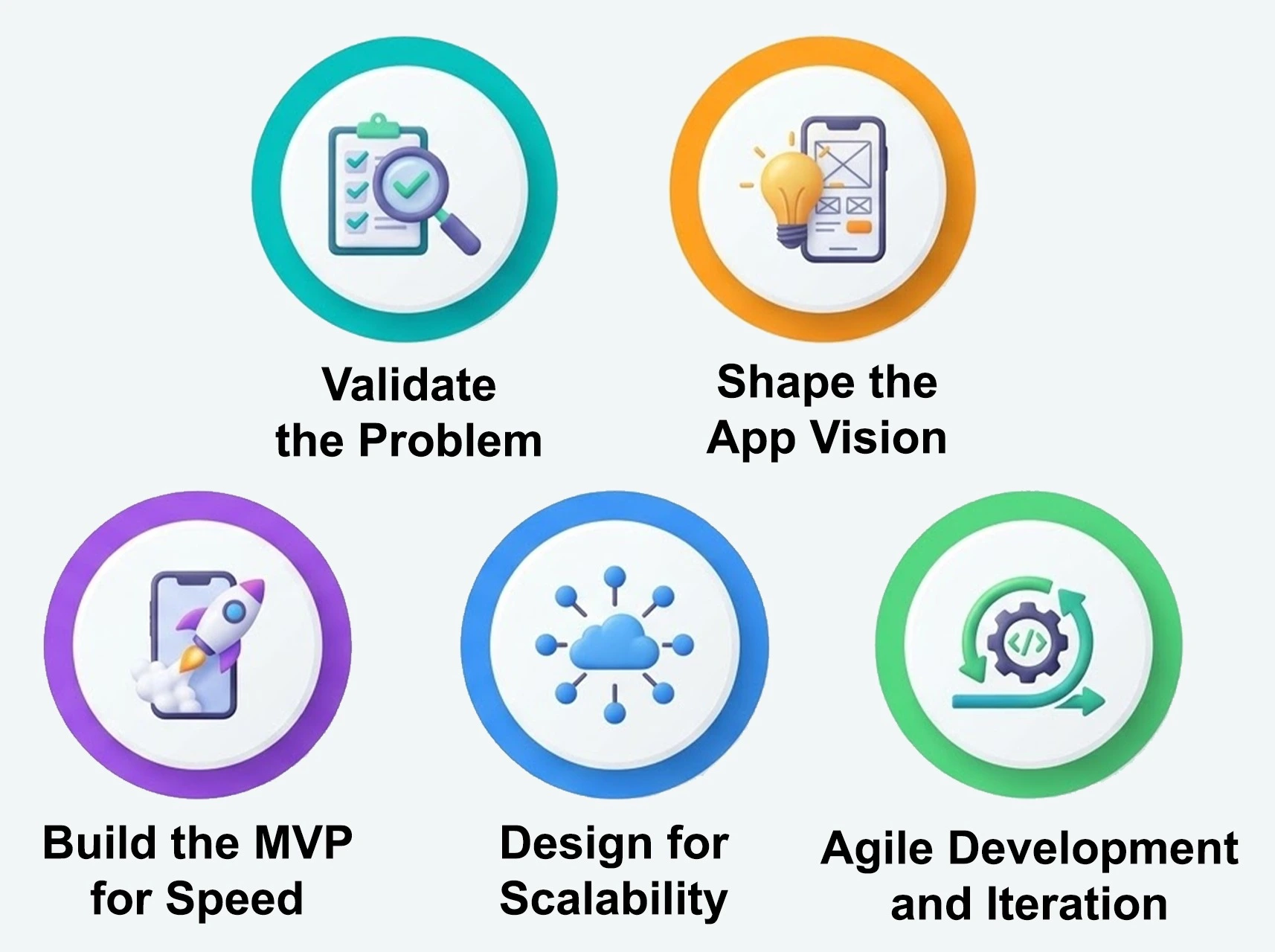
Your custom app development process can’t be a linear checklist that ends at launch. It needs to be a continuous product journey that evolves through validation, iteration, and ongoing improvement as your startup grows. Because it is a journey from idea and validation to product and growth engine.
1. Validate the Problem
Most failed custom apps have a common thing: they were built around an idea instead of a real user problem. Successful startups begin by deeply understanding the people they want to serve.
At this stage, your focus should be on understanding the user needs, identifying gaps that competitors haven’t solved well, and thus testing early concepts before the commitment to build the app.
2. Shape the App Vision
Once the problem is validated, the next step is to shape your custom app’s vision. This is where your startup defines what makes your app worth using and why it deserves a place in a user’s daily routine.
Your main focus should be on the type of experience you want your users to have, the core outcome your app delivers, and the real reason behind your users choosing your app over alternatives.
3. Build the MVP for Speed
After the correct shaping of the app vision step, the next step involves the process of developing and launching an MVP version that delivers real business value quickly. Speed to market is one of the biggest competitive advantages a startup can have.
Your MVP should focus only on the core features required to solve the primary user problem. This first version should be simple, stable, and easy to use, while also collecting early user feedback and behavioural data. This early launching allows your startups to learn faster and validate assumptions instead of relying on any sort of guesswork.
4. Design for Scalability
As your user base grows, your app must be able to grow with it. If you are planning for app scalability, you should ensure your product can handle increased demand without performance issues or costly rebuilds.
At this stage, your complete focus should be on building a flexible app architecture that can support increasing traffic, new integrations, and additional features. A scalable app foundation ensures that your app remains fast, reliable, and adaptable enough. This will help you grow and expand your app, thus making it fully aligned with the future needs.
5. Agile Development and Iteration
Launching your app is only the beginning of the journey. The real advantage of custom app development lies in the ability to continuously improve and refine your product over time. After launch, your team should regularly analyse user behaviour, release updates in smaller cycles, and experiment with new ideas based on feedback and data.
This ongoing iteration helps your app stay relevant, competitive, and aligned with changing user expectations. Successful apps are never truly finished; they evolve continuously alongside their users and the market.
The Total Cost of Custom App Development for Startups
Let’s be real, startup budgets are tight. Every dollar matters and has to earn its place, and when it comes to developing a custom mobile app, it’s not just about “how much it costs,” but whether it’s worth the investment at this stage and “what kind of return can this investment deliver?”
On average, the cost of developing a custom mobile app for startups ranges from $20,000 to $80,000+, depending on what you’re building, how complex the features are, your choice of platform (iOS, Android, or both), and whether you’re hiring a local team or outsourcing your project from a top custom app development company.
However, to give a clear vision, here we have given a table breakdown on the overall estimated cost of custom app development for startups:
| App Type | Features | Estimated Cost |
| MVP (Minimal Viable Product) | Basic features, limited UI, launch-ready core | $20,000 to $40,000 |
| Mid-Level Custom App | User accounts, real-time data sync, 3rd-party integrations | $40,000 to $60,000 |
| Enterprise-Grade Custom App | Rich UI/UX, payment systems, admin panel, custom backend | $60,000 to $80,000+ |
Always keep in mind that the cost is also shaped by factors like the experience level of your development team, the depth of UI/UX design, backend infrastructure requirements, and post-launch maintenance. A cheaper build upfront can often mean higher costs down the line if scalability wasn’t planned from the start.
Real-World Examples of Startups Winning with a Custom App Development Approach
1. Notion
Notion didn’t just build another productivity app. They built an entirely new category of tool from scratch, one that combined notes, databases, wikis, and project management into a single flexible workspace. That level of originality simply wasn’t possible with a ready-made solution.
What made it custom-built:
- Custom Block System: Notion built a fully flexible content block architecture that no existing platform offered, giving users the freedom to structure their workspace however they wanted.
- Workflow Flexibility: Rather than forcing users into predefined templates, the app was designed to adapt around each user’s unique way of working.
- Scalable Feature Growth: New features were added progressively without ever making the core experience feel cluttered or overwhelming.
Result:
A product so uniquely useful that it grew primarily through word of mouth, evolving from a small startup into a multi-billion-dollar company without ever feeling like “just another template tool.”
2. Duolingo
Duolingo had a mission that no off-the-shelf EdTech platform could support, which was to build an adaptive learning engine that personalises every lesson in real time based on how each individual user learns.
What made it custom-built:
- Spaced Repetition Engine: A custom-built system that adjusts lesson difficulty based on each user’s individual retention patterns, not a one-size-fits-all curriculum.
- Integrated Gamification: Game mechanics were built directly into the learning logic rather than simply layered on top, making progress feel genuinely rewarding.
- AI-Driven Personalisation: The app continuously evolves with each user’s pace, habits, and performance to deliver a truly personal learning path.
- Multilingual Architecture: A seamless content system built to handle dozens of languages without compromising the experience for any of them.
Result:
Today, Duolingo is the world’s most downloaded education app. That outcome was only possible because the product was engineered around a unique vision from day one, not squeezed into someone else’s framework.
3. Loom
Loom spotted a very specific gap in how teams communicate asynchronously and built a custom app designed entirely around solving that one problem well. Rather than adapting an existing screen recording tool, they built their own infrastructure from the ground up.
What made it custom-built:
- Instant Recording: Near-zero processing delay meant users could record and share without any friction slowing them down.
- Automatic Link Sharing: Every recording instantly generated a shareable link, removing the need for file downloads or uploads entirely.
- Viewer Analytics: Senders could see exactly who watched their video, when, and for how long, adding a layer of accountability to async communication.
- Distraction-Free Interface: The entire UI was purpose-built for async workflows, keeping the focus entirely on the message being shared.
Result:
Loom grew rapidly across remote and hybrid teams and was eventually acquired by Atlassian, proof of the value of a sharply executed custom product.
4. Figma
Figma made one of the boldest technical bets in recent startup history. At a time when every serious design tool was desktop-only, they decided to build a fully browser-based design platform from scratch.
What made it custom-built:
- Browser-Based Rendering: Figma custom-engineered its own rendering technology to process complex vector graphics live in a browser, something no existing solution was capable of.
- Real-Time Collaboration: A multiplayer engine was built into the core architecture from the start, allowing multiple designers to work on the same file simultaneously.
- Native-Level Performance: The app was optimised so thoroughly that working in a browser felt just as fast and responsive as any desktop application.
Result:
Figma completely reshaped how design teams collaborate and led to Adobe’s reported $20B acquisition offer.
5. Calm
Calm entered the mental wellness space before it was a proven market and built its entire product around one goal: making users feel at peace the moment they open the app. Achieving that required custom development at every layer.
What made it custom-built:
- Ambient Sound Engine: A fully custom audio system designed specifically for relaxation and focus, far beyond what any standard media player could deliver.
- Personalised Meditation Pathways: The app adapts its recommendations based on each user’s stated goals, habits, and progress over time.
- Sleep Story Architecture: A purpose-built content system designed to guide users naturally and gently into rest through narration and sound.
- Breathing Exercise Tools: Visual and audio cues were carefully engineered together to create a genuinely calming, synchronised experience.
Result:
Calm’s custom-built approach allowed it to keep evolving its content and features based on real user behavior, helping it grow into one of the highest-grossing health apps in the world and a brand genuinely trusted by millions.
Wrapping Up
For every startup who are looking forward to leading the industry, customer app development is one of the best strategic approaches. Indeed, ready-made app solutions are popular for short-term convenience, but they do come with limited features, flexibility, and growth. Therefore, a custom app is considered ideal for startup businesses as it offers more tailored features, scalability, and security.
So, if you are a startup, you can connect with a leading and reputable custom mobile app development company to create a unique and scalable app that perfectly aligns with your business model. They will help you in the best possible way to take your startup business to new heights.
FAQs
Q1. Why should startups choose a custom app development approach?
Because startups are often solving very specific problems, and generic templates don’t cut it. It’s an investment that sets you up for flexibility, funding, and faster user adoption. Custom development helps you:
- Design around real user pain points
- Add only the features that matter (reducing clutter)
- Build for scalability from day one
- Differentiate your brand visually and functionally
Q2. How much does it cost to start up an app development?
Realistically, a basic MVP (Minimum Viable Product) for a startup using custom app development ranges from $20,000 to $60,000—depending on complexity, platform (iOS, Android, both), and development team (agency vs freelancer vs in-house). More complex apps with integrations, dashboards, or AI features can go beyond $100,000+. But if done right, it’s not just a cost—it’s the foundation of your business model.
Q3. How long does custom app development take for a startup?
Typically, 8 to 20 weeks.
- A simple MVP can be built in 2–3 months
- A full-featured, scalable app may take 4–6 months or more
However, the timeline depends on features, UI/UX design, backend complexity, integrations, and testing. Agile methods can help roll out faster and iterate along the way.
Q4. What industries benefit most from custom app development for startups?
Almost every industry, but particularly:
- Fintech (where security, compliance, and UX are critical)
- Healthcare (needs HIPAA/GDPR-safe, tailored workflows)
- E-commerce (custom shopping flows, payments, logistics)
- EdTech & eLearning (user-driven content, gamification)
- SaaS platforms (custom dashboards, subscriptions, analytics)
If your startup aims to solve complex problems or monetize unique user flows, then custom is the way to go.
Q5. Should startups choose native or cross-platform app development?
For most startups, cross-platform development is a better starting point because it allows faster launch on both iOS and Android with lower costs. However, if your app requires high performance, complex features, or deep device integration, native development may be the better long-term choice.

SHARE
WRITTEN BY

Ishan Gupta
CEO & Founder
Ishan Gupta is a seasoned entrepreneur and CEO with extensive 8+ years of experience in business and mobile app development landscape. He believes that the right digital product allows companies to focus on what they do best, while technology handles the rest. With deep exposure to global markets, he understands what makes an app succeed. His approach translates business needs into clear product strategies, ensuring that every feature contributes to measurable ROI.
View All Articles



 India
India USA
USA Australia
 Canada
 UK
UK UAE
UAE