


Every business today is sitting on a goldmine of data, tools, and talent, but without the right infrastructure, none of it moves fast enough. Markets shift overnight, AI is reshaping entire industries, and customers expect seamless digital experiences as the bare minimum. The businesses pulling ahead are not necessarily the ones with the biggest budgets. They are the ones running on infrastructure that is fast, flexible, and built for scale. That infrastructure is the cloud.
Cloud computing has come a long way from being a smarter alternative to physical storage. In 2026, it is the engine behind AI deployment, real-time collaboration, global application delivery, and data-driven decision making. The global cloud market is on track to surpass $900 billion this year, and the growth shows no signs of slowing down. Businesses across healthcare, finance, logistics, retail, and technology are not just experimenting with the cloud anymore. They are building their entire operations on it.
Yet despite how far cloud adoption has come, many businesses still lack a clear understanding of how cloud infrastructure actually works, which model suits their needs, and how to make the right choice without overspending or overcomplicating their setup. Whether you are a startup evaluating your first cloud environment or an established enterprise looking to modernise legacy infrastructure, the decisions you make around cloud adoption will directly impact your speed, security, and ability to compete.
In this guide, we cover everything you need to make those decisions confidently, from what cloud computing is and how it works, to the different deployment types, service models, including the fast-rising AIaaS, real-world benefits, current pricing benchmarks, and a practical framework for choosing the right cloud solution for your business.
Key Takeaways
- Cloud adoption success depends less on tools and more on aligning infrastructure decisions with long-term business strategy.
- The competitive advantage of cloud lies in speed, enabling faster experimentation, deployment, and continuous innovation cycles.
- AI readiness is no longer optional, and cloud infrastructure has become the default gateway to scalable intelligence.
- Cost efficiency in the cloud is achieved through optimisation discipline, not just shifting from on-premise to pay-as-you-go models.
- Businesses that treat cloud as an ecosystem, not a tool, unlock higher scalability, resilience, and cross-functional integration.
Table of Contents
Understanding Cloud Computing: What It Is and How It Works
As a consumer, you must have used Google Drive or Office 365 for personal or professional use at some point. Even mobile apps like Netflix are great examples of cloud streaming. To define the cloud, we can refer to it as a practice of using remote servers to store, manage and process data instead of traditional computer storage. When the data is stored on a server, it can be accessed from anywhere at any point in time.
The global public cloud services market has grown exponentially over the past decade and is projected to surpass $900 Billion in revenues by 2026, with an annual growth rate consistently above 20%.
This rapid expansion is being further accelerated by the surge in AI workloads, as businesses increasingly rely on cloud infrastructure to train and deploy machine learning models at scale. You can imagine how fast businesses are actively trying to integrate cloud services into their ecosystem to achieve agility and flexibility.
Regarding the working of the cloud, organisations have to decentralise their network by converting it to a shared network. Hosting providers take the responsibility of maintaining cloud services. Some organisations sign a service package with mobile app development companies to look after the cloud services. Whatever hosting company you choose, they are further responsible for maintaining the safety and connection to data centres.
The most popular cloud service providers are Amazon Web Services, Microsoft Azure, and Google Cloud, collectively accounting for over 65% of the global cloud market. Teams in the organisation can work on multiple projects live from remote places. Managers can manage the projects, check progress, and communicate with their team members easily.
The Real Business Benefits of Cloud Computing in 2026
Enterprises leverage numerous benefits by using cloud computing. Here are the top benefits of using cloud computing in your infrastructure:
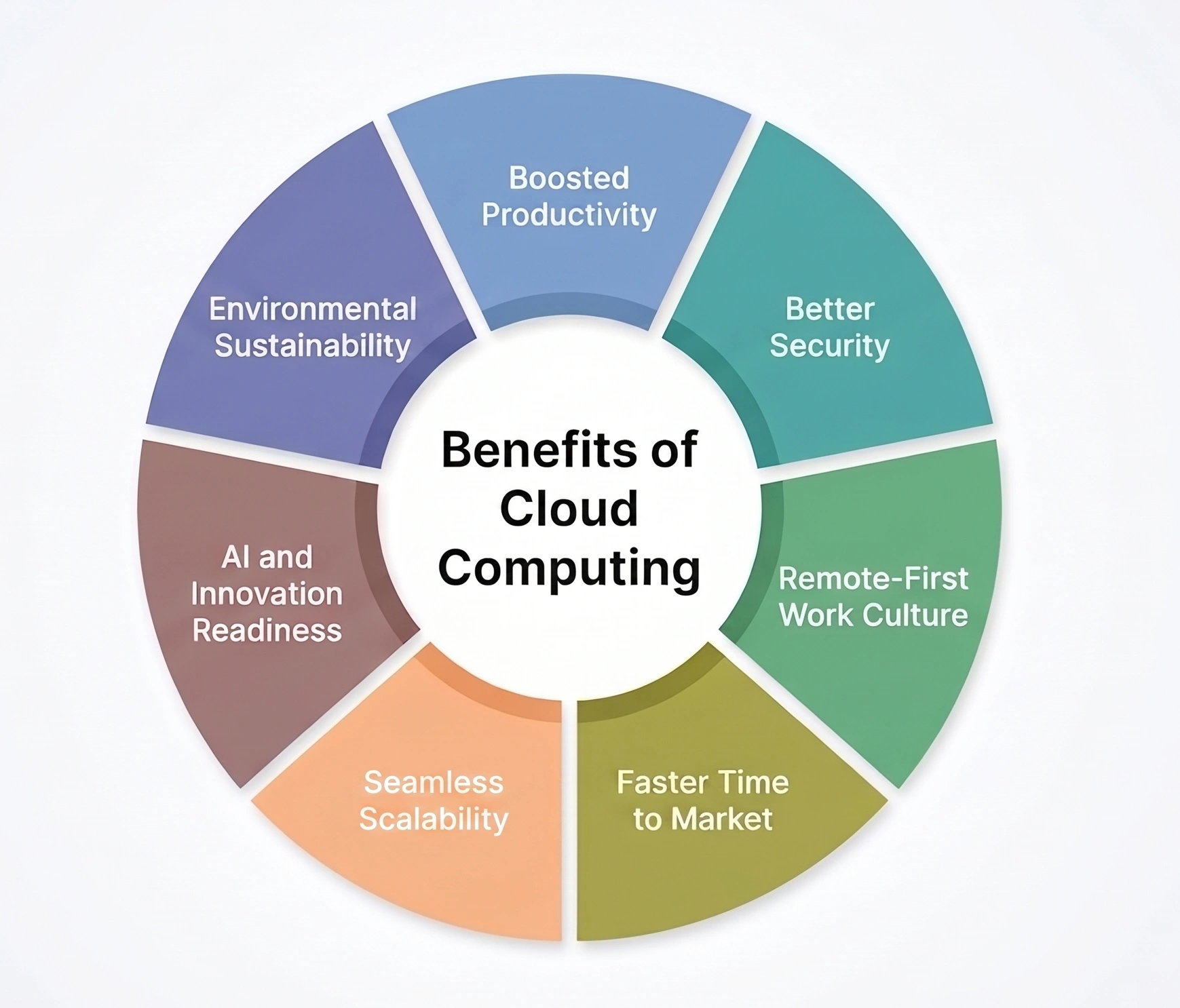
Boosted Productivity
What can be better than running an organization that runs on the cloud, where employees can work live on networks, watching live changes? Further, team leaders can better share the information with the team members and monitor it effectively. Altogether, it will no doubt boost the overall productivity of the organization.
Better Security
From no worries about disaster recovery to authorizing users to access information, cloud computing delivers a strong security model to enterprises. Enterprises do not have to worry about system crashes since everything stays on the web. A refresh is all you need to get back to work. Further, cloud service providers integrate strong security for data theft and unauthorized access.
Remote-First Work Culture
Who wants to work with specific hardware requirements? Digital transformation is making remote work possible, where the server’s hardware requirements are shared with the user’s computer through the web. It delivers a positive work culture.
Faster Time to Market
Speed is everything in today’s competitive digital landscape. Cloud computing allows businesses to provision resources instantly, spin up development environments in minutes, and deploy applications globally without waiting weeks for hardware setup.
For startups and enterprises alike, this means ideas move from concept to launch significantly faster than traditional infrastructure would ever allow. Businesses often collaborate with a cloud service provider to build scalable cloud-native applications aligned with global standards.
Seamless Scalability
One of the most powerful advantages of cloud infrastructure is the ability to scale up or down based on real-time demand. Whether a business is handling a sudden traffic spike during a product launch or scaling down during off-peak hours, cloud platforms adjust automatically. This elasticity ensures businesses only use what they need, when they need it, without over-investing in idle capacity.
AI and Innovation Readiness
By 2026, cloud infrastructure will have become the backbone of AI adoption. Businesses running on the cloud can instantly access AI tools, machine learning frameworks, and large language model APIs without building any underlying infrastructure themselves. This gives organizations of all sizes the ability to innovate rapidly, experiment with emerging technologies, and stay competitive in an AI-driven market.
Environmental Sustainability
Cloud computing contributes to greener business operations. Shared cloud infrastructure means fewer physical data centres, lower energy consumption per workload, and significantly reduced hardware waste. Major cloud providers like AWS, Google Cloud, and Microsoft Azure have committed to running on renewable energy, making the cloud a more environmentally responsible choice compared to maintaining on-premise servers. For businesses with sustainability goals, this is an increasingly important advantage.
Top Real-World Uses of Cloud Computing for Businesses
The uses of cloud computing portray strong reasons why companies are transforming their operations to cloud models. Below are the uses of cloud computing, leveraging organisations towards growth:
File Storage
Cloud computing delivers a robust file storage system accessible by authorised parties anytime and anywhere. With an efficient user experience, the process of storing, accessing, modifying, and removing data becomes easy for organizations. Meanwhile, the file storage service stays on demand and is upgradable anytime, according to the requirements of companies.
Communication and Collaboration
Cloud services offer an effective communication method for businesses. Gone are the days when companies relied on the email system for communication. Applications like Microsoft Teams, Slack, Zoom, and Notion have redefined how teams collaborate on cloud infrastructure. From sharing files to holding meetings and managing projects asynchronously, everything is available on demand to the employees and users associated with companies.
Backup and Disaster Recovery
Storing the files on computer storage is definitely the fastest process to manage files. But you have to keep backing up data to multiple storage devices for the disaster recovery case. At the same time, cloud computing offers an automatic backup service. And organisations do not have to worry about losing their important data.
Big Data Analytics
Cloud computing offers futuristic use cases to businesses. Since data is one of the key elements for the growth of the organisation, companies want to use data to leverage their business goals. Cloud infrastructure integrates big data analytics tools for the organization to produce insights for businesses. In 2026, this goes hand-in-hand with AI and ML pipelines and most organizations now use cloud platforms to process data and feed it directly into predictive models and generative AI systems in real time.
Software Development and Testing
Losing the code due to a power failure is a common issue that organisations faced before the advent of cloud technology. Today, mobile app developers and website developers use cloud-based IDEs to build and test apps. AI-assisted development tools like GitHub Copilot and cloud-native CI/CD pipelines have further transformed this space, making the cloud app development process faster, more collaborative, and largely automated in 2026.
What Are the Different Types of Cloud Computing?
Cloud computing service providers have their own way of implementing cloud solutions for businesses. With these different approaches, cloud computing is divided into multiple cloud deployment model types:
Private Cloud
You can imagine what a private cloud is by the name. Private clouds are internal corporate models specifically managed by the organisation itself. However, it is also managed by the service providers, but it is maintained on a private network, working only on the internal assets of the company.
Nobody outside the company can access a private cloud. A survey by technical professionals revealed that 37% of professionals used the Microsoft Azure stack. Private cloud adoption has grown steadily, with industries like banking, healthcare, and government being the primary drivers due to strict data sovereignty and compliance requirements. The prices of private clouds are higher than those of public clouds because they are highly secure.
Public Cloud
Public clouds are available to the general public because the data is stored on third-party servers. Eventually, service providers are the owners of the cloud, and users availing of the service do not have to worry about its maintenance. Public clouds like AWS, Microsoft Azure, and Google Cloud Platform are highly used for application development, testing, file exchange, AI model deployment, and much more.
Hybrid Cloud
Public and Private cloud models are combined to build a hybrid cloud infrastructure. This model is highly used by businesses to scale their infrastructure rapidly by utilizing the power of both public and private cloud infrastructure. For example, when there is a high load on the private cloud, the public cloud’s resources are utilized so that the company can meet the high traffic demands of users. By 2026, hybrid cloud will have become the default architecture for most large enterprises, offering the right balance between control, compliance, and scalability.
Community Cloud
Communities like universities and government offices use community cloud infrastructure. Users are basically from the same industry, sharing files between their networks. The system is flexible with high-quality security. In 2026, this model has gained renewed relevance with the rise of sovereign cloud initiatives, where countries and regulated industries build shared cloud environments to keep data within specific legal and geographic boundaries.
Choosing the Right Cloud Service Model for Your Business
Cloud application development companies can save up to 30% on resources when they shift to cloud infrastructure. This shift is not just about cost savings, but also about flexibility, scalability, and faster time-to-market. Here are the different types of cloud service models that you can offer or avail as a business:
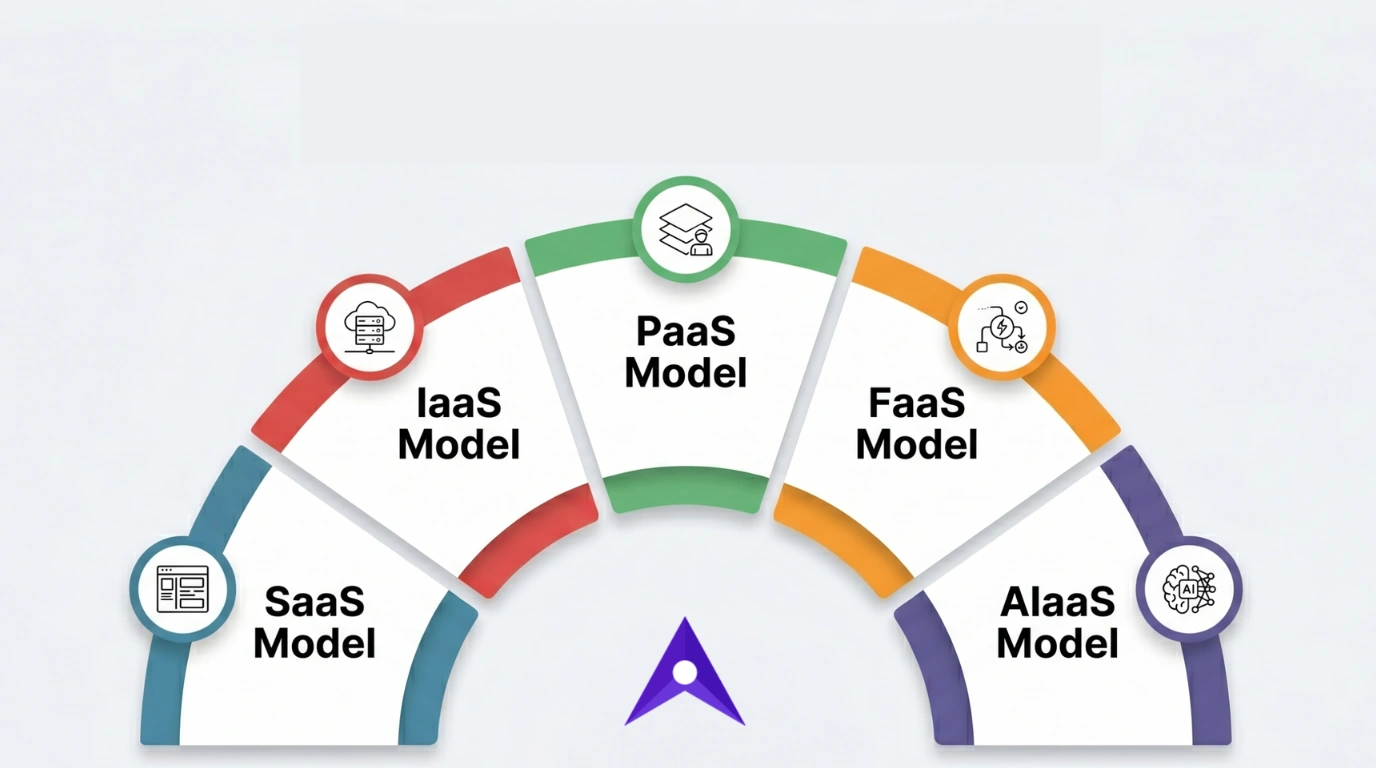
Software as a Service (SaaS)
The cloud service provider takes care of managing your software, infrastructure, and security of your infrastructure. Generally, the applications reside on the web, where users can log in from anywhere and on any device.
This model eliminates the need for installations or updates, making it ideal for businesses looking for quick deployment and minimal maintenance. It also ensures automatic updates, seamless scalability, and reduced IT dependency, allowing businesses to focus more on core operations rather than technical management. Many SaaS-driven ecosystems are further optimised with support from an elite saas development services company to align tools with business workflows.
Infrastructure as a Service (IaaS)
Businesses require hardware to perform their processes efficiently. And this hardware needed to be maintained from time to time, costing so much to businesses. With Infrastructure as a Service, businesses just have to pay the subscription, and all the hardware needs are handled by the service provider.
However, you always have control over your infrastructure. This model offers maximum flexibility and control, making it suitable for businesses with custom configurations and dynamic workloads.
Platform as a Service (PaaS)
Basically, when you build applications, you need a specific platform to start over. Either you start it from scratch or purchase it as a service. But starting from scratch will cost you more as compared to buying it as a service.
Platform as a Service delivers a basic foundation to build apps so that businesses can save money and not have to worry about basic setups. You need to partner with a react js development company that helps you accelerate development cycles by providing pre-configured environments, allowing developers to focus purely on building and innovating.
Function as a Service (FaaS)
This service is also widely known as Serverless Computing. Function as a Service allows businesses to run individual pieces of code in response to specific events, without provisioning or managing any servers at all. You only pay for the exact compute time your code consumes, making it highly cost-efficient for workloads that are sporadic or event-driven.
AWS Lambda, Google Cloud Functions, and Azure Functions are the most widely adopted examples. For businesses that want maximum scalability with minimum infrastructure overhead, FaaS will become a go-to model by 2026.
AI as a Service (AIaaS)
As artificial intelligence becomes central to business operations, cloud providers now offer AI capabilities, including machine learning models, natural language processing, image recognition, and generative AI tools, directly as a service. Businesses do not need to build or train models from scratch.
Instead, they can access pre-built AI APIs and integrate them into their existing applications with minimal effort. Offerings like AWS Bedrock, Azure OpenAI Service, and Google Vertex AI have made AIaaS one of the fastest-growing cloud service models in 2026, enabling even small businesses to leverage enterprise-grade AI without the associated infrastructure costs.
Understanding Cloud Costs: A Model-by-Model Pricing Guide for Businesses
Cloud computing pricing in 2026 is not one-size-fits-all. Costs vary significantly depending on the service model you choose, the scale of your operations, the cloud provider, and any add-ons like advanced security, compliance tools, or AI capabilities.
The shift from fixed on-premise hardware costs to flexible, consumption-based pricing is one of cloud computing’s biggest financial advantages. It means that you pay for what you use, and scale as you grow. Below is a general cost overview across the most common cloud service models to help you benchmark before approaching a provider.
| Service Model | What You’re Paying For | Typical Cost Range | Best For |
| SaaS | Per user/month subscription | $10 to $50/user/month | Small to large businesses needing ready-to-use software |
| IaaS | Compute, storage, networking | $0.01 to $0.40/hour per instance | Businesses needing flexible, scalable infrastructure |
| PaaS | Development platform & runtime environment | $50 to $500/month, depending on usage | Development teams building and deploying applications |
| FaaS (Serverless) | Per function execution and compute time | $0.00001 to $0.0002 per request | Event-driven workloads with unpredictable traffic |
| AIaaS | API calls, model usage, compute for AI workloads | $0.002 to $0.06 per 1K tokens / varies by model | Businesses integrating AI without building their own models |
| Cloud Storage | Per GB stored per month | $0.02 to $0.08/GB/month | All business sizes for file storage and backups |
| Enterprise Plans | Custom bundled services with SLAs | $10,000 to $500,000+/year | Large enterprises with complex, high-volume requirements |
These figures represent general market ranges across providers like AWS, Microsoft Azure, and Google Cloud as of 2026. Actual costs will differ based on your region, data transfer volumes, reserved vs. on-demand pricing, and any negotiated enterprise agreements. We strongly advise consulting directly with cloud service providers and using their native FinOps and cost estimation tools, such as AWS Pricing Calculator or Azure Cost Management, to get an accurate quote tailored to your business needs.
A Practical Framework for Choosing the Right Cloud Solution Provider
Selecting the right cloud computing solution requires a strategic approach aligned with your business goals, technical requirements, and long-term scalability. Instead of making a quick decision, businesses should evaluate multiple factors to ensure the chosen solution delivers both performance and value.
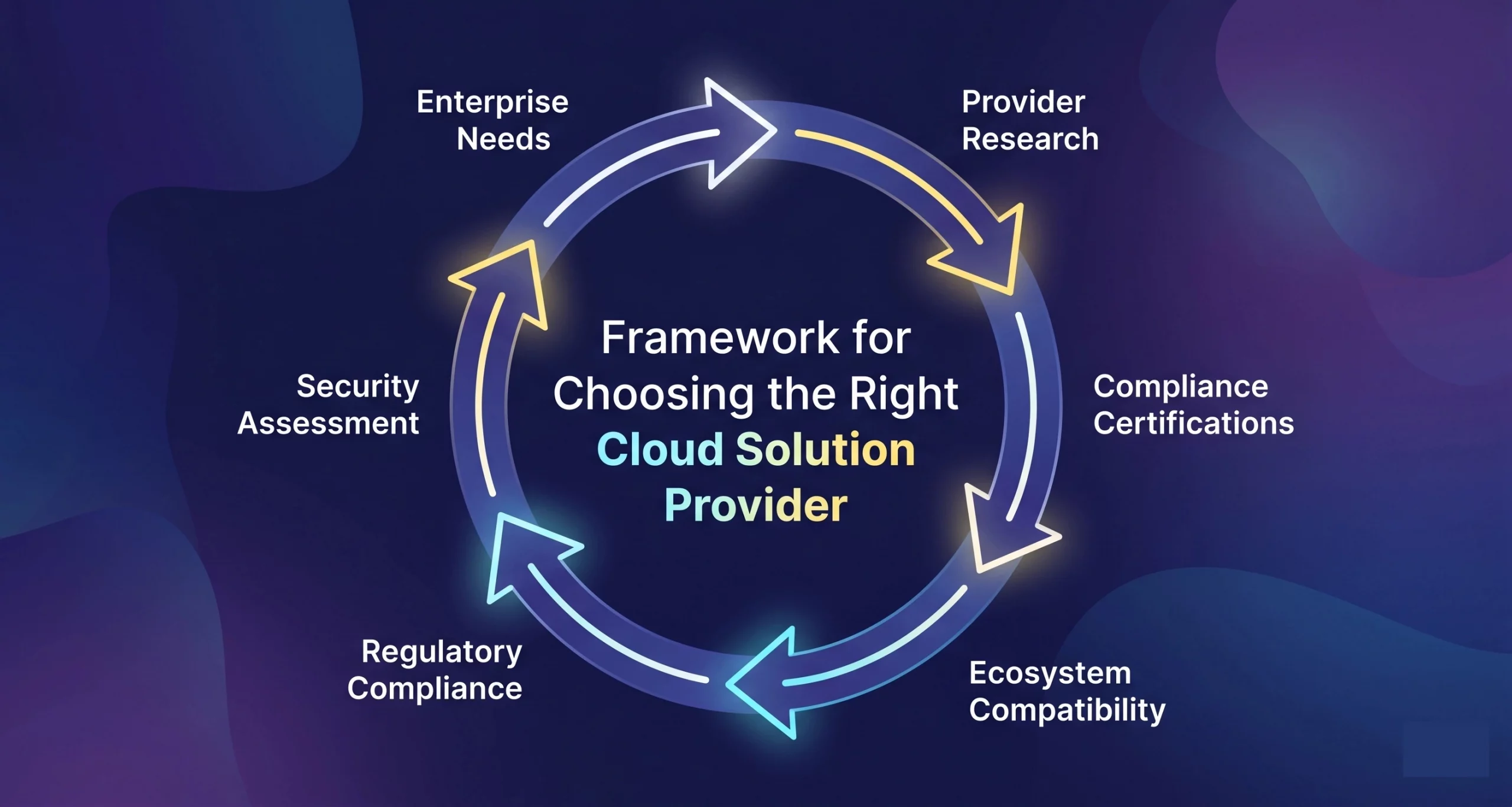
Here are some key questions to guide your decision-making process:
Identify the Needs of Your Enterprise
Start by clearly defining what your business actually needs from a cloud solution. Whether it is scalability, cloud cost optimisation, data storage, or application hosting, your requirements will determine the type of cloud model you should choose. Understanding your workload, user base, and growth expectations helps in selecting a solution that supports both current operations and future expansion.
Research Cloud Service Providers
Not all cloud providers offer the same level of services or expertise. Conduct thorough research to compare providers based on performance, pricing, reliability, and support. Look for providers with a strong market reputation, proven case studies, and experience in handling projects similar to your industry.
Check Certifications and Compliance Standards
Certifications are a strong indicator of a provider’s credibility and security standards. Ensure the provider complies with global standards such as HIPAA, ISO, SOC, or GDPR where applicable. This ensures that your data is handled securely and meets industry-specific regulatory requirements.
Evaluate Compatibility with Your Ecosystem
Your chosen cloud solution should seamlessly integrate with your existing tools, workflows, and systems. If the platform does not align with your organisation’s ecosystem, it may create inefficiencies. Compatibility ensures that you have access to a smoother cloud migration & data security strategy, better team adoption, and minimal disruption to ongoing operations.
Ensure Regulatory and Policy Compliance
Different regions have specific data governance and compliance laws. It is essential to verify whether the cloud provider adheres to government policies and data protection regulations. This is especially critical for industries like cloud computing in healthcare, finance, and eCommerce where compliance is non-negotiable.
Assess Security and Risk Management
Security should be a top priority when selecting a cloud solution. Evaluate the provider’s approach to data encryption, access control, threat detection, and backup systems. A robust security framework not only protects sensitive data but also builds long-term trust and reliability for your business.
Final Thoughts
Cloud computing in 2026 is the foundation every modern business runs on. Throughout this guide, we have covered what cloud computing is and how it works, its core uses across file storage, collaboration, analytics, and development, the four deployment models including public, private, hybrid, and community, the five service models from SaaS to the rapidly growing AIaaS, and the key benefits ranging from cost reduction and scalability to AI readiness and environmental sustainability.
Whether you are evaluating cloud for the first time or looking to modernize an existing setup, understanding these building blocks puts you in a strong position to make decisions that are right for your business today and scalable for tomorrow.
At RipenApps, we don’t just build applications; we leverage leading cloud migration services and build them on cloud infrastructure designed to grow with your business. From helping you choose the right cloud model to developing and deploying scalable, AI-ready applications on AWS, Azure, and Google Cloud, our team brings the technical depth and industry experience to make your cloud journey smooth and results-driven.
FAQs
Q1. Should I use cloud computing for my enterprise?
Absolutely. Cloud computing delivers the flexibility, scalability, and security that modern businesses need to stay competitive. In 2026, it is no longer just a trend; it is the standard infrastructure model across industries of all sizes, from early-stage startups to global enterprises.
Q2. What are the benefits of cloud computing to businesses?
Cloud computing offers a modern, flexible infrastructure that reduces operational costs, boosts team productivity, and strengthens data security. Teams can collaborate on multiple projects simultaneously in real time, leaders get better visibility and control over operations, and businesses gain the ability to scale instantly based on demand.
In 2026, access to AI and machine learning tools through the cloud adds another powerful layer of value for businesses looking to innovate.
Q3. What is the cost of integrating cloud computing into infrastructure?
Different businesses take different approaches toward cloud computing, and costs vary accordingly. Public, private, hybrid, and community cloud models are all priced differently. Further, your choice of service model, whether SaaS, IaaS, PaaS, FaaS, or AIaaS, will also impact your overall spend. If you have customised requirements, that too will alter your overall cost.
Q4. What are the different types of cloud computing models?
There are four types of cloud computing models: public, private, hybrid, and community. Private cloud is beneficial for companies that want dedicated infrastructure within their internal environment. Public cloud is best for businesses that want scalable, on-demand resources without managing hardware.
Hybrid cloud combines both and has become the most widely adopted model for enterprises in 2026. Community cloud is used by organisations from the same industry or regulatory environment, such as government bodies and universities, sharing a secure common infrastructure.
Q5. How will cloud computing provide value to my business?
Cloud computing reduces the cost of maintaining hardware, offers enterprise-grade security, and enables remote access to data from anywhere in the world. Beyond the basics, it gives businesses access to cutting-edge tools in AI, big data analytics, and automation without having to build the underlying infrastructure themselves, delivering both immediate operational value and long-term competitive advantage.
SHARE
WRITTEN BY

Prankur Haldiya
Chief Technical Officer
A tech innovator and engineering leader, Prankur Haldiya drives RipenApps’ product development strategy and oversees cutting-edge solutions in mobility, AI, and cloud ecosystems. He is passionate about building high-performance teams and helping brands launch secure, scalable, and user-centric digital products.
View All Articles



 India
India USA
USA Australia
 Canada
 UK
UK UAE
UAE