

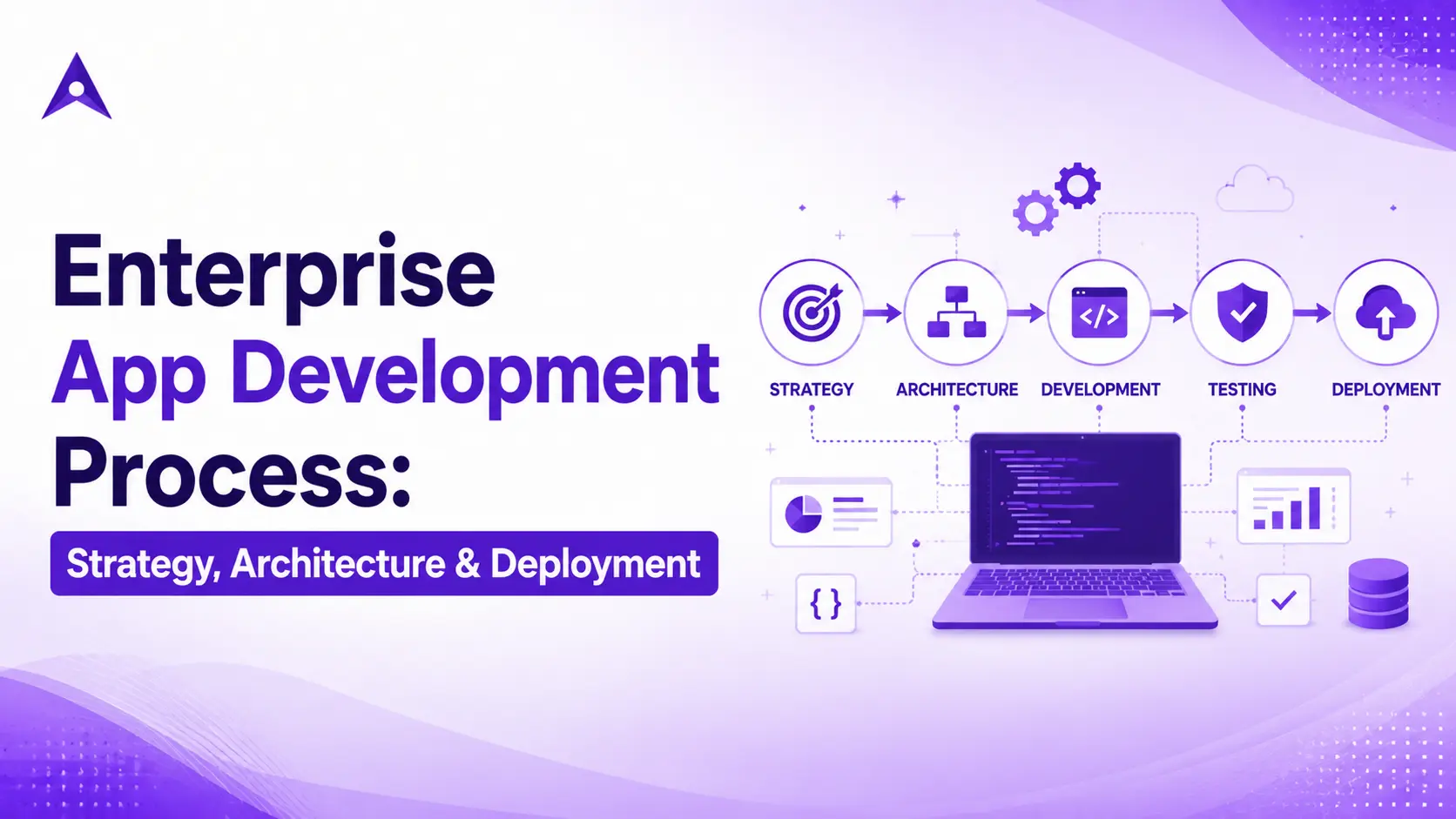

Key Takeaways
- Enterprise applications improve efficiency, collaboration, and business scalability.
- A structured development process reduces technical and operational risks.
- Strong planning helps businesses build secure and scalable applications.
- Agile development and cloud infrastructure accelerate deployment and flexibility.
- Security and compliance are critical for modern enterprise systems.
- AI, automation, and analytics are transforming enterprise applications.
Enterprise applications have become the operational backbone of modern businesses. From streamlining workflows and improving collaboration to enabling data-driven decision-making, enterprise-grade software now plays a direct role in business growth, customer experience, and long-term scalability. For startups and enterprises across the USA, digital transformation is no longer optional. Companies that fail to modernize their systems often struggle with operational inefficiencies, fragmented workflows, security vulnerabilities, and slower market responsiveness.
At the same time, building enterprise applications is far more complex than developing standard consumer software. Enterprise platforms must support thousands of users, integrate with legacy systems, maintain compliance, protect sensitive business data, and scale alongside evolving business goals. According to the 2025 McKinsey State of AI report, 88% of organizations now use AI in at least one business function, highlighting how enterprise technology ecosystems are becoming increasingly intelligent, automated, and data-driven.
This is why forward-thinking organizations invest heavily in strategic enterprise app strategy planning and scalable development frameworks. Whether businesses are seeking enterprise application development services or advanced enterprise mobility platforms, success depends on following a structured enterprise app development lifecycle that aligns technology investments with measurable business outcomes.
For startup founders and product leaders, understanding the enterprise software development process is essential for making informed digital transformation decisions. This guide explores the complete enterprise app development process, from strategy and architecture planning to deployment, optimization, and long-term scalability.
Table of Contents
What is the Enterprise App Development Process?
Enterprise app development refers to the process of designing, developing, deploying, and maintaining software applications built specifically for organizational use. Unlike consumer apps that focus primarily on individual users, enterprise applications are designed to solve operational challenges, automate business processes, improve productivity, and support cross-functional collaboration.
These applications often serve multiple departments simultaneously, including operations, HR, finance, customer support, sales, logistics, and supply chain management. Enterprise systems also handle large volumes of data and require high-level security, scalability, and integration capabilities.
Why Enterprise Applications Require a Different Development Approach
Enterprise applications are fundamentally different from consumer apps because they are built to support large-scale business operations, complex workflows, cross-functional collaboration, and long-term organizational growth. Unlike consumer applications that primarily focus on user engagement and simplicity, enterprise systems must prioritize scalability, security, compliance, integrations, operational efficiency, and infrastructure reliability.
These applications often manage sensitive business data, integrate with multiple enterprise systems such as ERP and CRM platforms, and support thousands of users across departments and locations simultaneously. As a result, the enterprise app development process requires a more strategic approach involving architecture planning, governance frameworks, cloud infrastructure, security-first development, and long-term scalability considerations.
Why do Businesses Need a Structured Enterprise App Development Process?
A structured enterprise app development process reduces technical, operational, and financial risks while ensuring applications align with long-term business objectives. Many enterprise software initiatives fail because organizations rush into development without strategic planning, governance frameworks, or scalability considerations.
A clearly defined process enables enterprises to:
- Align technology investments with business goals
- Improve operational efficiency
- Reduce development bottlenecks
- Enhance cybersecurity and compliance readiness
- Accelerate deployment timelines
- Increase cross-department collaboration
- Support future scalability and modernization
A well-defined strategy becomes easier when enterprises follow a structured enterprise app development guide that outlines key development stages, scalability planning, and modernization approaches.
1. Supporting Long-Term Scalability
Scalability is one of the biggest challenges in developing enterprise applications. Systems built without long-term planning often face performance issues, costly infrastructure upgrades, and integration limitations.
A strategic enterprise app strategy planning approach ensures applications are designed with:
- Flexible architectures
- Cloud scalability
- API-first integrations
- Modular development frameworks
- Enterprise-grade data management
This becomes particularly important for high-growth startups and rapidly scaling enterprises that expect evolving operational demands.
2. Reducing Security and Compliance Risks
Modern enterprise environments face growing cybersecurity threats, compliance regulations, and governance challenges. Enterprise applications often handle sensitive financial, operational, and customer data, making security a business-critical priority.
According to IBM’s 2024 Cost of a Data Breach Report, the global average cost of a data breach reached USD 4.88 million in 2024, reinforcing the importance of security-first enterprise application architecture and governance frameworks.
An effective enterprise application development process includes:
- Security-first architecture
- Data encryption
- Identity and access management
- Compliance frameworks
- Penetration testing
- Continuous monitoring
These capabilities protect organizations against financial, legal, and reputational risks.
Key Stages of Enterprise App Development From Planning to Launch
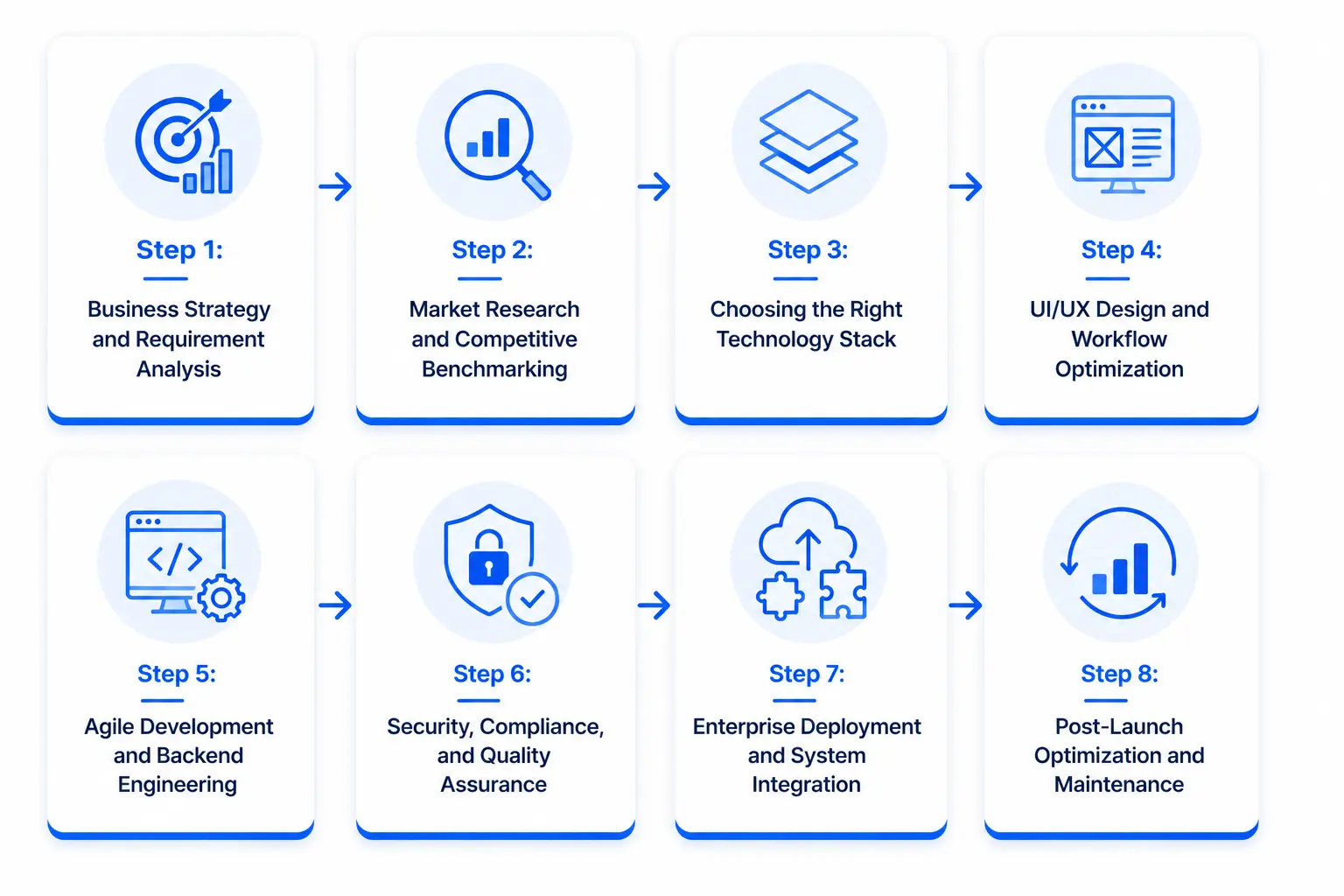
A successful enterprise app development process requires collaboration between business leaders, product strategists, developers, designers, architects, and operational teams. Each stage directly impacts scalability, performance, ROI, and deployment success.
Step 1: Business Strategy and Requirement Analysis
Every successful enterprise application starts with a clear business strategy. Before writing code, organizations must identify operational challenges, business goals, user pain points, and expected outcomes.
This stage typically includes:
- Stakeholder interviews
- Process audits
- User journey mapping
- Competitor benchmarking
- Workflow analysis
- Technical feasibility assessment
- KPI definition
Strong enterprise software requirements documentation prevents scope creep and ensures all stakeholders align on priorities.
Step 2: Market Research and Competitive Benchmarking
Competitive research helps organizations understand:
- Industry expectations
- Technology trends
- User adoption patterns
- Emerging operational standards
- Compliance requirements
This stage also helps enterprises identify opportunities for differentiation.
For example, AI-driven process automation has become a major competitive advantage across industries. Businesses increasingly expect AI-driven enterprise application development providers to have process automation capabilities that reduce manual workloads and improve decision-making.
Step 3: Choosing the Right Technology Stack
Technology selection plays a major role in the process of developing scalable enterprise applications. Poor technology decisions can create integration challenges, infrastructure limitations, and long-term maintenance costs.
Modern enterprise application architectures often include:
- Cloud-native infrastructure
- Microservices architecture
- API-first frameworks
- Containerization
- AI and machine learning integrations
- Real-time analytics capabilities
- Cross-platform compatibility
To ensure scalability, security, and operational efficiency during development, businesses should make a comprehensive enterprise app features checklist covering essential functionalities, integrations, and enterprise-grade capabilities.
Native vs Cross-Platform Enterprise Development
Choosing between native and cross-platform development depends on an organization’s performance requirements, scalability goals, budget, and deployment strategy. While native apps deliver superior performance and platform-specific experiences, cross-platform solutions offer faster development cycles and cost efficiency for businesses targeting multiple platforms simultaneously.
Here is a table for your convenience:
| Development Approach | Best Use Case | Key Advantage |
| Native Development | Performance-intensive enterprise apps | Maximum performance |
| Cross-Platform Development | Faster deployment and cost efficiency | Shared codebase |
| Hybrid Development | Internal operational apps | Rapid deployment |
Businesses partnering with experienced enterprise application development providers agile development processes, and teams often gain significant advantages in architectural planning and technical execution.
Step 4: UI/UX Design and Workflow Optimization
Enterprise UX design focuses heavily on productivity, usability, workflow efficiency, and operational simplicity. Unlike consumer apps that prioritize engagement and entertainment, enterprise applications must minimize friction and support task completion.
Effective enterprise UI/UX strategies include:
- Role-based dashboards
- Simplified workflows
- Accessibility compliance
- Mobile-first experiences
- Data visualization tools
- Employee-centric interfaces
At this stage, many organizations work with mobile application development services providers to ensure enterprise mobility experiences remain seamless across devices.
Step 5: Agile Development and Backend Engineering
The actual development phase combines frontend engineering, backend infrastructure development, API integrations, database architecture, and cloud deployment preparation.
Modern enterprises increasingly rely on agile development processes to improve flexibility, reduce delays, and accelerate product iterations.
Agile frameworks support:
- Continuous feedback loops
- Faster feature deployment
- Improved collaboration
- Better risk management
- Incremental improvements
Organizations developing enterprise applications also prioritize DevOps and CI/CD pipelines to streamline testing, deployment, and updates.
Step 6: Security, Compliance, and Quality Assurance
Security is embedded throughout the development lifecycle, not added as a final checkpoint. Core validation at this stage covers penetration testing, vulnerability assessments, compliance audits, and API security validation.
Enterprise-grade security also requires zero-trust architecture, role-based access controls, multi-factor authentication, and endpoint protection; all designed to protect sensitive business data before and after deployment.
Companies investing in building enterprise software with security-first frameworks reduce operational risks and improve long-term customer trust.
Step 7: Enterprise Deployment and System Integration
Deployment success depends on preparation, not just code quality. Enterprise deployments typically use staged rollouts, CI/CD pipelines, and hybrid cloud environments, with rollback planning and employee onboarding built in from the start.
Infrastructure scaling and phased release strategies ensure applications remain stable throughout the transition from staging to full production.
A successful custom enterprise application development process ensures seamless interoperability across all business systems.
Step 8: Post-Launch Optimization and Maintenance
The enterprise app development process does not end after deployment. Enterprise applications require continuous optimization, updates, monitoring, and support.
Post-launch priorities include:
- Performance monitoring
- Feature enhancements
- User feedback analysis
- Infrastructure optimization
- Security patching
- Compliance updates
- Scalability improvements
Organizations often invest in dedicated application maintenance services to ensure long-term operational continuity and system reliability.

Enterprise Software Development Best Practices
Organizations seeking long-term success should follow proven enterprise software development best practices throughout planning, development, deployment, and optimization.
1. Prioritize Scalability From Day One
Architectural decisions must support:
- Growing user bases
- Expanding data volumes
- Geographic expansion
- Multi-platform accessibility
- Future integrations
2. Adopt Agile and DevOps Frameworks
Agile and DevOps methodologies help enterprises accelerate development while maintaining flexibility.
Benefits include:
- Faster releases
- Continuous deployment
- Improved collaboration
- Reduced operational bottlenecks
- Faster issue resolution
Many organizations partner with a custom app development company experienced in DevOps-driven enterprise environments to improve deployment efficiency.
3. Build Security Into the Architecture
Security should be embedded throughout the entire enterprise application development process rather than treated as a final-stage checklist.
Security-first strategies include:
- Encryption frameworks
- Identity management
- Secure APIs
- Automated vulnerability testing
- Compliance monitoring
4. Focus on Data and Analytics
Businesses use enterprise software to:
- Track operational performance
- Monitor KPIs
- Predict trends
- Automate reporting
- Improve customer experiences
AI-powered analytics capabilities are becoming a major differentiator in modern enterprise ecosystems.
Key Innovations Transforming Enterprise App Development
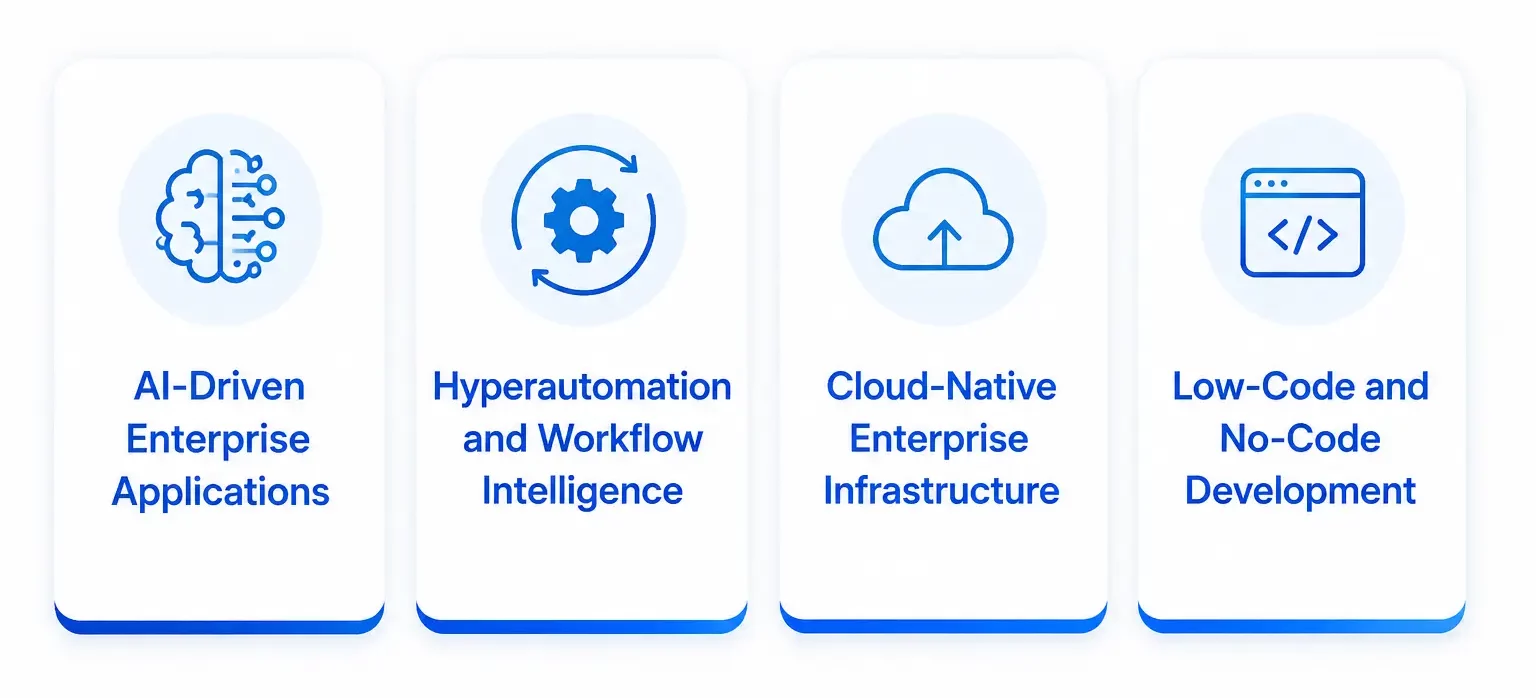
Enterprise technology landscapes are evolving rapidly. Organizations that fail to adapt risk losing operational efficiency and market competitiveness.
1. AI-Driven Enterprise Applications
Artificial intelligence is transforming enterprise operations across industries.
AI capabilities now support:
- Predictive analytics
- Intelligent automation
- Personalized user experiences
- Workflow optimization
- Fraud detection
- Operational forecasting
Businesses increasingly seek enterprise application development services that integrate AI-driven operational intelligence.
2. Hyperautomation and Workflow Intelligence
Hyperautomation combines AI, machine learning, robotic process automation, and analytics to streamline enterprise workflows.
Companies adopting hyperautomation frameworks often achieve:
- Faster operational cycles
- Reduced manual workloads
- Improved productivity
- Lower operational costs
Organizations exploring AI-driven workflow optimization and operational efficiency can refer to this in-depth intelligent automation guide for enterprises to understand implementation strategies, automation readiness, and enterprise adoption frameworks.
3. Cloud-Native Enterprise Infrastructure
Cloud-native development has become the foundation of scalable enterprise architecture.
Benefits include:
- Faster scalability
- Lower infrastructure costs
- Improved performance
- Disaster recovery capabilities
- Global accessibility
4. Low-Code and No-Code Development
Low-code platforms are enabling faster prototyping and workflow automation.
However, enterprises still require custom architectures for:
- Advanced integrations
- Security frameworks
- Large-scale infrastructure
- Enterprise-grade scalability
Real-World Examples of Successful Enterprise Applications
Modern businesses across industries are leveraging the enterprise app development process to build scalable, secure, and intelligent digital ecosystems that streamline operations, improve collaboration, and accelerate digital transformation. Below are real-world examples of successful enterprise applications that reflect how strategic planning, scalable architecture, seamless integrations, and enterprise-grade deployment drive measurable business outcomes.
1. Microsoft Teams
Microsoft Teams is a leading enterprise collaboration platform built to streamline communication, project management, file sharing, and hybrid workforce coordination. The platform reflects how building enterprise applications with cloud-native infrastructure, enterprise-grade security, and scalable deployment frameworks can support over 320 million monthly active users, delivering sub-200ms message latency across 100+ countries with 99.9%+ uptime SLA for enterprise deployments.
Its success also highlights the growing importance of developing enterprise applications that support real-time collaboration and enterprise mobility in modern work environments.
2. Salesforce
Salesforce is one of the most widely adopted enterprise CRM ecosystems, helping organizations automate sales operations, centralize customer data, and optimize business workflows. Its cloud-native infrastructure and modular architecture represent strong enterprise software development best practices for businesses seeking scalable, data-driven, and highly customizable enterprise ecosystems.
Salesforce also demonstrates how developing enterprise software with AI-powered analytics and workflow automation can process over 1.8 trillion transactions annually, with enterprise customers reporting an average 25% increase in sales productivity and 30% reduction in customer service resolution times post-implementation.
3. eGurukul
eGurukul is a large-scale EdTech platform developed to simplify and modernize medical exam preparation through live classes, assessments, digital learning modules, and community engagement features. The platform demonstrates how a well-structured enterprise mobile app development process can support 500,000+ active learners with real-time progress tracking, live class delivery, and concurrent session handling, maintaining platform stability during peak exam preparation periods with zero unplanned downtime.
Its cloud-enabled infrastructure and workflow-driven design showcase the importance of developing enterprise applications with long-term scalability and operational efficiency in mind.
4. Al Muzaini
Al Muzaini is a fintech-focused enterprise platform designed to facilitate secure remittance and digital financial transactions at scale. The application reflects how the enterprise application development process integrates security-first architecture, real-time API synchronization, AI-powered KYC verification, and compliance-driven infrastructure.
It is there to support processing 100,000+ verified transactions across 200+ countries, with AI-powered KYC verification reducing onboarding time by 60% and biometric authentication achieving sub-3-second identity confirmation at scale. It highlights the importance of building enterprise software with scalability, security, and seamless system integration capabilities.

How RipenApps Enables Secure and Scalable Enterprise App Development
RipenApps follows a strategic enterprise app development process focused on scalability, security, and long-term business growth. From discovery and architecture planning to deployment and optimization, the company helps businesses build future-ready enterprise applications using cloud-native infrastructure, agile development methodologies, AI-driven capabilities, and API-first architectures that support evolving operational needs.
Security and reliability remain central throughout the development lifecycle. RipenApps integrates enterprise-grade security frameworks, compliance-focused development practices, data encryption, role-based access controls, and continuous monitoring to help businesses protect sensitive data and maintain operational continuity. The company also focuses on seamless integrations, workflow automation, and performance optimization to support scalable and efficient enterprise ecosystems.
Final Thoughts
The modern enterprise app development process is no longer just a technical initiative. It is a strategic business transformation framework that directly impacts operational efficiency, customer experience, scalability, security, and long-term competitiveness. Organizations that approach enterprise app development with structured planning, agile execution, cloud-native infrastructure, AI integration, and security-first strategies position themselves for stronger innovation and sustainable growth in increasingly digital markets.
For startups, enterprises, and fast-scaling businesses seeking reliable application modernization solutions, enterprise mobility solutions, or long-term digital transformation support, partnering with experienced technology experts becomes essential. RipenApps helps organizations build scalable, secure, and future-ready enterprise ecosystems through advanced enterprise app strategy planning, intelligent automation, and modern application engineering solutions tailored to evolving business goals.

FAQs
Q1. What is the Enterprise App Development Process?
The enterprise app development process is a structured framework for planning, designing, developing, deploying, and maintaining enterprise-grade software solutions tailored to business operations and organizational goals. The enterprise application development process typically includes business analysis, architecture planning, UI/UX design, development, testing, deployment, and long-term optimization to ensure scalability, security, and operational efficiency while developing enterprise software for complex business environments.
Q2. Why is enterprise app strategy planning important?
Enterprise app strategy planning helps organizations align technology investments with business objectives, scalability goals, and operational requirements before building enterprise applications. A strategic approach minimizes development risks, improves workflow efficiency, strengthens security readiness, and ensures enterprises can successfully build enterprise applications that support long-term digital transformation and measurable ROI.
Q3. How long does developing enterprise applications take?
The timeline for developing enterprise applications depends on project complexity, infrastructure requirements, integrations, compliance standards, and customization needs. While smaller enterprise solutions may take a few months, large-scale platforms involving advanced automation, cloud infrastructure, and enterprise software requirements can take a year or longer. The custom enterprise application development process also varies based on business goals, scalability expectations, and deployment strategies.
Q4. What technologies are commonly used in enterprise app development?
Modern enterprise app development relies on technologies such as cloud-native infrastructure, microservices architecture, APIs, AI frameworks, DevOps pipelines, containerization, and enterprise analytics platforms. Businesses developing enterprise software also leverage automation tools, cybersecurity frameworks, and scalable backend technologies to support performance, operational agility, and intelligent workflows. Many AI-driven enterprise application development providers incorporate automation capabilities into enterprise ecosystems to improve efficiency and decision-making.
Q5. What is the biggest challenge in building enterprise applications?
One of the biggest challenges in building enterprise applications is balancing scalability, security, integrations, and user adoption while maintaining operational continuity. Organizations often struggle with legacy system modernization, enterprise software requirements, compliance regulations, and infrastructure scalability during the enterprise application development process. Businesses working with enterprise application development providers, agile development processes teams can better manage deployment complexity, workflow optimization, and long-term scalability while building enterprise software for evolving market demands.

SHARE
WRITTEN BY

Ishan Gupta
CEO & Founder
Ishan Gupta is a seasoned entrepreneur and CEO with extensive 8+ years of experience in business and mobile app development landscape. He believes that the right digital product allows companies to focus on what they do best, while technology handles the rest. With deep exposure to global markets, he understands what makes an app succeed. His approach translates business needs into clear product strategies, ensuring that every feature contributes to measurable ROI.
View All Articles


 India
India USA
USA Australia
 Canada
 UK
UK UAE
UAE