


Key Takeaways
- Rapid prototyping helps businesses validate product ideas faster while reducing development risks and unnecessary engineering costs.
- A structured prototyping process improves product-market fit through continuous user feedback and iterative refinement.
- Low-fidelity and high-fidelity prototypes serve different purposes, from workflow validation to realistic UX testing and stakeholder alignment.
- AI-powered tools and agile workflows are accelerating rapid prototyping cycles, improving experimentation speed and operational efficiency.
- Continuous usability testing and feedback analysis help businesses identify friction points before full-scale product development begins.
- Rapid prototyping acts as a strategic bridge between product strategy, user validation, and scalable MVP development.
Step-by-Step Rapid Prototyping Process in Product Development is a structured, iterative approach used to quickly design, test, and validate product ideas before full-scale development. It enables businesses to reduce uncertainty, improve product-market fit, and accelerate decision-making through early-stage user feedback and continuous iteration.
In today’s hyper-competitive digital economy, rapid prototyping has become essential for startups, SaaS companies, and enterprise innovation teams that need to move faster, validate assumptions early, and avoid costly development mistakes. Whether organizations are building AI-powered platforms, mobile apps, enterprise software, or digital ecosystems, rapid prototype development and rapid prototyping in product development help teams refine workflows and improve usability before committing engineering resources.
The growing adoption of AI is also accelerating experimentation-driven product strategies. According to McKinsey AI insights, 64% of organizations say AI is enabling innovation across their businesses, pushing companies toward faster, more agile validation approaches. This shift is reshaping how digital products are built, making rapid prototyping methodology a core part of modern software product development services. In this blog, we will discuss rapid prototyping, its importance, and its benefits in detail.
Table of Contents
What is Rapid Prototyping In Product Development?
Rapid prototyping is an iterative product development methodology used to quickly design, test, refine, and validate product ideas before full-scale development begins. It enables businesses to create early-stage versions of products or features to gather real-world feedback and improve concepts rapidly.
Unlike traditional development approaches that depend heavily on long planning cycles and delayed testing, rapid prototyping processes emphasize experimentation, collaboration, and continuous improvement. Businesses can test usability, functionality, technical feasibility, and customer experience long before investing in full-scale engineering.
Today, rapid prototyping in product development plays a major role across:
- SaaS platforms
- Enterprise software
- Mobile applications
- AI-powered products
- Healthcare systems
- Fintech platforms
- E-commerce ecosystems
- Cloud-native applications
Why does Rapid Prototyping Matter in Product Development?
Modern customers expect seamless digital experiences and rapid innovation. Businesses that fail to validate product assumptions early often face increased development costs, delayed launches, poor adoption, and scalability challenges.
Rapid prototyping methodology helps organizations:
- Accelerate time-to-market
- Reduce engineering waste
- Improve product-market fit
- Strengthen stakeholder alignment
- Minimize development risk
- Increase operational efficiency
- Improve customer experience
For startups and enterprises alike, digital product prototyping creates a faster path from concept to scalable innovation.
For modern digital businesses, rapid prototyping methods provide greater agility and market responsiveness compared to conventional development models.
The Rapid Prototyping Process In Product Development: Step-by-Step
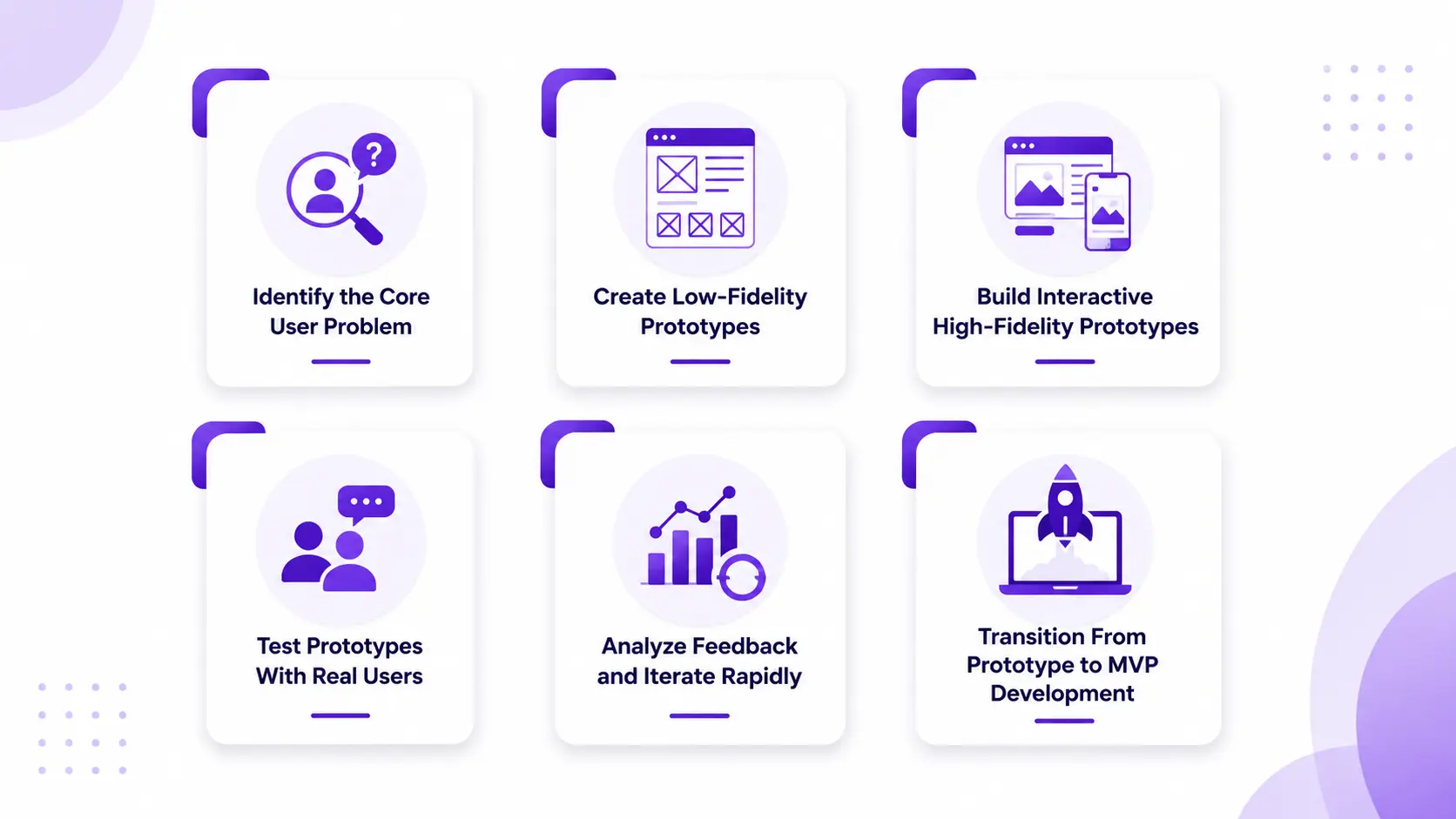
A structured rapid prototyping process helps businesses move from concept to validated product strategy while minimizing technical and market risks.
Step 1: Identify the Core User Problem
Every successful digital product begins with solving a real customer problem. Before building interfaces or workflows, businesses must deeply understand user pain points, market gaps, and customer expectations.
This discovery stage typically includes:
- User interviews
- Competitor analysis
- Product discovery workshops
- Behavioral research
- Market validation
- Stakeholder discussions
Many startups fail because they build products based on assumptions instead of customer insights. Rapid prototyping for product development minimizes this risk by validating ideas early.
For example, a SaaS company may initially prioritize advanced automation features but later discover that customers primarily struggle with onboarding complexity. Early validation prevents unnecessary engineering investment and improves product direction.
Key Discovery Questions
- What core problem are users facing?
- Which workflows create the most friction?
- What alternatives are customers using today?
- Which features create the highest business value?
- What user outcomes matter most?
This phase establishes the strategic foundation for the entire prototyping process.
Step 2: Create Low-Fidelity Prototypes
Low-fidelity prototypes are simplified visual representations of product concepts used for early-stage idea validation.
These may include:
- Wireframes
- Sketches
- Paper prototypes
- Workflow diagrams
- Basic UI layouts
The primary goal is speed and experimentation rather than visual perfection.
Low-fidelity rapid prototyping techniques allow businesses to validate navigation structures, information hierarchy, and usability before investing in detailed UI design or engineering. Many organizations also collaborate with specialized product prototyping services providers during this stage to accelerate validation cycles and improve early-stage product clarity.
Popular rapid prototyping tools include:
- Figma
- Balsamic
- Miro
- FigJam
- Whimsical
For startup founders seeking investor validation, low-fidelity prototypes provide a fast and cost-effective way to communicate product vision.
Benefits of Low-Fidelity Prototyping
Low-fidelity prototyping helps businesses validate ideas quickly, improve collaboration, and identify usability issues early before investing in detailed design and development.
- Faster concept validation
- Reduced design costs
- Easier iteration
- Better stakeholder collaboration
- Early UX testing
Step 3: Build Interactive High-Fidelity Prototypes
Once workflows are validated, teams move into high-fidelity rapid prototyping design.
High-fidelity prototypes closely resemble the final product experience and often include:
- Interactive user flows
- Responsive layouts
- Visual branding
- Animations
- Realistic UI interactions
- Dynamic components
These prototypes are especially valuable for:
- SaaS platforms
- Mobile applications
- Enterprise dashboards
- AI-powered products
- Customer-facing portals
Interactive rapid prototyping in software engineering improves communication between product teams, developers, and stakeholders while reducing implementation ambiguity.
Advantages of High-Fidelity Prototypes
High-fidelity prototypes provide a realistic product experience that helps teams validate usability, improve stakeholder communication, reduce development ambiguity, and strengthen product decision-making before engineering begins.
- More accurate usability testing
- Stronger stakeholder alignment
- Better investor presentations
- Reduced engineering misunderstandings
- Improved UX validation
Modern app design services increasingly combine AI-assisted design workflows with human-centered UX strategy to accelerate prototyping cycles and improve digital product experiences.
Step 4: Test Prototypes With Real Users
Prototype testing is one of the most critical stages of the rapid prototyping process. Without real user feedback, businesses risk making expensive product decisions based on internal assumptions.
Usability testing evaluates:
- Navigation clarity
- Workflow efficiency
- User friction points
- Feature comprehension
- Accessibility
- Customer satisfaction
Testing methods commonly include:
- Remote usability testing
- A/B testing
- Heatmap analysis
- Session recordings
- User interviews
- Survey-based validation
Key Metrics to Measure
The following metrics help evaluate product usability, user experience, workflow efficiency, and overall market relevance during the validation process.
| Metric | Purpose |
| Task Completion Rate | Measures usability effectiveness |
| Time on Task | Detects workflow friction |
| Error Rate | Identifies confusion points |
| User Satisfaction Score | Evaluates customer experience |
| Feature Adoption Intent | Assesses market relevance |
Organizations that validate ideas early through rapid prototyping in product development are significantly better positioned to reduce development risks, improve customer adoption rates, and build products aligned with real user expectations.
Security validation is also becoming increasingly important during digital product prototyping. According to IBM’s Cost of a Data Breach Report 2024, the global average cost of a data breach reached $4.88 million in 2024, highlighting why secure architecture validation and early-stage testing are now critical components of modern product engineering.
Step 5: Analyze Feedback and Iterate Rapidly
Iteration is the foundation of successful rapid prototyping methodology. Product teams continuously analyze user feedback, prioritize improvements, and refine workflows based on real-world insights.
This iterative approach helps organizations:
- Improve usability
- Refine workflows
- Eliminate friction points
- Increase customer satisfaction
- Reduce engineering waste
- Improve scalability readiness
Many businesses also partner with specialized product engineering services teams to accelerate iteration cycles, optimize technical scalability, and improve long-term product performance through agile engineering workflows.
Common Iteration Workflow
AI-powered engineering workflows are also accelerating iteration efficiency. This is making AI-assisted rapid prototyping increasingly valuable for modern digital product teams.
- Gather feedback
- Identify recurring issues
- Prioritize improvements
- Refine prototypes
- Re-test with users
- Repeat validation cycles
Step 6: Transition From Prototype to MVP Development
Once prototypes successfully validate core assumptions, businesses can move toward MVP development.
An MVP (Minimum Viable Product) differs from a prototype because it includes functional backend systems and real-world usability.
POC vs MVP vs Prototype Differences: Quick Comparison
Understanding POC vs MVP vs Prototype Differences helps startups and enterprises make smarter investment decisions throughout the product development.
| Type | Purpose | Audience | Functionality |
| POC (Proof of Concept) | Validate technical feasibility | Internal stakeholders | Minimal |
| Prototype | Validate workflows and UX | Users & stakeholders | Simulated |
| MVP | Launch usable product | Real customers | Functional |
Before transitioning into MVP development, businesses should confirm:
- Product-market assumptions are validated
- User demand exists
- Workflows perform effectively
- Technical feasibility is confirmed
- Stakeholder alignment is achieved
This reduces costly rework while improving launch confidence.
Rapid Prototyping Workflow Diagram
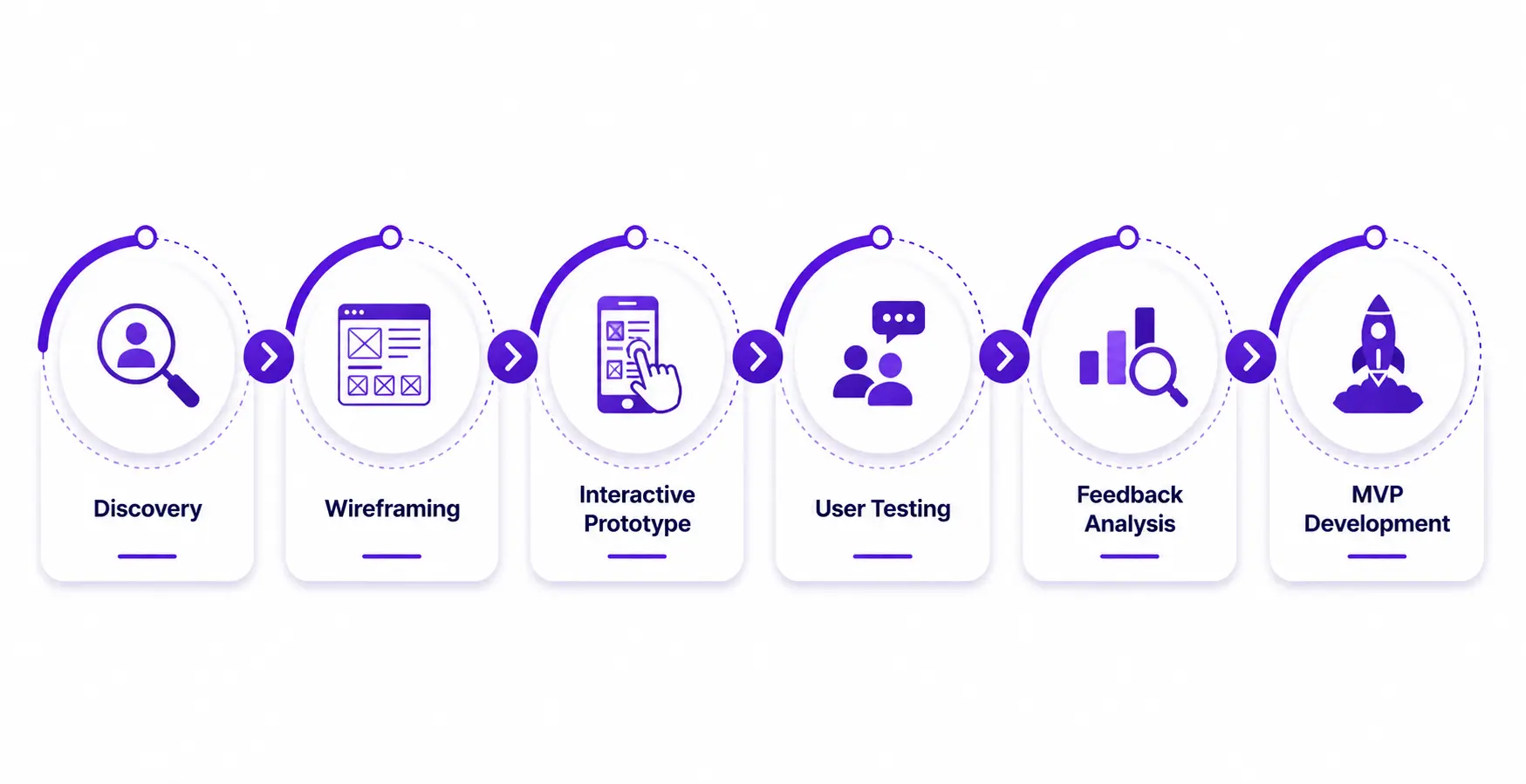
A standard rapid prototyping workflow typically follows this cycle:
Discovery – Wireframing – Interactive Prototype – User Testing – Feedback Analysis – MVP Development
Unlike traditional product development approaches that follow rigid linear execution, rapid prototyping for product development is designed as a continuous iterative process. Each stage focuses on validating assumptions, improving usability, and refining product functionality based on real user feedback before moving into full-scale development.
This flexible workflow enables businesses to reduce development risks, accelerate decision-making, adapt quickly to changing market demands, and build products that are more closely aligned with user expectations and business goals.
How Much Does Rapid Prototyping Cost?
One of the most common questions businesses ask before starting is straightforward: What will this actually cost? The answer depends on prototype fidelity, product complexity, team structure, and how far validation needs to go before development begins.
Here is a realistic breakdown across common product categories.
Rapid Prototyping Cost by Product Type
| Product Type | Low-Fidelity Prototype | High-Fidelity Prototype | MVP Transition |
| Startup / Early-Stage | $2,000 – $6,000 | $8,000 – $20,000 | $25,000 – $80,000 |
| SaaS Platform | $4,000 – $10,000 | $15,000 – $35,000 | $40,000 – $150,000 |
| AI-Powered Product | $6,000 – $15,000 | $20,000 – $50,000 | $60,000 – $200,000+ |
| Enterprise Workflow | $8,000 – $20,000 | $25,000 – $70,000 | $80,000 – $300,000+ |
Note: These ranges reflect general market estimates and vary based on team location, scope, and partner expertise.
How Leading Companies Use Rapid Prototyping
This section highlights how leading digital platforms and enterprise products use rapid prototyping to validate ideas, refine user experiences, reduce development risks, and accelerate scalable product innovation. These real-world examples demonstrate how iterative testing and continuous feedback directly contribute to product growth, user adoption, and long-term business success.
Airbnb: Rapid UX Experimentation That Redefined Travel Booking
Airbnb used rapid prototyping and continuous user feedback to refine booking workflows, trust systems, and customer experience at scale. By rapidly testing interface changes and host-guest interaction flows, Airbnb improved usability and contributed to a platform now serving over 150 million users worldwide.
Dropbox: Validating Product Demand Before Building the Full Platform
Dropbox used prototype-led validation to test market demand before investing heavily in engineering resources. Its early MVP explainer video generated over 70,000 waitlist signups within a short period, proving strong customer interest before full-scale product development began.
Spotify: Iterative Product Testing Behind Personalized User Experiences
Spotify leveraged rapid experimentation and prototype testing to optimize music discovery, personalization, and cross-device engagement. Continuous A/B testing and iterative UX improvements helped Spotify scale to more than 600 million active users globally while maintaining highly personalized listening experiences.
eGurukul: Scaling Digital Learning Through Continuous Prototype Validation
Rapid prototyping helped streamline large-scale EdTech learning experiences through continuous UX validation, workflow optimization, and scalable learning journeys for over 500,000 users. Early-stage usability testing and iterative feature refinement helped improve engagement, reduce navigation friction, and accelerate platform adoption.
Al Muzaini: Refining Secure Fintech Experiences Before Large-Scale Rollout
Iterative prototyping improved secure fintech onboarding, transaction workflows, and compliance-driven user experiences before large-scale deployment across 200+ countries. Rapid validation cycles helped optimize KYC processes, reduce operational friction, and strengthen transaction reliability in a highly regulated environment.
Why Many Product Validation Processes Fail
Many product validation efforts fail because businesses rely on assumptions, biased feedback, and limited user testing instead of structured, data-driven validation processes.
- Testing With the Wrong Audience: Validation fails when prototypes are not tested with actual target users in real-world conditions.
- Biased Stakeholder Feedback: Internal opinions often overshadow real user feedback, leading products away from actual market needs.
- Vanity Validation: Positive metrics without meaningful user behavior insights can create a false sense of product success.
- Overengineering Before Validation: Building polished prototypes too early can distract teams from validating the core problem first.
- Weak UX Metrics: Relying only on satisfaction feedback without behavioral data limits usability insights.
- Single-Round Validation: Skipping multiple testing and iteration cycles leaves unresolved usability issues in the product.
- Assumption-Driven Prioritization: Feature decisions based on internal assumptions instead of user research often result in poor product-market fit.
Common Rapid Prototyping Mistakes to Avoid
Even experienced product teams can make costly mistakes during the rapid prototyping process. Without proper validation and iteration, businesses risk wasting resources, delaying launches, and building products that fail to meet customer expectations.
Overbuilding Too Early
Many businesses spend too much time perfecting UI designs before validating core workflows and user needs. Early-stage rapid prototyping should prioritize speed, experimentation, and learning rather than visual perfection.
Skipping User Validation
Internal assumptions rarely reflect real customer behavior. Continuous testing and feedback collection are essential for validating usability, improving customer experience, and reducing costly development revisions later.
Testing With the Wrong Audience
Testing prototypes with non-target users can generate misleading feedback and poor product decisions. Effective rapid prototyping in modern product development requires feedback from the right customer personas and business users.
Ignoring Feedback Patterns
Successful rapid prototype development focuses on recurring user behavior and data-driven insights rather than isolated opinions. Prioritizing meaningful feedback patterns improves product-market fit, scalability, and long-term product success.
Avoiding these mistakes helps businesses reduce risk while improving scalability and product-market fit.
Benefits of a Structured Rapid Prototyping Process
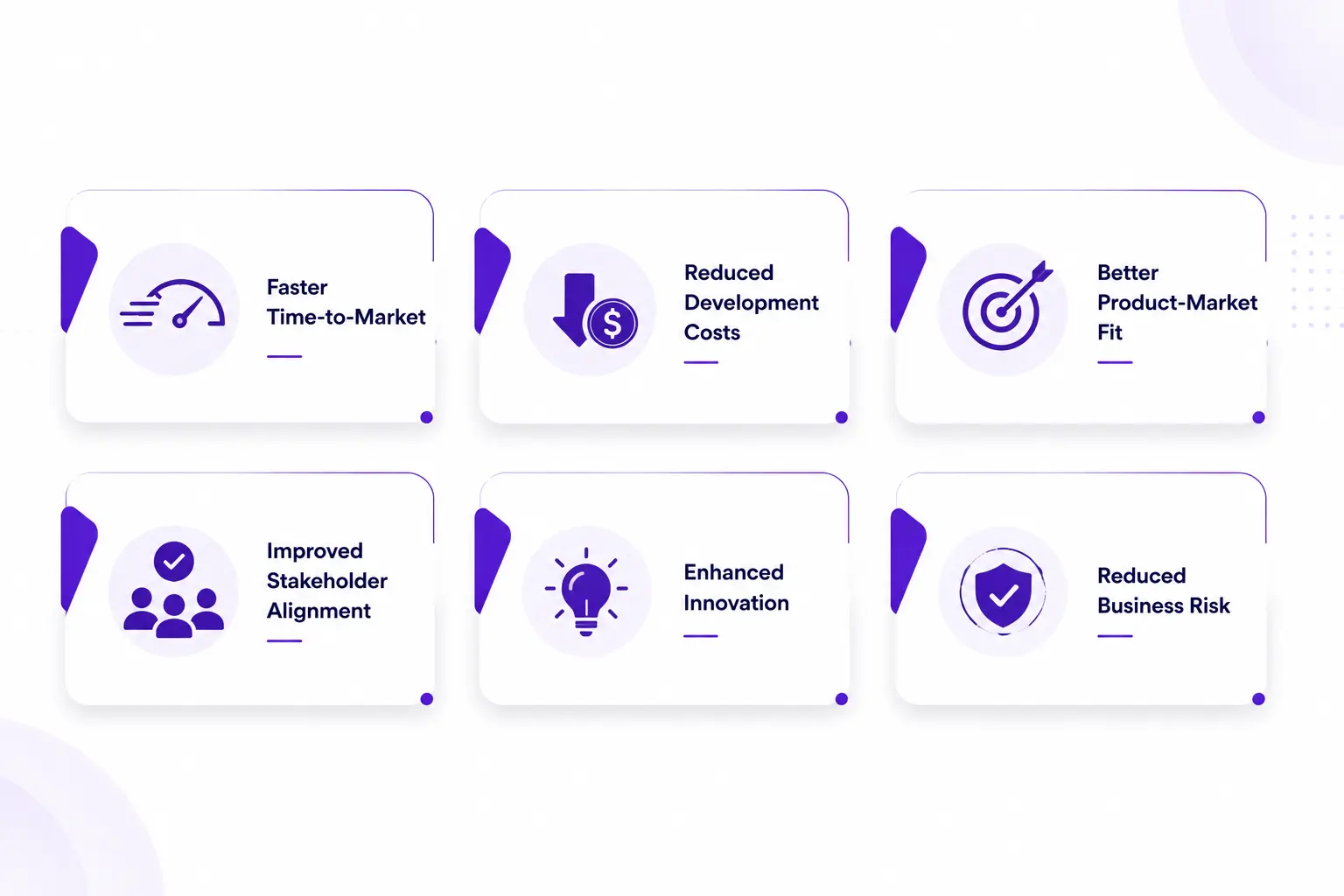
The benefits of rapid prototyping extend far beyond faster design cycles. In today’s fast-moving digital economy, businesses must validate ideas quickly, reduce uncertainty, and respond to changing customer expectations with greater agility.
Faster Time-to-Market
One of the biggest advantages of prototyping in product development is the ability to shorten product launch timelines. Instead of spending months building invalidated features, businesses can test ideas early, identify usability gaps, and refine workflows before development begins.
This iterative approach helps startups and enterprises launch digital products faster while staying ahead of competitors in rapidly evolving markets.
Reduced Development Costs
Late-stage engineering changes are often expensive and resource-intensive. Rapid prototyping methodology minimizes this risk by identifying technical, UX, and workflow issues early in the product design prototyping phase.
Businesses can reduce unnecessary engineering rework, optimize development resources, and improve budget efficiency throughout the product development.
Better Product-Market Fit
Successful products are built around customer needs, not assumptions. Through continuous testing and feedback collection, rapid prototyping processes help businesses align product experiences with real user expectations.
This improves customer satisfaction, increases adoption rates, and strengthens long-term product-market fit across SaaS platforms, enterprise software, and mobile applications.
Improved Stakeholder Alignment
Interactive prototypes create a shared visual understanding between executives, investors, designers, engineers, and product managers. Instead of relying on static documentation or assumptions, stakeholders can evaluate realistic workflows and provide strategic feedback early.
This improves collaboration, accelerates approvals, and reduces communication gaps across cross-functional teams.
Enhanced Innovation
Rapid prototyping encourages teams to experiment, iterate, and explore multiple ideas without major development risks. Businesses can test new concepts, validate innovative features, and improve digital experiences faster through agile workflows and continuous iteration.
This culture of experimentation is especially valuable for AI-driven products, startup ecosystems, and innovation-focused enterprises.
Reduced Business Risk
Data-driven validation helps organizations make smarter investment decisions before committing significant engineering resources.
By validating workflows, usability, technical feasibility, and customer demand early, businesses can reduce launch risks, improve scalability planning, and avoid costly product failures.
Organizations embracing AI-powered experimentation are already seeing measurable business impact. According to McKinsey AI ROI Analysis, companies implementing focused AI transformation strategies are achieving nearly $3 in returns for every $1 invested, reinforcing the growing value of rapid experimentation, automation, and innovation-driven product development.
Product Development Life Cycle: Where Rapid Prototyping Fits
Understanding the product development life cycle helps organizations integrate rapid prototyping effectively.
A typical PDLC includes:
- Ideation
- Product Discovery
- Rapid Prototyping
- Validation
- Development
- Testing
- Deployment
- Optimization
Rapid prototyping acts as the bridge between strategy and engineering execution, helping businesses reduce uncertainty before large-scale development begins.
PDLC vs SDLC: Quick Comparison Table
Many business leaders confuse Product Development Life Cycle (PDLC) with Software Development Life Cycle (SDLC).
Here is a comparison table for better understanding of PDLC vs SDLC:
| PDLC | SDLC |
| Focuses on business strategy and validation | Focuses on software engineering execution |
| User-centric | System-centric |
| Covers market research and prototyping | Covers coding and deployment |
| Includes product innovation strategy | Includes technical implementation |
Rapid prototyping plays a strategic role in both by aligning business objectives with scalable engineering execution.
Final Thoughts
As digital competition intensifies and customer expectations continue evolving, businesses can no longer rely on slow, assumption-driven development models. Rapid prototyping provides a scalable and innovation-focused framework for validating ideas, improving user experiences, reducing engineering waste, and accelerating product-market fit. Whether organizations are building SaaS platforms, AI-powered applications, enterprise systems, or digital ecosystems, adopting a structured rapid prototyping process creates stronger alignment between business goals, customer needs, and scalable technology execution.
For startups, enterprises, and innovation-driven organizations evaluating MVP development services, partnering with the right technology expert becomes essential for long-term success. RipenApps helps businesses transform ideas into scalable digital products through strategic rapid prototyping, agile product engineering, UX-driven validation, and modern digital innovation solutions tailored for growth-focused companies.

FAQ
1. How does rapid prototyping work?
Rapid prototyping works by creating simplified versions of products, testing them with users, gathering feedback, and continuously refining the solution through iterative development cycles. This rapid prototyping process helps businesses validate ideas, improve workflows, and reduce risks before moving into full-scale development. Modern rapid prototyping methods also integrate AI tools, digital prototyping, and agile collaboration to accelerate product validation.
2. What are the benefits of rapid prototyping?
The benefits of rapid prototyping include faster product validation, lower engineering costs, improved customer experience, reduced development risk, and quicker time-to-market. Businesses using rapid prototyping in development can identify usability issues early, improve scalability planning, and optimize digital product prototyping workflows before investing heavily in engineering resources.
3. What are the types of rapid prototyping?
Common types of rapid prototyping include low-fidelity wireframes, high-fidelity prototypes, clickable interfaces, digital prototyping, proof of concept (POC) models, and MVP validation prototypes. Different rapid prototyping techniques are used depending on business goals, product complexity, user testing requirements, and the stage of the product design prototyping process.
4. What are the best rapid prototyping tools?
Popular rapid prototyping tools include Figma, Framer, Adobe XD, Sketch, Bubble, Uizard, Maze, and Hotjar. These rapid prototyping tools help businesses streamline digital product prototyping, improve collaboration, accelerate rapid prototype development, and optimize product design and rapid prototyping workflows across startup and enterprise environments.
5. What is the difference between POC, MVP, and prototype?
A Proof of Concept (POC) validates technical feasibility, a prototype validates workflows and user experience, and an MVP (Minimum Viable Product) is a functional product released to real users. Understanding POC vs Prototype Differences is essential within the product development life cycle guide because each stage serves a different purpose in rapid prototyping for product development and business validation.
6. Why is rapid prototyping important for startups?
Rapid prototyping helps startups validate ideas faster, reduce investment risks, improve investor communication, and accelerate product-market fit. Through rapid prototyping methodology and iterative testing, startups can gather real customer feedback early, refine business models, and avoid costly development mistakes while scaling digital products more efficiently.
7. How is rapid prototyping used in software engineering?
Rapid prototyping in software engineering helps teams validate workflows, user experiences, scalability assumptions, architecture decisions, and technical feasibility before development begins. Businesses use rapid prototyping design and digital prototyping processes to improve software usability, streamline agile development cycles, and reduce engineering rework across modern product ecosystems.

SHARE
WRITTEN BY

Prankur Haldiya
Chief Technical Officer
A tech innovator and engineering leader, Prankur Haldiya drives RipenApps’ product development strategy and oversees cutting-edge solutions in mobility, AI, and cloud ecosystems. He is passionate about building high-performance teams and helping brands launch secure, scalable, and user-centric digital products.
View All Articles



 India
India USA
USA Australia
 Canada
 UK
UK UAE
UAE