


Key Takeaways
- The decision between AI vs automation is not about choosing one over the other, but about understanding what your SaaS product needs at each stage of growth.
- Automation should be the priority for most startups, as it improves operational efficiency, reduces manual workload, and delivers faster ROI through structured workflows.
- AI creates the most value when products require intelligence-driven capabilities such as prediction, personalization, recommendation systems, and real-time decision-making.
- Leading digital platforms like Netflix, Uber, Amazon, Spotify, and Duolingo demonstrate that the most successful products strategically combine AI and automation rather than relying on a single approach.
- Startups often make the mistake of implementing AI too early, leading to higher costs, technical complexity, and unclear ROI before core processes are optimized.
- A phased approach works best: begin with automation for operational stability, add intelligence layers for insights, and scale into advanced AI systems for long-term competitive advantage.
Modern SaaS products are expected to deliver more than just functionality. Businesses now demand intelligent experiences, seamless workflows, personalization, operational efficiency, and scalable growth, all while reducing costs and speeding up product launches. This growing demand is pushing companies to rethink how they build and scale digital products.
As AI adoption accelerates, many businesses are struggling to identify where AI creates real business value. According to McKinsey & Company’s 2025 report Superagency in the Workplace, 92% of companies plan to increase AI investments over the next three years. However, many organizations still implement AI too early without fixing core operational inefficiencies, leading to higher costs, fragmented workflows, and unclear ROI.
This is where the AI vs automation debate becomes critical for startup founders, CTOs, and enterprise leaders. In many cases, building scalable automation systems first creates a stronger operational foundation before adding advanced AI capabilities.
Businesses investing in AI feature integration must align technology decisions with operational maturity, user needs, and long-term scalability. Understanding when to use AI and when to prioritize automation directly impacts product scalability, development costs, operational efficiency, user retention, and competitive differentiation. This guide explains how businesses can strategically evaluate AI vs automation, identify where each creates the most value, and scale digital products without overengineering too early.
Table of Contents
AI vs Automation: The Strategic Difference for SaaS Products
The terms AI and automation are often used interchangeably. In reality, they solve very different business problems.
Automation focuses on executing repetitive tasks using predefined rules. AI focuses on enabling systems to learn, predict, analyze, and make intelligent decisions based on data.
For startup founders and enterprise leaders, understanding this distinction is essential before making major technology investments.
1. Automation Solves Repetitive Operational Problems
Automation is best suited for tasks that follow structured workflows and predictable logic.
Examples include:
- Invoice processing
- Employee onboarding
- CRM data synchronization
- Automated notifications
- Workflow approvals
- Reporting systems
- Ticket routing
In most SaaS products, automation improves speed, consistency, operational efficiency, and cost reduction.
This is why discussions around automated vs manual processes remain highly relevant for businesses undergoing digital transformation.
Automation technologies may include:
- Workflow automation
- Business process automation
- RPA (robotic process automation)
- Trigger-based systems
- Low-code integrations
When businesses compare robotic process automation vs AI, the biggest difference is that automation does not learn independently. It follows predefined logic.
2. AI Solves Prediction, Intelligence, and Personalization Problems
AI becomes valuable when applications need to analyze behavior, identify patterns, predict outcomes, or deliver personalized experiences.
AI-powered enterprise app features often include:
- Predictive analytics
- Recommendation engines
- Fraud detection
- Smart search
- Conversational assistants
- AI copilots
- Customer behavior analysis
- Intelligent content generation
The growing conversation around intelligent automation vs AI reflects how businesses are evolving beyond rule-based systems into adaptive intelligence. One of the key benefits of AI in mobile app development is the ability to deliver hyper-personalized user experiences, predictive insights, and intelligent automation that significantly improve engagement and retention.
Unlike traditional automation, AI systems continuously improve using data.
This is especially important for SaaS companies focused on:
- Customer retention
- Hyper-personalization
- Enterprise productivity
- Revenue forecasting
- Operational intelligence
Businesses evaluating automation vs AI vs machine learning should understand that machine learning is a subset of AI that enables systems to improve predictions through data training.
3. AI vs Automation Comparison Table
Understanding the difference between AI and automation helps businesses make smarter technology investments based on scalability, operational efficiency, and long-term product goals. The table below highlights how both technologies differ across functionality, complexity, cost, and business impact.
| Factor | Automation | AI |
| Primary Goal | Task execution | Intelligent decision-making |
| Logic Type | Rule-based | Data-driven learning |
| Learning Capability | No | Yes |
| Best Use Case | Repetitive workflows | Dynamic problem solving |
| Development Complexity | Moderate | High |
| Infrastructure Cost | Lower | Higher |
| Time-to-ROI | Faster | Longer-term |
| Scalability Needs | Process scaling | Data + compute scaling |
| Maintenance | Workflow updates | Model monitoring and optimization |
For many enterprise SaaS products, the future is not AI or automation – it is combining both strategically.
Why do Most Startups Add AI Too Early?
The AI market is growing rapidly, and investors increasingly expect startups to showcase AI capabilities. However, many businesses pursue AI implementation before solving operational inefficiencies.
This creates a dangerous pattern:
Companies add expensive intelligence layers to products that still lack process maturity. In startup app development, prioritizing scalable workflows and operational efficiency early often delivers faster ROI than implementing expensive AI systems prematurely.
The Hidden Cost of Premature AI Adoption
AI implementation is not simply about adding APIs or deploying large language models.
Enterprise AI systems require:
- Large data pipelines
- Infrastructure scaling
- Security frameworks
- Model optimization
- Governance systems
- Ongoing monitoring
- AI maintenance operations
For startups with limited operational maturity, this can quickly create technical debt.
Many founders underestimate the long-term costs associated with:
- AI inference expenses
- Model retraining
- Data engineering
- Compliance risks
- Cloud compute consumption
- AI governance requirements
This is why many companies exploring AI automation vs rpa often realize that automation provides faster business outcomes in early growth stages.
Why does Automation create faster ROI?
Automation usually delivers measurable operational improvements faster than AI.
For example, automating repetitive workflows can:
- Reduce manual labor
- Improve process consistency
- Accelerate response times
- Lower operational costs
- Increase employee productivity
- Improve customer support efficiency
Examples of high-impact automation features include:
- Automated onboarding workflows
- Customer ticket routing
- CRM synchronization
- Workflow approvals
- Reporting automation
- Document management
For startups focused on accelerating product development cycles, automation often becomes the operational foundation that enables future AI scalability.
Signs Your Product is Actually Ready for AI
Many businesses ask when they should move beyond automation into intelligent systems.
Typically, AI becomes strategically valuable when:
- You have sufficient behavioral data
- Customer interactions become highly dynamic
- Personalization drives retention
- Predictive insights improve business outcomes
- Support operations become difficult to scale manually
- Decision-making requires pattern recognition
At this stage, businesses can begin evaluating AI vs. intelligent automation frameworks to determine where adaptive intelligence creates measurable value.
Enterprise App Features That Should Be Automated First
Not every business problem requires AI. In many enterprise environments, operational bottlenecks originate from repetitive manual workflows- not a lack of intelligence. This is why some of the most valuable enterprise application features are automation-first.
Businesses investing in integrating AI in product development should focus on capabilities that improve decision-making, personalization, and operational intelligence rather than adding unnecessary complexity.
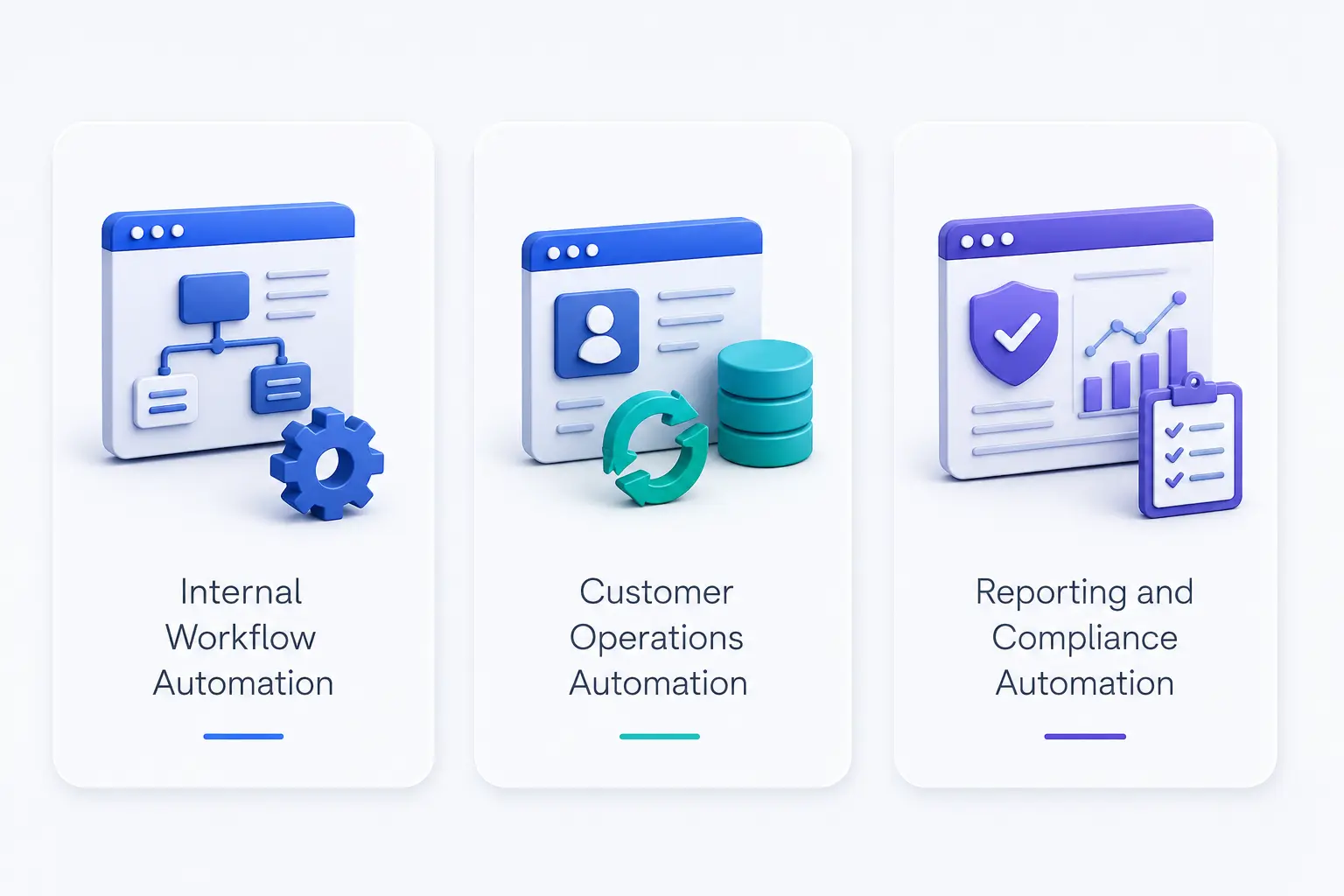
1. Internal Workflow Automation
Enterprise organizations operate across complex approval chains, departments, and compliance requirements.
Automation improves operational consistency while reducing human dependency.
High-impact workflow automation examples include:
- Approval routing systems
- HR onboarding workflows
- Procurement management
- Expense approvals
- Leave management systems
- Internal document workflows
- Employee task automation
For enterprises modernizing legacy infrastructure, workflow automation becomes one of the most practical application modernization strategies.
2. Customer Operations Automation
Customer-facing enterprise systems often involve repetitive support and operational processes.
Automation significantly improves efficiency in areas such as:
- Support ticket categorization
- Customer onboarding sequences
- Notification management
- CRM synchronization
- Subscription management
- Billing workflows
- Lead assignment systems
These features improve both operational efficiency and customer experience.
Businesses evaluating AI agents vs automation often discover that fully autonomous AI agents are unnecessary for many operational tasks. Structured automation can solve the majority of workflow inefficiencies.
3. Reporting and Compliance Automation
Compliance and reporting remain critical for enterprise scalability.
Automation helps businesses:
- Generate scheduled reports
- Monitor compliance workflows
- Trigger audit alerts
- Track operational KPIs
- Manage governance documentation
- Reduce manual reporting errors
Industries such as healthcare, fintech, insurance, and logistics rely heavily on compliance-driven enterprise app features.
Enterprise Systems That Benefit Most From Automation
Modern enterprises achieve faster ROI when automation is built into core business operations from the beginning. Successful digital transformation strategies often prioritize workflow automation, operational efficiency, and high-impact enterprise app features before implementing advanced AI capabilities. These features help enterprises streamline repetitive processes, reduce manual effort, and improve overall system scalability.
1. Healthcare
- Appointment scheduling
- Insurance claim workflows
- Patient onboarding
- Compliance documentation
2. Logistics
- Shipment tracking updates
- Delivery notifications
- Warehouse operations
- Fleet reporting systems
3. Fintech
- KYC workflows
- Transaction monitoring
- Invoice processing
- Risk reporting
4. HR & Workforce Management
- Recruitment workflows
- Payroll processing
- Employee onboarding
- Attendance tracking
As businesses compare RPA vs AI, many realize that robotic process automation remains one of the fastest ways to reduce operational friction.
Enterprise Application Features Where AI Creates Real Value
While automation improves operational efficiency, AI creates competitive differentiation through intelligence.
This is where businesses move beyond process optimization toward predictive decision-making and adaptive user experiences.
1. Predictive Analytics Features
Predictive analytics remains one of the highest-value AI implementations for enterprise SaaS products. Modern enterprise platforms increasingly rely on predictive data analytics to forecast demand, reduce churn, identify operational risks, and improve strategic decision-making.
AI-powered predictive systems help organizations:
- Forecast revenue
- Predict churn
- Analyze user behavior
- Optimize inventory
- Detect operational risks
- Improve demand planning
For enterprise SaaS businesses, predictive intelligence improves strategic decision-making across departments.
This is one of the most important benefits of AI in mobile app development and enterprise software ecosystems.
2. Intelligent Search and NLP Interfaces
Modern enterprise systems manage enormous amounts of data.
Traditional search systems often fail because they rely on exact keyword matching.
AI-powered NLP (Natural Language Processing) improves enterprise search by enabling:
- Context-aware search
- Conversational interfaces
- Smart document retrieval
- Semantic understanding
- Voice-based enterprise assistance
As businesses evaluate AI agent vs. AI automation strategies, NLP-powered enterprise copilots are becoming increasingly important.
Recommendation Engines
Recommendation systems drive personalization across SaaS ecosystems.
Examples include:
- Workflow recommendations
- Product recommendations
- Knowledge suggestions
- Learning path recommendations
- Sales optimization recommendations
Many innovative AI app ideas emerging today are built around intelligent recommendation ecosystems.
3. AI-Based Fraud Detection and Risk Monitoring
Fraud detection is one of the most mature enterprise AI use cases. AI systems analyze behavioral patterns and anomalies in real time.
Industries benefiting from AI-powered risk systems include:
- Banking
- Insurance
- Fintech
- E-commerce
- Healthcare
Compared to static automation rules, AI continuously adapts to evolving fraud patterns, making AI for fraud detection significantly more effective in preventing financial losses and improving enterprise security posture.
This is a major difference in discussions around AI vs. RPA and intelligent enterprise systems.
4. AI Copilots for Enterprise Productivity
AI copilots are becoming a major trend in enterprise software today.
These systems assist employees with:
- Content generation
- Workflow recommendations
- Knowledge retrieval
- Decision support
- Operational guidance
- Enterprise search
The rapid rise of AI content creation software demonstrates how AI is shifting from simple automation toward collaborative productivity enhancement.
According to McKinsey research, AI could contribute up to $4.4 trillion annually in productivity growth potential across enterprise use cases. This explains why organizations are increasingly investing in AI copilots and intelligent productivity systems to improve efficiency, decision-making, and operational scalability.
Businesses exploring agentic AI vs. RPA frameworks are increasingly investing in AI copilots capable of contextual enterprise assistance. Enterprise demand for AI chatbot development is also increasing as businesses look to improve customer support, employee productivity, and self-service experiences.
Key Benefits of AI Integration in SaaS Products
AI integration helps SaaS products move beyond operational efficiency toward intelligent, data-driven experiences. When implemented strategically, AI improves personalization, accelerates decision-making, enhances customer engagement, and creates stronger competitive differentiation.
The following are the AI integrations’ benefits:
- Personalized user experiences
- Predictive analytics and forecasting
- Faster decision-making
- Improved customer retention
- Intelligent workflow optimization
- Scalable customer support through AI assistants
- Enhanced operational intelligence
How Top Tech Companies Use AI vs Automation at Scale
Many of today’s leading digital platforms combine automation and AI strategically to improve scalability, operational efficiency, personalization, and customer experience. These real-world examples highlight how a strong AI Strategy for Digital Products enables automation to handle structured workflows, while AI drives intelligence, prediction, and personalization at scale.
1. Netflix: AI-Powered Personalization at Scale
Netflix uses AI-driven recommendation engines to analyze viewing behavior, engagement patterns, and user preferences in real time. Its personalization system is a key growth driver, with recommendations influencing a significant portion of users’ viewing decisions.
Many innovative AI app ideas today are emerging around intelligent recommendation systems that enhance personalization, automate decision-making, and improve user engagement across SaaS platforms.
This demonstrates how AI directly improves engagement, retention, and content discovery in subscription-based platforms.
2. Uber: Combining Automation and AI for Operational Efficiency
Uber is a strong example of a hybrid model where automation and AI work together. Automated systems manage ride matching, payments, and notifications, while AI handles demand forecasting, route optimization, ETA prediction, and surge pricing. This layered approach shows how modern SaaS platforms combine both technologies to achieve scale and efficiency.
3. Amazon: Predictive Data Analytics for Smarter Operations
Amazon relies heavily on predictive data analytics and AI models to forecast demand, optimize inventory, personalize recommendations, and streamline logistics. This data-driven intelligence enables Amazon to reduce operational inefficiencies while improving customer experience across its global ecosystem.
4. Duolingo: Scaling AI Features After Building Operational Foundations
Duolingo’s growth shows the importance of building strong operational systems before scaling AI. The platform first focused on engagement and structured learning workflows, then gradually introduced AI-driven personalization and conversational learning features. This phased approach highlights why startups should prioritize automation before advanced AI adoption.
5. Hungama: AI-Powered Content Discovery in Entertainment Platforms
Hungama demonstrates how AI can scale entertainment experiences for massive audiences. The platform leverages AI-powered recommendation systems to improve content discovery and user engagement across its ecosystem.
According to RipenApps case study data, Hungama supports over 50 million monthly active users, with a library of 30M+ songs and 8,000+ movies and shows. This showcases how AI-driven personalization helps large-scale media platforms deliver highly engaging digital experiences at scale.
What to Build First vs What to Scale Later
One of the biggest mistakes product teams make is attempting to implement advanced AI capabilities too early. Successful SaaS products usually evolve through stages.
Understanding this progression helps startups reduce risk while scaling intelligently.
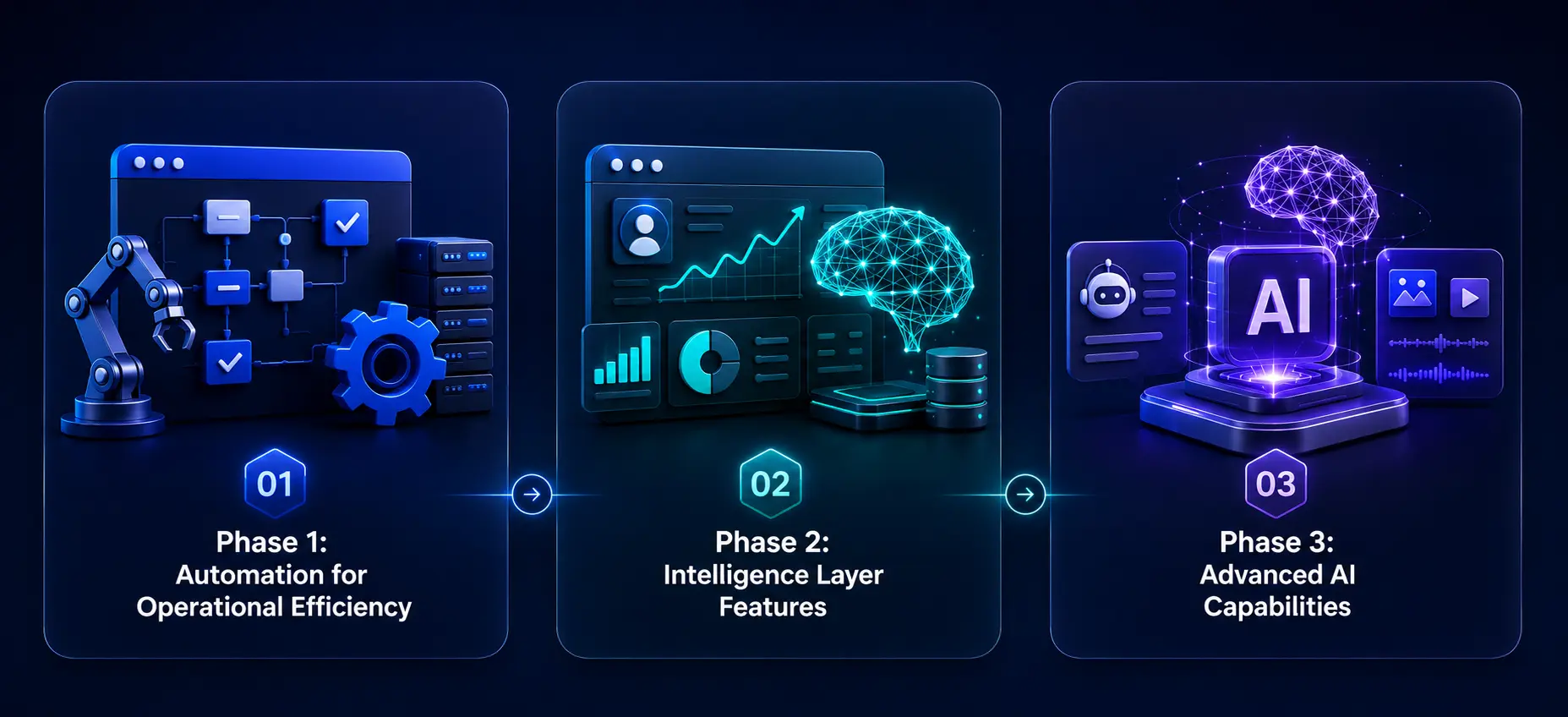
Phase 1: Automation for Operational Efficiency
In early-stage product development, the goal should be operational consistency. In modern SaaS development, automation-first architecture often creates stronger scalability foundations before advanced AI systems are introduced.
Priority features include:
- Workflow automation
- CRM integrations
- Notifications
- Reporting systems
- Approval chains
- Data synchronization
- Customer onboarding automation
These features:
- Reduce operational costs
- Improve execution speed
- Create scalable operational systems
- Improve customer experience
- Build process maturity
At this stage, businesses focused on integrating AI in development should avoid overengineering unnecessary intelligence layers.
Phase 2: Intelligence Layer Features
Once operational foundations stabilize, businesses can begin adding intelligence-driven features.
Examples include:
- Analytics dashboards
- Recommendation systems
- User behavior analysis
- Smart reporting
- Intelligent search
- Personalized experiences
This phase creates data maturity while improving strategic insights.
It also lays the groundwork for advanced AI adoption.
Phase 3: Advanced AI Capabilities
At scale, organizations can begin investing in:
- AI copilots
- Autonomous workflows
- Predictive decision systems
- AI agents
- Intelligent operational systems
- Real-time forecasting
This is where discussions around AI agents vs automation become strategically important.
Unlike traditional automation, AI agents can operate dynamically with contextual reasoning and adaptive behavior.
However, enterprise AI maturity is essential before scaling into agentic systems.
Common AI Integration Mistakes Businesses Should Avoid
Many businesses rush into AI adoption without building the operational maturity required to support it effectively. While AI can create significant competitive advantages, poor implementation strategies often increase complexity, costs, and technical debt instead of improving business outcomes.
Common AI integration mistakes include:
- Implementing AI before optimizing core workflows
- Adding AI features without clear business objectives
- Relying on poor-quality or insufficient data
- Ignoring governance, compliance, and security requirements
- Overengineering products with unnecessary AI complexity
- Underestimating long-term AI infrastructure and maintenance costs
- Failing to align AI capabilities with real user needs
For startups and enterprise teams alike, successful AI adoption requires a phased approach. Businesses that first establish scalable automation systems, structured data pipelines, and operational consistency are typically better positioned to scale AI initiatives successfully over time.
Enterprise SaaS Feature Roadmap Framework
A structured enterprise SaaS feature roadmap helps organizations evolve from basic automation to advanced AI capabilities in a controlled and scalable way. It ensures that each stage builds on the previous one, reducing complexity while improving operational efficiency and product intelligence. This phased approach enables businesses to adopt AI responsibly while maximizing long-term ROI and system stability.
A practical enterprise AI maturity roadmap often looks like this:
- Workflow Automation
- Operational Intelligence
- Predictive Analytics
- AI Copilots
- Autonomous AI Systems
Businesses that follow this structured roadmap typically achieve:
- Faster ROI
- Lower technical debt
- Better scalability
- Higher user adoption
- Improved operational maturity
Many startups partner with AI-powered product development consulting teams to identify which automation and AI capabilities should be prioritized at different growth stages. This phased approach also helps startups optimize development budgets while accelerating product development.
Cost, Maintenance, and Scalability Considerations
This section breaks down the cost, maintenance, and scalability differences between automation, AI, and RPA to help businesses evaluate long-term investment impact. It highlights how each approach affects operational efficiency, infrastructure needs, and overall ROI.
- Automation cost advantage: Automation systems are cost-efficient because they rely on rule-based workflows with minimal infrastructure and maintenance overhead.
- AI cost structure: AI requires higher investment due to data pipelines, model training, compute resources, and continuous optimization needs.
- RPA cost efficiency: RPA offers moderate setup costs with predictable ROI, making it suitable for structured enterprise workflows.
- Scalability difference: Automation scales linearly with workload, while AI scales non-linearly due to increasing data and compute requirements.
- Enterprise cost impact: AI-driven automation initiatives can improve operational efficiency by up to 40%, depending on maturity and use case complexity.
- ROI timeline variation: Automation and RPA typically deliver faster ROI, while AI systems require longer timelines due to setup and training cycles.
Cost Comparison: Automation vs AI vs RPA
Here is a table for quick comparison and better understanding.
| Factor | Automation | AI | RPA |
| Initial Development Cost | Low to Moderate | High | Moderate |
| Infrastructure Cost | Low | High | Low to Moderate |
| Maintenance Cost | Low & predictable | High due to continuous model updates | Moderate |
| Scalability Cost Growth | Linear | Non-linear | Linear |
| Typical Cost Impact | 30–60% efficiency improvement | 20–40% productivity gains | 20–40% cost reduction |
| Time to ROI | Fast (weeks to months) | Medium to long-term (6–24 months) | Fast (1–3 months) |
AI vs Automation Decision Matrix for Product Teams
Many business leaders still struggle with deciding when to automate and when to introduce AI.
A simple decision framework can help product teams prioritize effectively.
1. Use Automation When:
Choose automation if:
- Tasks are repetitive
- Workflows are predictable
- Rules rarely change
- Operational efficiency is the priority
- Faster ROI is required
- Process consistency matters most
Examples:
- Workflow approvals
- CRM updates
- Employee onboarding
- Billing automation
- Reporting systems
2. Use AI When:
Choose AI if:
- User behavior changes dynamically
- Prediction improves outcomes
- Personalization drives retention
- Large datasets require analysis
- Pattern recognition matters
- Intelligent recommendations improve productivity
Examples:
- Fraud detection
- Recommendation engines
- AI copilots
- Predictive analytics
- Conversational assistants
3. Use a Hybrid AI + Automation Model When:
Many modern SaaS products benefit from combining both.
Examples include:
- AI-powered workflow automation
- Predictive customer support systems
- Intelligent CRM automation
- AI-assisted compliance monitoring
- Enterprise operational copilots
This hybrid approach reflects the growing convergence between AI and intelligent automation ecosystems.
Future of Enterprise App Features: From Automation to Autonomous Systems
The future of enterprise software is moving toward intelligent autonomy.
However, autonomous systems will evolve gradually – not overnight.
1. Hyperautomation Trends
Hyperautomation combines:
- RPA
- AI
- Analytics
- Process mining
- Workflow orchestration
The goal is to automate increasingly complex enterprise operations.
This trend is accelerating across industries such as healthcare, logistics, finance, manufacturing, and SaaS.
2. AI Agents in Enterprise Software
AI agents are becoming a major innovation layer within enterprise products.
Unlike traditional automation, AI agents can:
- Analyze context
- Make decisions
- Adapt dynamically
- Coordinate workflows
- Execute multi-step tasks
McKinsey’s State of AI 2025 report found that 62% of organizations are already experimenting with AI agents and autonomous workflows. This signals a major shift toward intelligent enterprise operations and next-generation SaaS ecosystems.
The rise of AI agent vs. AI automation discussions reflects how enterprise systems are evolving toward greater autonomy.
3. Autonomous Enterprise Operations
Future enterprise platforms may eventually support:
- Self-optimizing workflows
- Autonomous decision systems
- Predictive operational management
- Intelligent business orchestration
However, enterprises must first build strong automation and governance foundations.
4. AI-Augmented Workforce Systems
AI is not replacing enterprise teams entirely.
Instead, the future points toward AI-augmented operations where employees collaborate with intelligent systems.
This creates opportunities for:
- Faster decision-making
- Improved productivity
- Reduced operational friction
- Smarter enterprise workflows
Organizations that strategically balance automation, AI, governance, and scalability will gain significant competitive advantages in the next decade.
Final Thoughts
The debate around automation vs AI is not about choosing one technology over the other. The real challenge is understanding what your business needs today versus what it may need at scale tomorrow. Automation creates operational consistency, process efficiency, and measurable ROI. AI creates intelligence, prediction, personalization, and long-term competitive differentiation. The smartest enterprise SaaS strategies combine both technologies in phases rather than treating AI as a shortcut to innovation. By strategically balancing automation and AI, businesses can significantly improve efficiency without increasing technical debt.
Businesses that align AI adoption with product maturity, governance readiness, and customer value creation are far more likely to achieve sustainable growth. At RipenApps, we help enterprises and startups strategically implement scalable digital products, intelligent enterprise app features, workflow automation systems, and AI-driven transformation solutions designed for long-term business impact.
Frequently Asked Questions
1. What is the difference between AI and automation in SaaS?
Automation follows predefined rules to execute repetitive tasks, while AI enables systems to learn, predict outcomes, analyze data, and make intelligent decisions dynamically.
2. Should startups implement automation before AI?
In most cases, yes. Automation typically delivers faster ROI, lower infrastructure costs, and stronger operational efficiency before advanced AI capabilities become necessary.
3. What enterprise app features should be automated first?
High-priority automation features include workflow approvals, CRM synchronization, onboarding systems, notifications, reporting automation, and compliance workflows.
4. Which enterprise application features benefit most from AI?
Predictive analytics, recommendation systems, fraud detection, intelligent search, AI copilots, and personalization engines are among the most valuable AI-powered enterprise app features.
5. Is AI more expensive than automation?
Generally, yes. AI systems require infrastructure scaling, model training, monitoring, governance, and ongoing optimization, making them more expensive than traditional automation systems.
6. Can AI and automation work together?
Absolutely. Many modern enterprise products combine AI with automation to create intelligent workflows, predictive support systems, and adaptive operational processes.
SHARE
WRITTEN BY

Ishan Gupta
CEO & Founder
Ishan Gupta is a seasoned entrepreneur and CEO with extensive 8+ years of experience in business and mobile app development landscape. He believes that the right digital product allows companies to focus on what they do best, while technology handles the rest. With deep exposure to global markets, he understands what makes an app succeed. His approach translates business needs into clear product strategies, ensuring that every feature contributes to measurable ROI.
View All Articles


 India
India USA
USA Australia
 Canada
 UK
UK UAE
UAE