


AI Fitness app development is reshaping how people engage with health and wellness platforms. Traditional fitness apps face a common and biggest struggle, which is keeping users engaged beyond the first few months.
A study shows that approximately 69% of fitness app users abandon the app within 90 days of download (Source: JMIR Publications). For startups, CTOs, and enterprises, this churn directly impacts growth and profitability.
The reason behind this app abandonment? Users don’t want generic, one-size-fits-all workout plans anymore. They want smart, adaptive, and engaging experiences that feel personal to their fitness journey.
This is where you need AI fitness app development services. By analyzing user data, behavior patterns, and performance metrics, AI allows apps to deliver workouts that evolve with each individual. From personalized training plans and real-time feedback to gamified progress tracking, AI fitness apps turn routines into motivating, dynamic experiences.
In this blog, we’ll break down how smart AI-powered apps boost user retention and accelerate growth. We’ll also highlight real-world examples and outline steps to get started with AI-driven fitness app development.
Key Takeaways
- AI-driven personalization significantly reduces churn by adapting workouts, nutrition, and coaching to individual user behavior and goals.
- Real-time feedback, wearable integration, and predictive analytics transform fitness apps into intelligent, always-available personal trainers.
- Gamification, community features, and AI-powered nudges increase engagement, improving retention rates and long-term user commitment.
- AI fitness apps unlock new monetization opportunities through premium features, subscriptions, and data-driven health ecosystem integrations.
- Investing in scalable, AI-powered fitness platforms positions businesses to capture growing market demand and sustain competitive advantage.
Table of Contents
Why User Retention Matters in Fitness Apps?
Before exploring how AI fitness app development helps businesses boost user retention and ROI, we should look at why user retention is more necessary than anything. Let’s explore why businesses need to focus on user retention while building fitness apps:
1. High Churn Rates in the Industry
As people have become health-conscious, fitness apps are gaining popularity, but even with growing downloads, fitness apps face steep churn. We have already discussed that 69% users abandon a fitness app within 90 days. This shows the growing churn rates in the industry.
What makes this more critical in 2026 is that users now have more choices than ever; the app stores are flooded with AI-powered fitness solutions, making it easier to switch and harder to retain. It makes user retention crucial, as acquiring new users is far more expensive than keeping existing ones. AI fitness app development allows businesses to combat this by providing personalized, adaptive experiences that keep users coming back.
2. Opportunity to Access the Global Market
The fitness app market size is projected to reach $33.58 billion by 2033, growing at a CAGR of 13.40% from 2026 to 2033. Most importantly, in 2026, the inflexion point of this growth curve is that early movers are already capturing disproportionate market share. These statistics reflect growing demand for smart, AI-driven solutions.
Businesses leveraging AI-powered fitness app development can capture a share of this booming market by offering personalized workouts, real-time coaching, and tailored recommendations.
3. Personalization to Increase Engagement
Retention thrives when users feel their needs are understood. In 2026, personalization has moved far beyond custom workout plans. Users now expect AI systems that converse with them, adapt to their mood, schedule, and recovery state, and deliver coaching that feels genuinely human.
AI-powered fitness apps analyze user data, behavior, and performance to create deeply customized experiences. Many platforms also rely on application modernization solutions to handle this data efficiently and deliver real-time insights. Features like LLM-based conversational coaching, predictive recommendations, progress tracking, and AI integration in fitness app platforms keep users motivated and engaged longer than any static plan ever could.
4. Unlock Business Growth
Getting high retention for your fitness app translates into tangible business outcomes like:
- Better subscription renewals and in-app purchases
- Increased user lifetime value
- Stronger brand loyalty and competitive edge
- New B2B2C revenue streams through corporate wellness and gym partnerships
You can partner with an AI fitness app development company to implement AI-driven fitness apps that maximize user engagement and ROI. This way, you can cater to a wider audience and leave your competitors far behind.
The Role of AI in Transforming Fitness Apps
Artificial Intelligence has quickly become the backbone of many successful industries, and fitness is no exception. AI helps in redefining user experience and personalized approach for health and wellness. But there’s more to uncover about the role of this emerging technology in shaping the future of fitness apps.
Let’s walk through the role of AI fitness app development in transforming the industry:
1. Data Collection
For businesses, everything starts with data. AI systems also rely on a wide range of data to understand each user’s habits, goals, and physical condition. These data sources are:
- Wearables and smart devices that collect metrics like heart rate, calories burned, activity levels, and sleep cycles
- Smartphones and app interactions: Capture user inputs, including body metrics, goal settings, and exercise preferences
- Connected gym equipment: Records data on reps, resistance, form, and exercise duration
- Continuous Glucose Monitors (CGMs) that provide real-time metabolic data, helping AI tailor nutrition and workout timing with a level of precision previously only available to elite athletes
This data forms the backbone of a user profile, allowing AI to begin learning and optimizing. That’s why you need to choose next-gen AI app development services to include advanced data collection capability in your mobile app.
2. Behavioral Analysis
AI algorithms monitor user patterns to draw insights and detect trends. An AI-based fitness app uses machine learning to understand:
- Workout consistency and frequency
- Preferred routines of types of workouts
- Engagement patterns or drop-off signs
- Open-ended user feedback and goals interpreted through LLM-powered analysis
This understanding enables AI to predict user behavior in the future, allowing it to adjust the fitness plan proactively. That’s why businesses choose AI fitness app development to analyze behavior and provide customers with what they want.
Read Also: Top 9 AI Trends 2026: What Every Entrepreneur Must Know To Stay Ahead?
3. Personalized Experience
After completing behavioral analysis for each user, AI starts tailoring the experience. It is one of the top AI fitness app marketing strategies because providing a personalized experience allows businesses to increase user retention. To provide a tailored experience, invest in AI-powered mobile app development services that focus on:
- Personalized workout plans that adjust based on past performance
- Adaptive nutrition suggestions aligned with fitness routines and real-time metabolic data
- Smart alerts and nudges when users didn’t feel like working out
- AI voice coaching and LLM-based conversational fitness assistants that let users interact with their fitness plan naturally
Providing this quality of personalized experience in your AI fitness app makes every interaction feel tailor-made and keeps users motivated far longer than static plans ever could.
4. Predictive Capabilities
AI isn’t limited to behavioral analysis. Apart from reacting to behavior, AI can anticipate it. With this speciality, AI can:
- Identify users who can disengage and initiate retention strategies
- Suggest gym visits during less crowded hours
- Alert gym operators about the equipment with maintenance needs
- Predict injury risk by analyzing movement patterns, training load, and recovery data across multiple sensors
These insights improve the user journey and the operational efficiency of fitness businesses, making AI-powered fitness apps an essential asset to increase user engagement and retention.
5. Real-Time Feedback
In 2026, real-time AI feedback has taken a significant leap forward. Two developments define this shift: on-device AI, which runs models locally on the user’s phone without needing an internet connection, delivering faster and more private feedback; and AR-based form correction, which has matured from a novelty into a reliable, mainstream feature. The application can provide:
- Posture correction using pose estimation from a camera, now with AR overlays that show users exactly where to adjust in real time
- Live coaching features that feel like one-on-one training, powered by voice AI that responds dynamically to what the user is doing
- Health alerts for elevated heart rate or fatigue signals
- On-device processing that ensures real-time feedback works even without connectivity, while also giving privacy-conscious users confidence that their biometric data stays on their device
With these real-time feedback capabilities, the AI fitness app ensures safety, boosts performance, and creates a feeling of having a virtual personal trainer always nearby.
Read Also: The Role of AR and VR in the Future of Interactive Fitness Training
Must-Have Features in an AI Fitness App
Understanding the role of AI is only half the equation. The other half is knowing exactly which features translate that AI potential into an app users actually love. In 2026, the bar for what users consider essential has risen significantly. Here are the ten must-have features every serious AI fitness app needs:
1. LLM-Powered Conversational AI Coach
An LLM-powered conversational coach lets users interact with their fitness plan in natural language, ask questions, request changes, and get motivation in real time. The AI responds contextually and remembers past conversations, replicating the experience of having a personal trainer available around the clock.
Read Also: Integrating Conversational AI into Healthcare Apps
2. AI-Powered Adaptive Workout Planning
The best apps in 2026 factor in sleep quality, stress levels, and recovery data to determine not just what the user should do today, but whether they should train at all. This intelligent adaptivity reduces burnout and converts free users into long-term paying subscribers.
3. Real-Time Form Correction Using Computer Vision
Real-time form correction using pose estimation from the phone camera has matured into a mainstream feature by 2026. It analyzes lifting technique across posture, range of motion, and foot placement, reducing injury risk and giving users the confidence to train harder.
4. AR-Based Body Scanning and Posture Tracking
Longitudinal body scanning tracks postural changes and body composition over weeks and months, turning the camera into an ongoing health metric. Users who can see measurable physical progress over time are significantly more likely to stay on the app and upgrade to premium plans.
5. Multi-Wearable and Health Ecosystem Integration
In 2026, users own an ecosystem, not just one device. Apps that unify data from smartwatches, smart rings, connected scales, and CGMs into a single coaching experience are the ones winning on retention. Supporting Apple Watch, Garmin, Oura Ring, and Samsung Galaxy Ring is now a baseline expectation.
6. On-Device AI Processing
By running AI models locally on the user’s phone without an internet connection, apps deliver faster feedback while keeping biometric data on the device. For privacy-conscious users and markets with patchy connectivity, on-device AI is a measurable competitive advantage.
7. Predictive Injury Prevention
By analyzing movement patterns, training load, and recovery data across multiple sensors, AI can flag early warning signs of overtraining before damage is done. This positions the app as a genuine health partner rather than just a workout tracker.
8. Gamification With Social and Community Layers
Group challenges, friend leaderboards, and corporate wellness leagues give users a reason to show up even on low-motivation days. Users who feel part of a fitness community churn at dramatically lower rates than solo users, making social gamification one of the highest-return investments in app development.
9. AI-Driven Nutrition and Metabolic Coaching
AI-driven nutrition coaching uses real-time metabolic data from CGMs, workout intensity from wearables, and user-logged meals to deliver adaptive nutrition recommendations timed around training and recovery. When nutrition and fitness coaching live inside the same AI, users experience a genuinely holistic health platform.
10. Smart Push Notifications and AI-Powered Nudges
The system learns each user’s peak engagement windows, mood patterns, and drop-off signals to send the right message at exactly the right moment. Apps that personalise their notification strategy using AI see significantly higher day-30 and day-90 retention rates compared to those relying on fixed-schedule reminders.
How Smart Workouts in AI Fitness App Development Drive Higher Engagement?
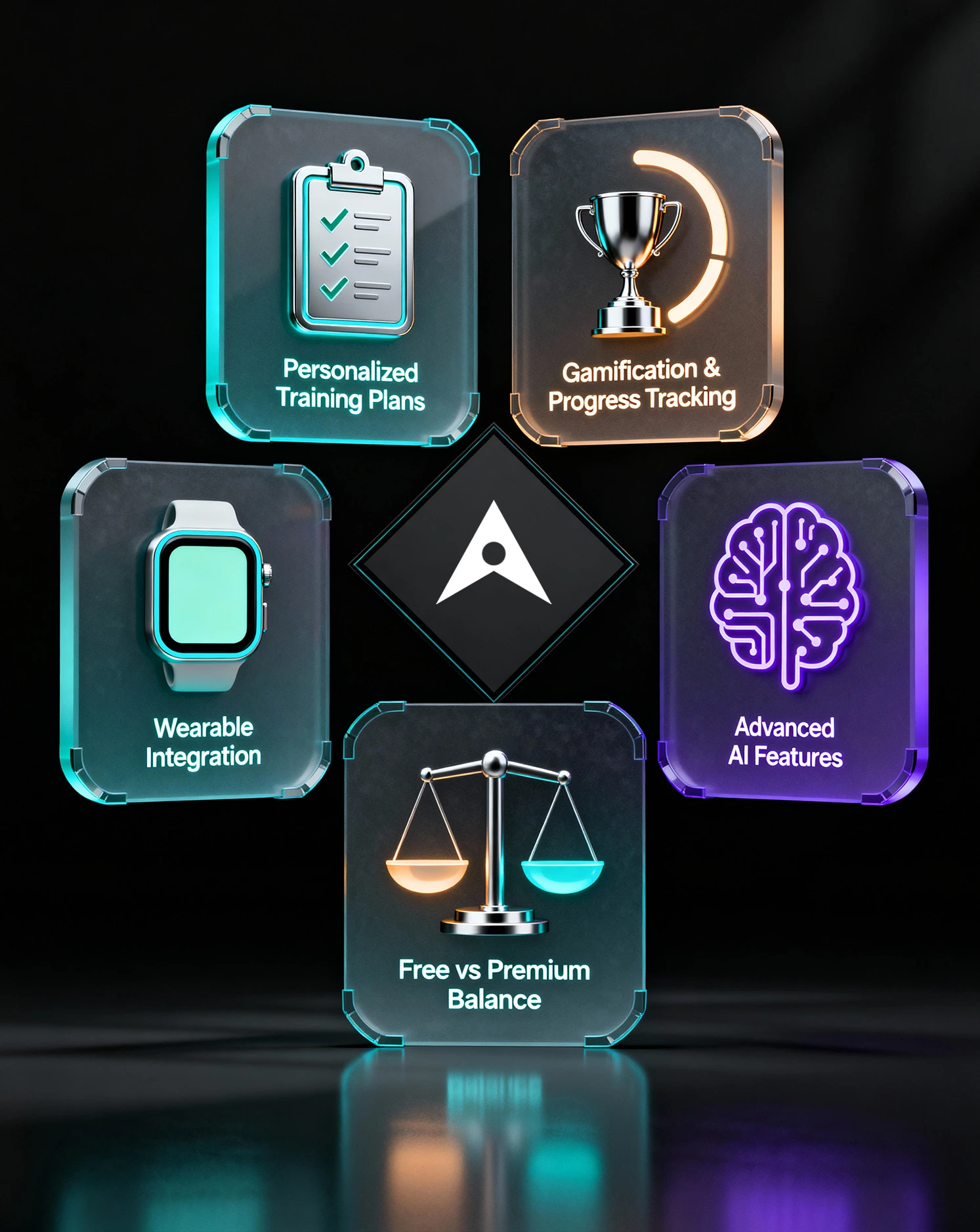
User engagement is the lifeline of any fitness application. While downloads provide visibility, it’s retention that determines profitability and growth. AI fitness app development plays a pivotal role here because smart workouts keep users motivated enough to return every day. Let’s break down how advanced AI features improve engagement and retention:
1. Personalized Training Plans
A one-size-fits-all workout plan doesn’t resonate with today’s health-conscious users. Research shows that fitness apps offering adaptive training see up to 40% higher engagement rates compared to static apps. This is a benchmark that has now been validated across hundreds of AI fitness platforms globally and is treated as an industry standard in 2026.
Through AI-powered fitness app development, startups and enterprises can create apps that adjust intensity, goals, and recovery recommendations dynamically. In 2026, the most advanced apps will have access to adjusting plans in response to sleep quality, stress levels, and real-time recovery data that is pulled from wearables. It results in making every session smarter than the last.
This adaptivity reduces user burnout and increases trust, making every AI-powered fitness app more sustainable in the long term.
2. Gamification and Progress Tracking
Gamification is no longer optional; now it’s an engagement driver for your business. Having features like streaks, badges, and performance dashboards, gamification encourages users to compete with themselves. This results in increasing motivation.
In 2026, the most successful apps have taken gamification a step further by adding social and community layers, group challenges, friend leaderboards, and shared fitness goals that tap into users’ desire for connection and accountability, not just personal competition.
Studies show that gamification and AI integration in fitness apps achieve up to a 25-30% increase in 30-day retention, compared to an 8-12% average for generic workout apps. This statistic shows why the best AI fitness apps 2026 are leaning heavily on gamified experiences to keep engagement levels high.
3. Wearable Integration To Provide Smarter Insights
Instead of just workouts, users prefer health ecosystems to improve their health. Looking at the wearable technology shaping the future, other industries also use this emerging technology. By connecting wearables like Apple Watch, Fitbit, Oura Ring, and Samsung Galaxy Ring, AI-powered fitness apps analyze real-world metrics such as heart rate, sleep cycles, and calorie expenditure.
The real competitive edge now lies in multi-device ecosystem sync, combining data from a smartwatch, smart ring, connected scale, and even Continuous Glucose Monitors (CGMs) to give users a 360-degree picture of their health that no single device can provide alone.
According to Business of Apps research, apps that integrate wearables data show significantly higher daily active usage because users feel the app is tailored to their lifestyle. This kind of AI-based fitness app ensures a holistic fitness journey that goes beyond workouts.
4. Advanced AI Features Like Body Scanning
The rise of the AI body scan fitness app demonstrates the market’s appetite for innovation. By scanning body posture or composition, these applications deliver precise insights into movement quality and progress. Many users are more likely to continue using an AI fitness app that scans their body because it feels personalized and measurable.
By 2026, AI body scanning via front-facing camera has matured considerably. Apps can now track postural changes over weeks and months, turning body scanning into a longitudinal health metric rather than a one-time novelty. This shift from snapshot to ongoing tracking is what makes body scan features genuinely sticky.
Some companies are even offering an AI fitness app body scan free as an entry point to attract early users and later upsell premium features, a freemium strategy that has now been proven at scale and is widely adopted across the industry. These advanced features make AI fitness app development necessary for businesses to become future-proof.
5. Balance Between Free vs. Premium Features
When startups offer a free AI fitness app, it helps them attract mass adoption. However, retaining those users depends on how well the premium AI-driven features justify the upgrade. So, you need to decide if you want to launch a free app to build the best free AI fitness app or develop an AI-powered fitness app with premium features.
In 2026, the dominant monetization model has shifted clearly toward AI-gated subscriptions where the core app is free, but the LLM-powered conversational coach, advanced body scanning, and multi-device health sync sit behind a paywall.
A free AI fitness coach app with limited features can build trust and reach a wider audience, but growth depends on nudging users toward advanced offerings such as personalized plans or motion tracking. Striking this balance is important for long-term retention.
Business Benefits of AI Fitness App Development
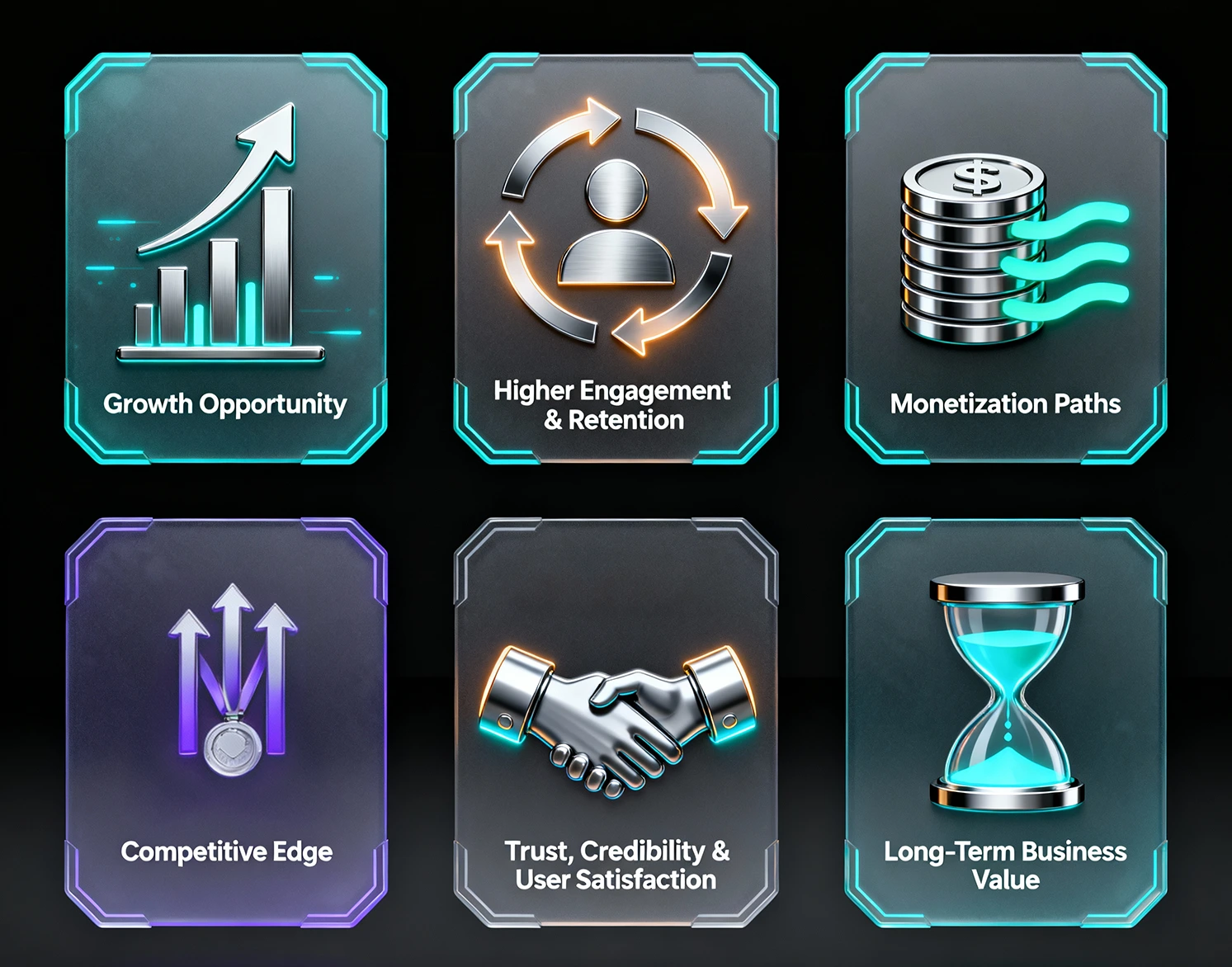
Investing in AI fitness app development drives real business value. So, building an AI app for the fitness industry can translate into stronger user retention, new revenue streams, and competitive differentiation. Below are the key benefits of building the best AI app for the fitness industry.
1. Opportunity For Maximum Growth
The AI in fitness and wellness market size was estimated at $10.68 billion in 2025, and is projected to grow to reach $57.80 billion by 2035, with a CAGR of 19.3%% (Source: InsightAce Analytic). This rise is driven by growing adoption of AI for fitness and wellness apps, integration of wearables, and demand for personalization.
These numbers highlight that AI fitness app development is well-positioned to tap into increasing market demand, especially for advanced features and AI fitness app Android or iOS versions that allow mass accessibility.
2. Higher Engagement & Retention
Applications that employ adaptive, personalized coaching (AI-driven fitness coaching apps) see noticeably better retention. AI in fitness apps enables tailored workout and nutrition plans to help users stay committed longer than usual.
Other than that, predictive analytics can cut churn by up to 30% via targeted interventions. When users install a personal trainer fitness AI app, and they feel like a personal trainer is training them, they feel more invested in the journey. That emotional investment increases lifetime value.
3. New Monetization Paths & Premium Features
Providing basic usage without any fees with a free fitness AI app can attract a large user base. Then, value-added features, like form correction, custom AI-body scan, or advanced fitness AI app plans, can be offered as a premium.
According to FitBudd’s 2026 fitness app statistics, paid fitness apps have contributed a significant share of total fitness app revenue, roughly 40% or more in several markets.
The growth is driven because consumers are willing to pay for high-quality AI features. Businesses investing in AI fitness app development need to offer bundle premium coaching, body scans, and personalized plans to create new recurring revenue streams. They also need to explore how to monetize health & fitness apps.
4. Competitive Edge & Differentiation
When you ask ‘what is the best AI fitness app,’ users often compare based on some necessary qualities such as intelligence, customization, and user-friendliness. Apps that simply count steps or show video workouts are being surpassed by fitness AI apps with AI integrations in fitness apps, such as workout adaptation, injury prevention, or voice-guided coaching.
For example, an AI fitness app that scans your body or features like advanced motion tracking differentiates products in crowded app stores. Also, offering an AI fitness coaching app for Android and iOS increases reach. Being early with personal trainer app development powered by AI helps brands establish leadership and stronger brand trust. You can hire app developers with expertise in advanced technology to meet evolving customer needs.
5. Trust, Credibility & User Satisfaction
One of the biggest hesitations users have is: ‘Do AI fitness apps work?’ Studies and use cases have proved that they work more than expected. Users consistently report higher satisfaction when apps adapt to their performance and offer real feedback.
API-driven apps that combine AI coaching with wearable insights, body scans, or motion-tracking are rated more credible. Also, features that protect privacy, ensure data security, and integrate smoothly with other health systems enhance trust, an important factor in retention.
6. Long-Term Business Value
Developing a well-architected AI-powered fitness app allows scaling more easily: adding more advanced features over time, like AI-body scan algorithms, voice coaching, or integrations with IoT wearables.
You need to work with an AI fitness app development company to build such an app that grows with your user base. Providing an advanced artificial intelligence fitness app to the audience makes your app future-proof and helps you stay relevant for a long time.
AI Fitness App Development Cost: What to Budget in 2026
One of the most common questions businesses ask after understanding the value of AI fitness apps is: What will it actually cost to build one? The answer depends on what you want to build, but having a clear framework helps you plan smarter from day one.
In 2026, AI fitness app development costs typically fall between $50,000 and $500,000, depending on how advanced the AI, personalization depth, real-time processing, and scalability requirements are. Here is a practical breakdown by app tier:
Tier 1: MVP/Basic AI Fitness App
Best for startups validating a concept or entering the market with a focused product. This tier covers core features, user profiles, workout library, basic activity tracking, push notifications, and entry-level AI workout recommendations. It is enough to attract early users and gather the real-world data you need to build smarter in the next phase.
Tier 2: Full-Featured AI Fitness App
This is the most common investment range for businesses serious about competing in 2026. A full-featured app at this tier includes AI coaching, nutrition tracking, wearable integrations, and social features. It also covers LLM-based conversational coaching, gamification layers, progress analytics, and multi-device sync, the features users now treat as standard expectations.
Tier 3: Enterprise-Grade AI Fitness Platform
Platforms at this level rival products like Peloton or MyFitnessPal, with live classes, marketplace features, and advanced AI personalization. This tier also includes computer vision form correction, predictive injury prevention, B2B2C corporate wellness infrastructure, and multi-platform support across mobile, wearable, and smart TV.
| Tier | Cost Range | Delivery Timeline | Platforms | AI Features | Monetization Model | Best For |
| Tier 1: MVP | $30,000 to $80,000 | 3 to 5 months | iOS or Android | Basic recommendations, activity tracking, push notifications | Freemium / one-time purchase | Startups and idea concept validation |
| Tier 2: Full-Featured | $80,000 to $200,000 | 6 to 9 months | iOS and Android | LLM coaching, nutrition AI, wearable sync, predictive analytics, gamification | Freemium and AI-gated subscription | Growth-stage startups and SMEs |
| Tier 3: Enterprise | $200,000 to $500,000+ | 10 to 18 months | iOS, Android, Wearable, and Web | On-device AI, AR form correction, injury prediction, CGM sync, computer vision | AI-gated subscription and B2B2C licensing | Enterprises and funded scaleups |
Final Thoughts
In 2026, investing in AI fitness app development services is one of the smartest moves for businesses. The window for early-mover advantage is still open, but not for long. Businesses that built AI fitness apps in 2025 are already seeing compounding retention advantages, and the gap between them and late entrants is widening every month. People want more than just basic workout trackers, and AI fitness apps can understand their goals, adjust to their progress, and keep them motivated.
With personalized plans, real-time data, conversational LLM coaches, multi-device health sync, and early warnings to prevent injuries, these apps are a big win for consumers and businesses. The bar has risen; users in 2026 expect their fitness app to feel as intelligent and responsive as a real personal trainer. However, building an AI-powered fitness app isn’t an easy task; you need to partner with RipenApps, a growth-focused fitness app development company, to create something your users will love and keep coming back to.
FAQs
Q1. How much does AI fitness app development cost?
An AI fitness app can cost you around $30,000 to $500,000 or more, with the total fitness AI app cost depending on the complexity of AI features, the range of functionalities, platform, design quality, and the development team’s location and expertise.
In 2026, integrating LLM-based coaching, on-device AI, and multi-wearable sync can push development costs toward the higher end, but the ROI from improved retention and premium subscriptions makes it a worthwhile investment.
Q2. What are the key benefits of AI integration in fitness apps?
The main benefits of integrating AI in your fitness app are:
- Better user retention via adaptive intelligent workouts
- Body scan and motion correction for higher accuracy
- Integration with wearables for a seamless experience
- Monetization opportunities for advanced AI features
- LLM-powered conversational coaching that delivers a genuinely personal trainer-like experience
- On-device AI processing for faster, privacy-first real-time feedback
Q3. How can enterprises ensure long-term success with AI fitness apps?
Partnering with an experienced AI fitness app development company ensures scalability, robust data security, and continuous updates. Enterprises benefit by delivering fitness apps powered by AI, positioning themselves as leaders in the rapidly growing fitness industry.
In 2026, long-term success also depends on building for AI transparency. Users want to understand why the AI is making specific recommendations, and apps that explain their logic clearly are earning significantly higher trust and retention scores.
Q4. What features make the best AI fitness apps stand out?
The best AI fitness apps 2026 include body scan analysis, personalized programs, gamified challenges, and integration with wearables. Apps with body scan and motion correction can stand out because they combine engagement with measurable results.
Q5. How is AI changing the personal training industry through fitness apps?
AI is fundamentally reshaping personal training by making high-quality, adaptive coaching accessible to everyone, not just those who can afford a gym trainer. In 2026, LLM-powered fitness coaches inside apps can hold natural conversations with users, remember their history, adjust plans on the fly, and provide motivation in a way that feels genuinely human.
Q6. What role does data privacy play in AI fitness app development?
As AI fitness apps collect increasingly sensitive data, such as biometrics, sleep patterns, metabolic data from CGMs, and movement history data, privacy has become a critical factor in user trust and long-term retention. In 2026, users are more privacy-aware than ever, and apps that clearly communicate how data is stored, processed, and protected have a measurable retention advantage.
On-device AI processing, transparent data policies, and compliance with global regulations like GDPR and India’s DPDP Act are no longer optional; they are expected features of any serious AI fitness platform.

SHARE
WRITTEN BY

Prankur Haldiya
Chief Technical Officer
A tech innovator and engineering leader, Prankur Haldiya drives RipenApps’ product development strategy and oversees cutting-edge solutions in mobility, AI, and cloud ecosystems. He is passionate about building high-performance teams and helping brands launch secure, scalable, and user-centric digital products.
View All Articles



 India
India USA
USA Australia
 Canada
 UK
UK UAE
UAE